Prescott’s Sharlot Hall Museum began with a practical question: what happens to a place when the people who remember its history are gone?
Sharlot M. Hall, a poet, journalist and historian who lived in the Prescott area, answered by gathering objects, records and stories—and by helping give a former territorial governor’s residence a new purpose. The museum that bears her name grew from that work. Her story is not only about one woman’s collecting; it is also about how a community can preserve the material traces of its past.
A life shaped by Arizona Territory
Hall was born in Kansas in 1870. Her family moved to Arizona Territory in 1882, settling in the Prescott region. The change placed her in a fast-developing part of the territory, where settlement, government and everyday life were changing within living memory.
Hall’s interests crossed several fields. She wrote poetry and prose, worked as a journalist and became an advocate for recording Arizona’s history. In 1909, she was appointed territorial historian. The position gave her a formal reason to document the territory’s people and events, but the impulse behind the work was broader: she believed that ordinary objects, firsthand accounts and local records could help tell a more complete story than official milestones alone.
That approach matters in a place like Prescott. A town’s past does not survive only in buildings or government documents. It also lives in tools, clothing, photographs, household items and memories of how people worked and traveled. Those things can appear unremarkable while they are in use. Their historical value becomes clearer when someone takes the trouble to preserve them and explain their context.
Giving an old building another use
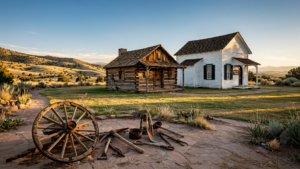
One of Hall’s most consequential preservation efforts centered on the former Territorial Governor’s Mansion in Prescott. The building had been associated with Arizona’s territorial government; by the time Hall acted, its original political function had passed. Rather than let the structure and its contents fade from public view, she worked to establish a museum there.
The museum opened in 1928. Hall’s project joined two kinds of preservation: protecting a historic building and filling it with objects that could help visitors understand the region’s past. The mansion itself became part of the story, while the collections offered a way to look beyond the rooms and imagine the people who had lived and worked in the territory.
A museum is never simply a room full of old things. Someone has to decide what to collect, how to care for it and what information visitors need in order to make sense of it. Hall’s work helped turn those decisions into a lasting local institution. By placing artifacts in a public setting, she made history something residents and visitors could encounter rather than something confined to specialist books or private collections.
Why local collections matter
Preservation can sound abstract until it is attached to a particular object or place. A building may show how government operated; a household item may reveal what daily life demanded; a photograph can make a vanished street or earlier landscape visible. No single object explains a whole community, but a collection can bring different parts of its history together.
There is also a quiet civic value in keeping those records close to where they were made. Local museums can connect regional history to the places people recognize: the streets they use, the landscapes around town and the buildings that have outlasted their original purpose. That connection gives visitors a chance to ask not only what happened, but whose experiences were recorded—and whose may still be missing.
Hall’s work took place in a period when historical institutions were often built by people working with limited resources and a strong sense of personal responsibility. Her example is not that one person can preserve everything. It is that collecting and documenting, done carefully and made available to others, can establish a foundation for future research and public understanding.
A Prescott legacy that remains public
Today, Sharlot Hall Museum continues to present the history of central Arizona through its historic buildings, collections and programs. Its name keeps Hall’s role visible, but the larger legacy is the institution she helped create: a public place where the region’s past can be examined, questioned and shared.
That legacy is especially relevant as communities decide what deserves protection. Historic preservation is not only about keeping an old structure standing. It also involves maintaining records, explaining the significance of places and making room for more than one perspective on local history. A museum cannot preserve every memory, but it can keep evidence accessible and invite people to interpret it.
Hall’s achievement in Prescott was to recognize that the territory’s history could disappear through neglect as surely as through demolition. She responded by collecting, writing and creating a museum. More than a century after her appointment as territorial historian, the work still offers a simple lesson: local history survives when someone takes responsibility for saving it—and when the results are shared with the public.