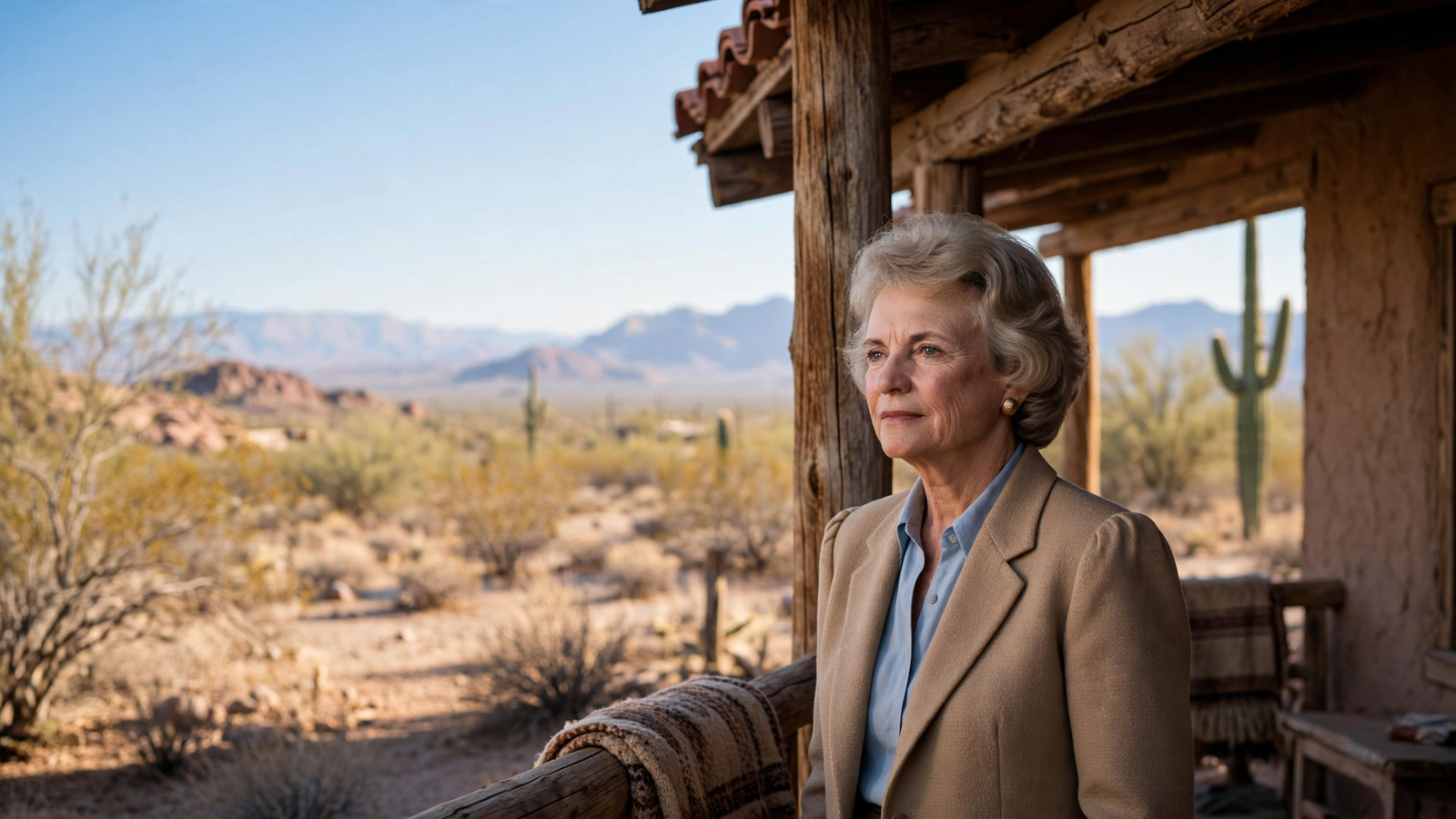
Before Sandra Day O’Connor entered the nation’s highest court, she had already learned how to make decisions with limited information, shared responsibility, and no guarantee that the work would be easy.
She learned those lessons on the Lazy B Ranch, a vast cattle operation near Duncan in southeastern Arizona. The ranch had no electricity during much of her childhood, and the nearest school was too far away for a daily commute. O’Connor’s early education took place partly at home, supported by books, correspondence lessons, and the expectations of a working family.
That background became part of the public story surrounding her career, but it was never the whole explanation. O’Connor was not simply an unlikely pioneer who happened to reach the Supreme Court. She was a disciplined student, an ambitious lawyer, a state legislator, a trial judge, and an appellate jurist who kept moving into institutions that had not yet made much room for women.
In 1981, President Ronald Reagan nominated O’Connor to the Supreme Court. The Senate confirmed her unanimously, making her the first woman to serve as a justice. Her appointment opened a door that had been closed for nearly two centuries of American constitutional history. Her work afterward helped define how that door would be used.
Growing up on the Lazy B
O’Connor was born in El Paso, Texas, in 1930 and grew up primarily at her family’s ranch in Arizona. The Lazy B covered a large, isolated stretch of high desert close to the New Mexico border. Ranch life demanded practical competence: tending animals, coping with weather, maintaining equipment, and understanding that the land could not be separated from the people who depended on it.
Her family sent her to El Paso for much of her formal schooling, where she lived with her maternal grandmother. The arrangement allowed her to attend school regularly while returning to the ranch during breaks. It also gave her an early view of two different worlds: the close, self-reliant life of southeastern Arizona and the more conventional educational path available in a larger city.
O’Connor graduated from Stanford University in 1950 with a degree in economics and completed Stanford Law School in 1952. She finished near the top of her class, but the legal profession offered few straightforward opportunities to a woman lawyer at the time. Law firms were often reluctant to hire women as attorneys, and O’Connor later recalled that one firm offered her a job as a legal secretary rather than as a lawyer.
Instead of waiting for the profession to change, she built a career through public service and persistence.
A career built through public institutions
O’Connor’s first legal work included serving as a deputy county attorney in California and later as an assistant attorney general in Arizona. She also spent time in private practice and worked as a county judge in Arizona before entering state politics.
In 1969, she was appointed to fill a vacancy in the Arizona Senate. She won election to the seat the following year and became a significant figure in a legislature that had previously been dominated by men. In 1973, O’Connor became the first woman to serve as majority leader of an American state senate, according to the Arizona Legislature’s historical materials.
The position required more than symbolic importance. A majority leader helps organize legislation, build coalitions, and guide the chamber’s work. O’Connor developed a reputation for preparation and negotiation, qualities that would later become central to her judicial style.
In 1975, Arizona Governor Raul Castro appointed her to the Maricopa County Superior Court. There, O’Connor handled trials and gained direct experience with the consequences of legal rules in ordinary people’s lives. In 1979, she moved to the Arizona Court of Appeals, where she considered more complex questions of law and procedure.
By the time Reagan selected her for the Supreme Court, O’Connor had experience in nearly every major layer of American government: executive agencies, a state legislature, a trial court, and an appellate court.
The nomination that changed the court
Reagan announced O’Connor’s nomination in July 1981, fulfilling a campaign promise to appoint the first woman to the Supreme Court. Her confirmation hearings attracted national attention, but the Senate ultimately approved her nomination without opposition.
O’Connor took her seat on September 25, 1981. She joined a court that was confronting major disputes about federal power, individual rights, government regulation, and the Constitution’s meaning in a changing country.
Her arrival mattered beyond the decisions she wrote. For women entering law, government, and the judiciary, her presence demonstrated that the highest judicial office was no longer formally closed to them. The significance was especially clear because O’Connor did not reach the court through a family legal dynasty or a long-established elite network. Her public career had developed through state and local institutions, including the Arizona Senate and the Maricopa County courts.
She also brought a distinctive temperament to the bench. O’Connor was known for careful questioning, close attention to practical consequences, and a willingness to work across ideological lines. She was often described as a swing vote, but that label can oversimplify her approach. Her opinions tended to focus on the specific legal question before the court rather than on a single all-encompassing theory of constitutional interpretation.
A decisive voice in major cases
During O’Connor’s 24 years on the Supreme Court, she participated in decisions that affected voting, education, gender equality, reproductive rights, religious freedom, criminal procedure, and the balance between federal and state authority.
In Planned Parenthood v. Casey in 1992, O’Connor joined an opinion that reaffirmed the central protection recognized in Roe v. Wade while allowing some regulations of abortion. The decision introduced a framework that asked whether a regulation placed an undue burden on a woman seeking an abortion. Although the court’s constitutional doctrine later changed, Casey became one of the most consequential opinions of O’Connor’s tenure.
In United States v. Virginia in 1996, the court ruled that the Virginia Military Institute’s male-only admissions policy violated the Equal Protection Clause. O’Connor joined the majority, which required the state to provide an exceptionally strong justification for sex-based discrimination. The case became an important statement about the government’s obligation to treat women as full participants in public institutions.
O’Connor also wrote influential opinions on the separation of church and state, affirmative action, federalism, and the rights of people accused of crimes. Her votes did not always fit neatly into one political category. That independence sometimes made her the justice whose position determined the outcome of closely divided cases.
Her influence was therefore both doctrinal and institutional. She helped shape the law while also changing public expectations about who could interpret the Constitution.
Making public service part of the legacy
O’Connor retired from the Supreme Court in 2006. Her post-court work reflected a continued interest in civic education and the health of democratic institutions. With her husband, John O’Connor, she had supported efforts to improve civics education before leaving the bench. After retirement, she became increasingly involved in programs designed to help young people understand government and participate in public life.
The Sandra Day O’Connor Institute, established in Arizona, continues that work through civics programs and educational resources. O’Connor also became an advocate for judicial independence, arguing that courts function best when judges can decide cases according to law rather than political pressure.
In 2018, she announced that she had been diagnosed with dementia, probably Alzheimer’s disease, and would withdraw from public life. She died in 2023 at age 93. Her death prompted renewed recognition of her importance as both a jurist and a public figure from Arizona.
An Arizona lesson in opening doors
O’Connor’s story is often reduced to a single historic first: the first woman on the Supreme Court. That achievement deserves its place in history, but it does not fully explain her significance.
Her career shows how national change can begin in local institutions. Before she became a familiar figure in Washington, she was an Arizona legislator learning how to assemble votes. Before she interpreted constitutional questions, she was a trial judge confronting the details of individual cases. Before she became a symbol, she was a lawyer looking for a place to practice in a profession that did not yet know how to make space for her.
The path from the Lazy B Ranch to the Supreme Court was not a straight line. It ran through classrooms, county offices, a statehouse, and Arizona courtrooms. Each step gave O’Connor a different view of public responsibility—and helped prepare her for a position where even one vote could alter the direction of the country.
That may be the most durable part of her Arizona legacy. Sandra Day O’Connor changed the court by entering it, changed the law through her decisions, and changed the idea of public leadership by showing that a career rooted in local service could reach the highest levels of national government.
Use: Verified O’Connor’s education, legal career, Supreme Court nomination, service, and retirement.
Use: Verified biographical details, Arizona roots, civic education work, and post-court legacy.
Use: Used to verify O’Connor’s service in the Arizona Senate and her role as the first woman to become a state senate majority leader in the United States.
Use: Provided contemporaneous documentation of President Reagan’s 1981 nomination announcement.
Use: Verified the Supreme Court case and its significance concerning Virginia Military Institute’s male-only admissions policy.
Use: Verified the 1992 case and the undue-burden framework discussed in the article.
Supreme Court of the United States — Justice Sandra Day O’Connor biography — https://www.supremecourt.gov/about/biographyOConnor.aspx — Verified O’Connor’s education, legal career, Supreme Court nomination, service, and retirement.
Sandra Day O’Connor Institute — Justice Sandra Day O’Connor — https://oconnorinstitute.org/about/justice-sandra-day-oconnor/ — Verified biographical details, Arizona roots, civic education work, and post-court legacy.
Arizona State Legislature — Historical information — https://www.azleg.gov/alisStaticPages/ — Used to verify O’Connor’s service in the Arizona Senate and her role as the first woman to become a state senate majority leader in the United States.
Ronald Reagan Presidential Foundation and Institute — Nomination of Sandra Day O’Connor — https://www.reaganlibrary.gov/archives/speech/remarks-president-nomination-sandra-day-oconnor-be-associate-justice-supreme-court — Provided contemporaneous documentation of President Reagan’s 1981 nomination announcement.
Oyez — United States v. Virginia — https://www.oyez.org/cases/1995/94-1941 — Verified the Supreme Court case and its significance concerning Virginia Military Institute’s male-only admissions policy.
Oyez — Planned Parenthood of Southeastern Pennsylvania v. Casey — https://www.oyez.org/cases/1991/91-744 — Verified the 1992 case and the undue-burden framework discussed in the article.