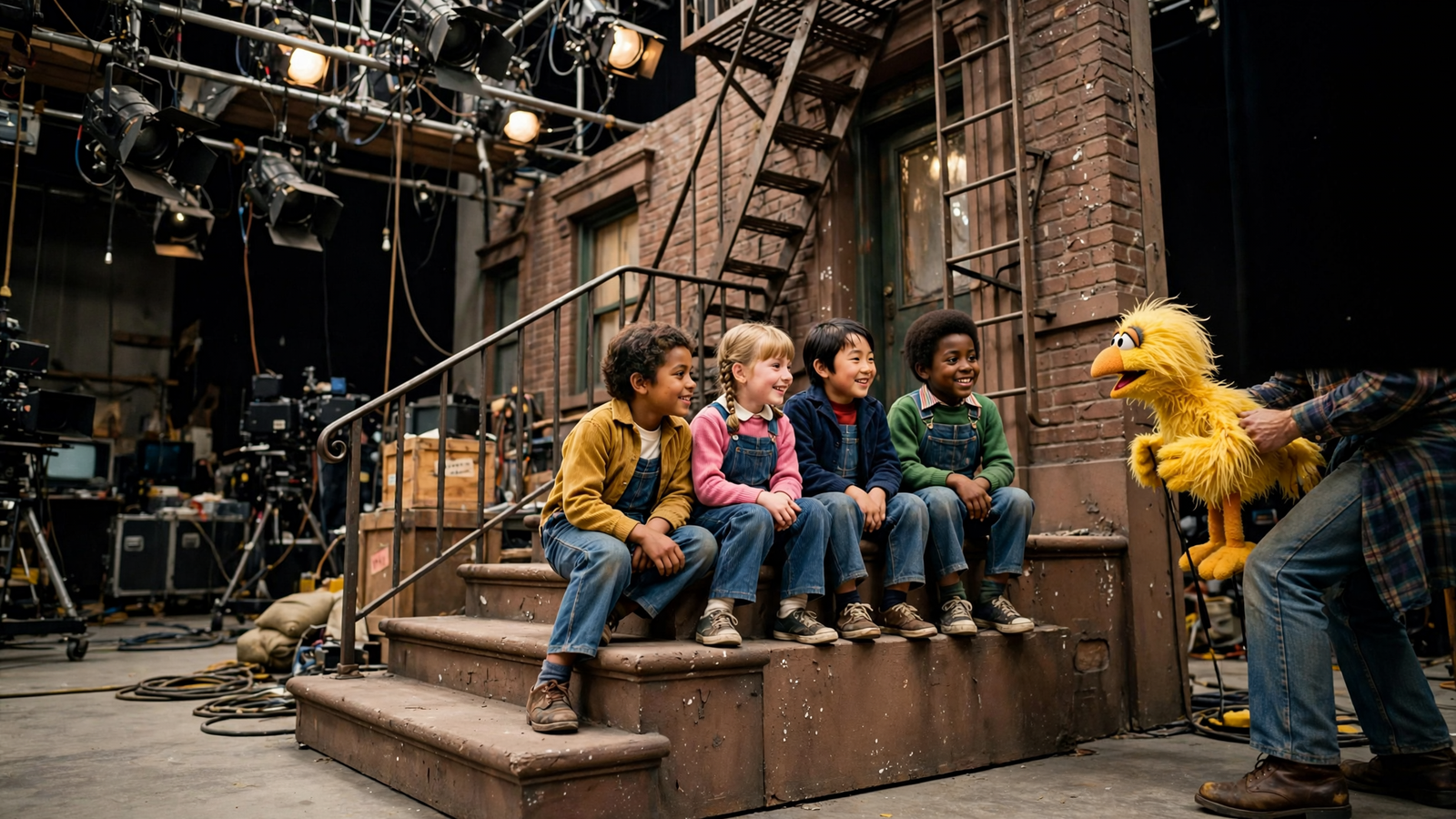
Before Sesame Street, children’s television was often treated as a holding room: a bright place to keep young viewers occupied until the adults came back. The team behind Sesame Street imagined something more ambitious. What if television could meet children where they were, respect how they learned and make the act of learning feel welcoming?
That question produced a neighborhood unlike any other in American broadcasting. Its buildings were ordinary, its residents were varied and its lessons were often hidden inside songs, jokes, games and small acts of friendship. Beginning in 1969, Sesame Street helped demonstrate that educational television did not have to sound like a lecture. It could be warm, funny, visually inventive and attentive to the realities of children’s lives.
More than half a century later, the program’s importance is not simply that it taught generations of viewers the alphabet. Sesame Street helped establish a model for children’s media: start with evidence, design for the whole child and treat representation, curiosity and emotional security as part of education.
A television experiment with a public purpose
Sesame Street grew out of a period when educators, broadcasters and policymakers were asking whether television could be used deliberately for public benefit. Joan Ganz Cooney, a television producer, explored that possibility in a 1966 report commissioned by the Carnegie Corporation. The report argued that educational television could reach children at home, including children whose families had limited access to preschool programs.
Lloyd Morrisett, a Carnegie Foundation executive, became one of the project’s early supporters. Cooney and Morrisett helped bring together educators, researchers, producers, musicians, performers and puppeteers. Their work led to the creation of the Children’s Television Workshop, now known as Sesame Workshop, and eventually to the premiere of Sesame Street on public television in November 1969.
The ambition was unusual for its time. The program was not designed merely to add educational material to a conventional variety show. Its creators wanted the entire experience to support learning. The pace, colors, editing, humor and repeated visual patterns were all considered part of the teaching environment.
That approach also reflected a practical insight: young children do not necessarily learn best when someone tells them that a lesson has begun. They learn through attention, repetition, imitation, questions and play. Sesame Street made those activities the structure of the program. For related reading, see Sesame Street: How a Neighborhood Made Television Feel Like a Classroom.
Research became part of the writers’ room
One of Sesame Street’s most influential innovations happened behind the camera. The production team worked with child-development specialists and used research to test whether children understood and remembered what they saw.
That did not mean turning the program into a laboratory demonstration. Instead, research helped producers decide how to present a concept. A segment about a letter might use repetition, a distinctive visual design and a familiar character. A counting exercise might become a song or a comic problem. If a sequence was confusing or failed to hold children’s attention, the team could revise it.
This process became known as formative research: gathering information during production so that a program can improve before it reaches its audience. Sesame Workshop has continued to describe research and evaluation as central to its work, using input from educators, child-development experts and families to shape content.
The result was a different relationship between entertainment and instruction. The jokes were not decorations placed around the lesson. They helped create attention. The songs were not interruptions. They gave children a way to rehearse ideas. The repetition was not a creative failure. It was an invitation to participate.
A street designed for more than one kind of childhood
Sesame Street’s setting was fictional, but it did not isolate children from the world around them. The program placed fantastical Muppets beside human neighbors, music beside conversation and basic academic skills beside questions about feelings, family and community.
That combination made representation one of the program’s defining features. The street included people of different racial and ethnic backgrounds, children with different experiences and adults who treated young viewers as members of a real community. The setting suggested that learning was not reserved for one type of child or one kind of household.
The show’s creators were making a cultural argument as well as an educational one: children should be able to recognize themselves in the public world, and they should have opportunities to encounter lives different from their own. Television could make difference familiar rather than frightening. For related reading, see The French Chef: How Julia Child Made Public Television Feel Like Home.
This did not mean Sesame Street avoided difficult subjects. Over the years, its producers have addressed topics such as grief, incarceration, homelessness, foster care, autism and racial justice through characters and stories designed for young audiences. The goal has generally been to give children language, reassurance and a way into a conversation rather than to reproduce the full weight of an adult news report.
The Muppets made abstraction feel alive
The program’s educational framework might have remained worthy but forgettable without its extraordinary creative language. Jim Henson’s Muppets gave Sesame Street a cast capable of making abstract ideas visible.
Big Bird could turn a confusing world into a child-sized one. Elmo’s curiosity could transform a simple question into a shared investigation. Cookie Monster made self-control funny without making the struggle disappear. Grover’s anxious bravado gave children a comic way to recognize uncertainty. Oscar the Grouch made room for an emotion that children often have but are not always encouraged to express.
These characters worked because they were not merely mascots attached to lessons. They had preferences, flaws, fears and relationships. A viewer could return to a familiar character for comfort while still encountering a new word, number or idea.
The Muppet design also made visual thinking central to the show. A letter could become a character in a skit. A number could enter a musical pattern. A monster could ask a question that a child at home was already considering. Sesame Street repeatedly turned invisible concepts into things that could be seen, heard and played with.
Public television gave the experiment room to grow
Sesame Street’s original home on public television was important to its identity. The program was created to serve children broadly, not only those whose families could afford a subscription channel or private preschool. Public broadcasting helped make the show part of a shared national experience, while local stations connected it to communities across the country.
The program’s success also helped establish that children’s educational content could be ambitious without becoming inaccessible. It could have high production values, memorable music and sophisticated visual storytelling while remaining focused on a public mission. For related reading, see Julia Child: How an American Cook Made French Food Feel Possible.
Over time, Sesame Workshop developed projects beyond the original street, including international co-productions and materials created for specific communities. Those adaptations did not simply translate American scripts word for word. They were designed with local partners to reflect different languages, cultures and educational needs.
That international work revealed both the strength and the limits of the original formula. The basic tools—play, repetition, music, trusted characters and clear goals—could travel. The details of family life, language and community had to be shaped by the people who knew the local context.
A lesson in what television can be
Sesame Street did not solve every problem facing children, and television cannot replace a caring adult, a safe home, a good school or access to health care. Its achievement is more specific and, in some ways, more useful: it showed that mass media could take children seriously.
It showed that a program could be entertaining without treating education as an afterthought. It showed that research could strengthen creativity rather than flatten it. It showed that a diverse cast could be part of the normal texture of a story instead of a special announcement. And it showed that emotional skills—recognizing feelings, asking for help, waiting, listening and caring for someone else—belong alongside letters and numbers.
The program’s enduring image is a street, but its deeper idea is a public room. There is space for a child who already knows the answer and one who is still figuring out the question. There is space for silliness, frustration, music, repetition and surprise. The neighborhood works because it makes learning social.
That may be Sesame Street’s most durable contribution to television. It did not make education look like a smaller version of adult life. It made learning look like what it can be at its best: a shared activity, built from curiosity, attention and the feeling that someone has made room for you.
Use: Background on Sesame Street’s origins, the Children’s Television Workshop and Sesame Workshop’s educational mission.
Use: Context on Joan Ganz Cooney’s 1966 report and the philanthropic and public-policy setting that preceded the program.
Use: Museum context for Sesame Street’s place in American television and popular culture.
Use: Independent reference checking for the program’s premiere, creators and broad historical development.