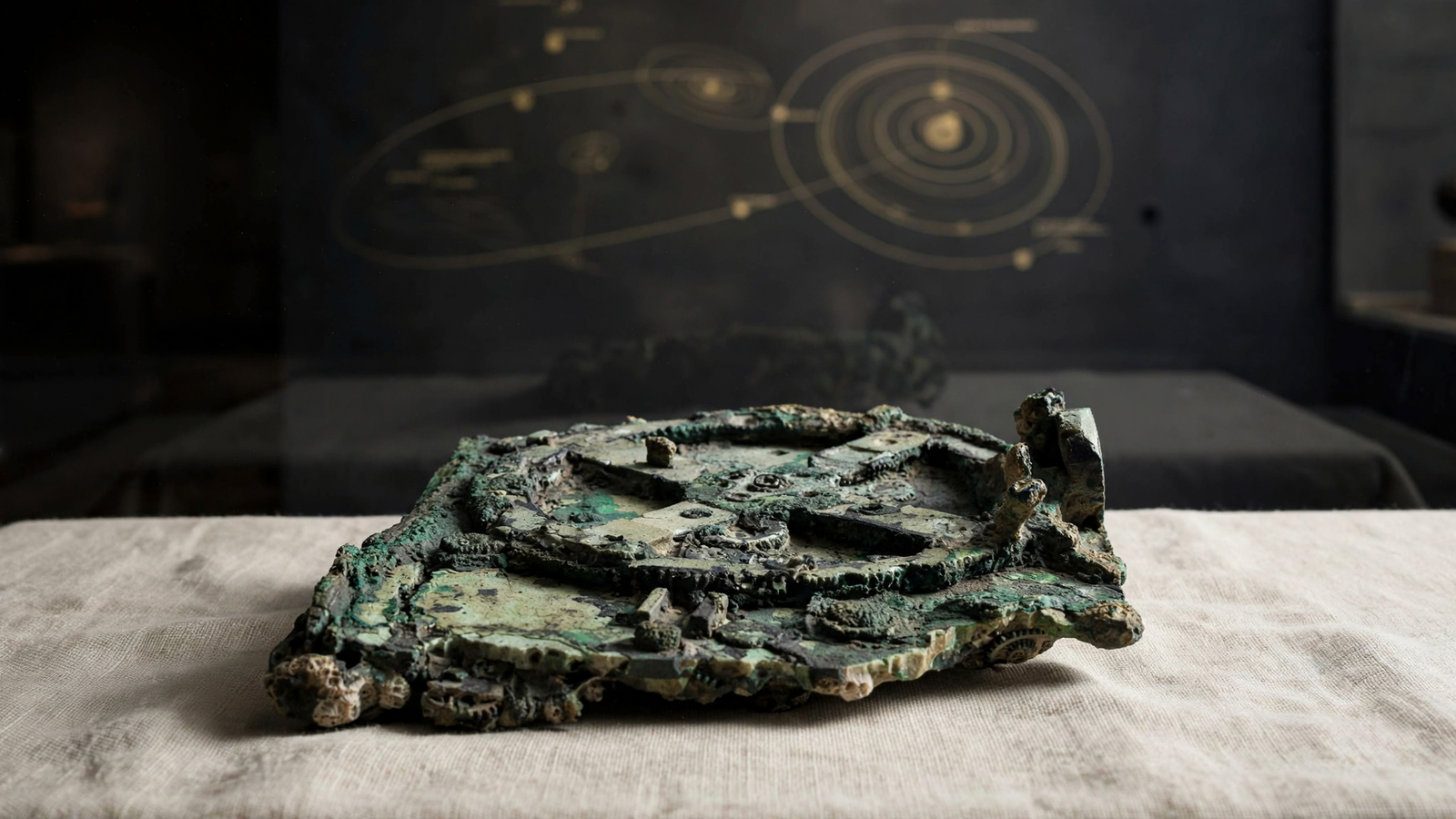
In the spring of 1900, sponge divers working near the Greek island of Antikythera made a discovery that changed the history of technology. Beneath the surface, among bronze statues, marble sculptures, coins, glassware and fragments of an ancient ship, they found a corroded object that looked, at first, like little more than a lump of bronze.
It was anything but ordinary. After decades of study, the object became known as the Antikythera Mechanism: a hand-powered device filled with precisely arranged gears, dials and inscriptions. Built more than 2,000 years ago, it could represent cycles of the Sun and Moon, predict eclipses and track the complex calendars used by ancient Greek communities.
The mechanism did not survive as an intact machine. It was recovered in dozens of fragments, its wooden case long gone and many of its gears damaged by corrosion. Yet even in pieces, it offered an extraordinary message. The ancient Greek world possessed a tradition of mechanical engineering far more sophisticated than surviving literary accounts had led many modern observers to expect.
A dangerous discovery beneath the sea
The wreck was located in the strait between the Greek mainland and Crete, close to Antikythera. According to the Hellenic Ministry of Culture and Sports, the divers were searching for sponges when they encountered the remains of a large ancient merchant vessel. The site was deep, roughly 40 to 60 meters below the surface, and difficult to work safely with the diving technology available at the time.
Between 1900 and 1901, a Greek naval expedition helped recover many objects from the wreck. The finds included celebrated bronze sculptures, a marble statue of the philosopher orator known as the “Antikythera Youth,” jewelry, coins and everyday vessels. The cargo appears to have been traveling westward from the eastern Mediterranean, possibly toward Rome, when the ship sank sometime in the first century BCE.
The object that would become famous as the Antikythera Mechanism was initially cataloged alongside other corroded bronze pieces. Its significance was not immediately clear. Several pieces had fused together, and the surfaces were obscured by mineral deposits formed during centuries underwater.
When researchers examined the fragments at the National Archaeological Museum in Athens, they noticed gear teeth and traces of inscriptions. That combination was startling. Gears were known from the ancient world, but no surviving device of comparable complexity had been identified.
The first clues came from the gears
Early investigations during the twentieth century gradually established that the object had been a mechanical calculator. The British science historian Derek de Solla Price played a major role in bringing the mechanism to wider attention. In a landmark 1959 article in Scientific American, Price argued that the fragments belonged to a geared astronomical device rather than an ordinary instrument or decorative object.
Later researchers used improved radiography and high-resolution imaging to look inside the corroded fragments without taking them apart. These techniques revealed gear teeth hidden beneath the surface, previously unread inscriptions and the arrangement of several display systems.
The Antikythera Mechanism Research Project, involving scholars from University College London and other institutions, has described the surviving object as the remains of a complex astronomical calculator housed in a wooden case. It was probably operated by turning a handle. That motion drove a network of gears connected to front and rear displays.
The front appears to have shown the positions of the Sun and Moon against a zodiacal scale, along with a calendar. The rear included spiral dials for longer astronomical cycles. One of those systems represented the Saros cycle, a period of approximately 18 years used to anticipate recurring patterns of solar and lunar eclipses.
Other components appear to have represented the Metonic cycle, a 19-year relationship between lunar months and the solar year. The device also included a four-year cycle associated with the Panhellenic Games, including the games held at Olympia. This detail is important because it shows that the mechanism was not simply an abstract astronomical model. It connected the sky to the rhythms of civic and religious life.
Why eclipses mattered
To modern eyes, an eclipse prediction may seem like a purely scientific achievement. In the ancient Mediterranean, celestial events carried practical, cultural and religious significance. Calendars governed festivals, agricultural activity and civic schedules, while the movements of the Moon and Sun were observed as part of a wider understanding of order in the cosmos.
The mechanism did not “predict” eclipses in the modern sense of calculating their precise path across the Earth with contemporary physics. Instead, its gearing encoded repeating relationships among astronomical cycles. By turning the device forward or backward, a user could follow where an eclipse would fall within those cycles and whether it was associated with the Sun or Moon.
That distinction makes the machine no less impressive. Its builders had transformed observations and mathematical relationships into a compact mechanical system. They had also designed the device so that a user could see those relationships represented on dials rather than reconstructing them from tables alone.
An ancient machine with a modern research history
The mechanism’s story is also a history of changing technology. In the 1970s, Price and the physicist Charalampos Karakalos used gamma-ray and X-ray images to study the fragments. Their work exposed more of the internal structure, but the object remained difficult to interpret because corrosion had fused the layers together.
In the early twenty-first century, a team including the astronomer Mike Edmunds and the mathematician Tony Freeth used advanced three-dimensional X-ray computed tomography. The scans allowed researchers to read inscriptions that had been invisible from the surface and to reconstruct the positions of internal parts.
A 2006 study published in Nature reported that the mechanism contained at least 30 surviving bronze gears and provided evidence for a device capable of displaying astronomical cycles and eclipse predictions. The research also helped clarify the ship’s likely date and the intellectual environment in which the mechanism was made.
In 2008, further research published in Nature connected the rear dials with the Metonic and Callippic cycles and identified references to the games cycle. The inscriptions suggested that the device’s makers worked within the astronomical traditions associated with Greek-speaking communities in the eastern Mediterranean.
More recent work has continued to revise the reconstruction. Researchers disagree about some details, including how the mechanism displayed the planets and how complete the surviving evidence is. A responsible account therefore avoids presenting every proposed feature as settled fact. The core conclusion, however, is firm: this was a geared astronomical instrument of remarkable sophistication.
Not exactly an ancient computer
The Antikythera Mechanism is often called the world’s first computer. The phrase is useful as a shorthand, but it can also mislead. The device had no electricity, software or programmable memory in the modern sense. It did not perform open-ended calculations. Its gears were configured to model particular cycles already known to its makers.
Still, the comparison points toward something real. Like a specialized analog computer, the mechanism accepted a mechanical input, processed it through a designed system and displayed information in a form a person could read. Its gears were not merely transferring power; they embodied mathematical relationships.
The greater surprise may be what the mechanism reveals about the historical record. Ancient authors such as Vitruvius and Cicero described astronomical instruments and mechanical wonders, but few machines survived to demonstrate what such descriptions could mean in practice. The Antikythera fragments provide physical evidence of a technological tradition that was largely lost, dismantled or destroyed.
There may have been other devices like it. The shipwreck’s cargo suggests that advanced objects could circulate through the Mediterranean world, moving between workshops, collectors, scholars and wealthy patrons. Because bronze was valuable and mechanical instruments were vulnerable to corrosion, later generations may have melted, reused or simply failed to preserve many of them.
A discovery still unfolding
The Antikythera Mechanism has never offered researchers a single, final answer. Each improvement in imaging has revealed another layer of the object’s design, while new readings of the inscriptions have changed ideas about its purpose and place of manufacture.
That continuing process is part of the discovery’s importance. The mechanism was not found as a perfect artifact waiting to explain itself. It was rescued from a difficult underwater site, separated from other debris, examined with increasingly sophisticated tools and interpreted through collaboration among archaeologists, historians, astronomers, engineers and conservators.
More than a century after the sponge divers first encountered the wreck, the fragments remain a reminder that technological history is not a straight line. Knowledge can be achieved, refined and then forgotten. A civilization can build a machine capable of turning astronomical theory into motion, while leaving behind only corroded pieces for later generations to understand.
What survives from Antikythera is therefore more than an ancient calculator. It is evidence of curiosity made physical: a machine built to bring the patterns of the sky down into the human hand.