For more than a thousand years, ancient Egyptian hieroglyphs stood in plain sight but remained largely unread. Temples, tombs, statues, and monuments preserved the symbols, yet the language behind them had become inaccessible to scholars.
That changed because of a damaged stone found near the Egyptian port town of Rashid—known in European languages as Rosetta—in 1799. The Rosetta Stone did not provide a magical translation key by itself. Its importance came from something more practical: it preserved the same official decree in three different writing systems. By comparing those versions, scholars eventually began to recover the language of ancient Egypt.
A discovery during a military campaign
The stone was found in July 1799 by soldiers serving with Napoleon Bonaparte’s expedition in Egypt. According to the British Museum, members of the French army were strengthening a fort near Rashid when they uncovered the large, dark slab. The fort was later known as Fort Julien.
The expedition had begun as a military campaign, but it also included scientists, engineers, artists, and scholars. Their work reflected a growing European interest in Egypt’s ancient monuments and natural history. The discovery at Rashid quickly became one of the expedition’s most important finds.
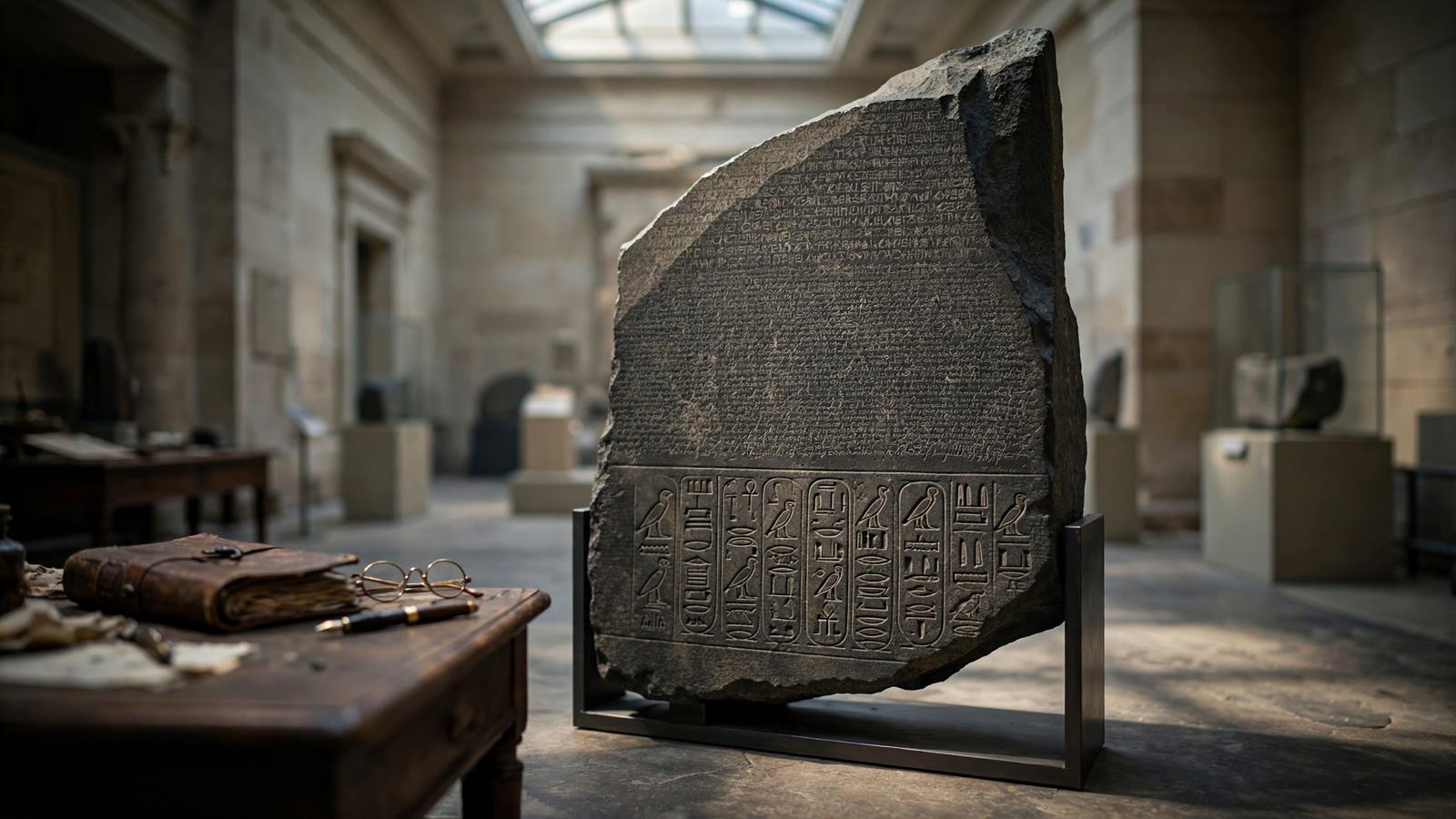
The stone is not complete. Its upper section, containing much of the hieroglyphic text, is missing, and the surviving fragment is broken along its edges. Even so, enough of the inscription remains to show that it carries the same decree in three scripts: hieroglyphs at the top, Demotic in the middle, and ancient Greek at the bottom.
What the inscription says
The text is a decree issued in Memphis in 196 BCE during the reign of Ptolemy V Epiphanes. It was produced by a gathering of Egyptian priests and honors the young ruler while recording measures connected with his rule and religious status.
The decree was written in the formal hieroglyphic script used for important religious and monumental texts, in Demotic—the everyday administrative script of later ancient Egypt—and in Greek, the language of the ruling Ptolemaic administration. Because Greek was already understood by scholars, it offered a starting point for identifying names, titles, and repeated phrases in the other versions.
The three scripts were not three unrelated messages. They were different written forms of one decree. That parallel structure made the stone unusually valuable. Earlier scholars had possessed examples of Egyptian writing, but they lacked a long, clearly connected text that could be checked against a known language.
From military prize to museum object
The French army kept the stone after its discovery, but its journey did not end in French hands. In 1801, British forces defeated the French expedition in Egypt. Under the terms of the resulting agreement, the Rosetta Stone and other antiquities were transferred to the British.
The stone arrived in England in 1802 and was soon presented to the British Museum, where it remains. Its display made it one of the most recognizable objects in the museum’s collection. Casts and printed copies also circulated among scholars, allowing researchers in different countries to study the inscription.
The object’s modern history has remained controversial. Egypt has repeatedly called for the stone’s return, arguing that it was removed during a colonial military campaign. The British Museum has continued to hold and display it. That debate is part of the stone’s story too: the artifact is both a landmark in the history of scholarship and a reminder that many ancient objects entered European collections through unequal political power.
Thomas Young and the first breakthroughs
Deciphering the inscription required more than simply reading the Greek section. Scholars had to determine how Egyptian writing worked and whether the signs represented sounds, ideas, or both.
English physician and polymath Thomas Young made important advances in the early 19th century. He studied the relationship between the Demotic script and the hieroglyphic form, identified connections between royal names, and showed that some hieroglyphic signs could represent sounds rather than only concepts.
Young’s work helped establish the direction of the investigation, but it did not produce a complete reading of hieroglyphic Egyptian. The decisive breakthrough came from the French scholar Jean-François Champollion.
Champollion’s breakthrough
Champollion had spent years studying Egyptian scripts, languages, and the surviving evidence from monuments. He also knew Coptic, the later Egyptian language preserved in the Christian tradition. That knowledge helped him recognize that ancient Egyptian writing could combine phonetic signs with signs representing words or categories.
In 1822, Champollion announced that he had made a major breakthrough in deciphering hieroglyphs. He used royal names—including those of Ptolemy and Cleopatra—to compare recurring signs across inscriptions. From there, he developed a broader understanding of the writing system rather than treating each symbol as a simple picture.
The Rosetta Stone was central to the process, but it was not the only evidence. Champollion compared the stone with other inscriptions and monuments. The stone supplied an essential bilingual and trilingual framework; knowledge of Egyptian language, careful comparison, and years of work turned that framework into a reading system.
A new history became possible
Once scholars could read hieroglyphic and Demotic texts with greater confidence, ancient Egypt became more than a civilization reconstructed from architecture and images. Its people could be studied through their own written records.
Inscriptions revealed royal announcements, religious beliefs, legal arrangements, personal names, occupations, letters, medical knowledge, and details of ordinary administration. The change affected not only Egyptology but the wider study of the ancient Mediterranean and Africa. Historians could compare Egyptian evidence with Greek and Roman accounts instead of relying on outside descriptions alone.
The Rosetta Stone therefore represents more than a famous archaeological find. It marks a turning point in the recovery of human memory. A damaged fragment, produced for a ruler in the second century BCE and found during a campaign nearly two thousand years later, helped reconnect modern readers with a civilization whose written voice had been silent for centuries.
Its lesson is both scholarly and human: understanding often begins not with a perfect object, but with a partial one that can be placed carefully beside other evidence.