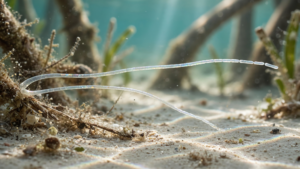
Bacteria are usually imagined as tiny dots visible only through a microscope. Thiomargarita magnifica is a striking exception: some of its threadlike cells grow to around two centimeters long, making them visible to the naked eye. Discovered in a mangrove swamp in Guadeloupe, this single-celled organism is the largest bacterium scientists have described by length.
Its scale is remarkable, but size is only part of the story. The cell also packages its genetic material in numerous small, membrane-surrounded compartments. Those compartments are not nuclei, and the organism is still a bacterium. But they offer an unusual example of how a bacterial cell can organize its interior—and invite scientists to reconsider how much complexity can fit into a familiar category of life.
A giant among microbes
Biologist Olivier Gros first encountered the organism in 2009 while studying sulfur-using bacteria in Guadeloupe’s mangrove environments. It appeared as a pale filament attached to submerged material. At first, its size made it easy to mistake for something made up of many cells. Closer examination showed that each filament could be a single cell.
The species was formally described in a 2022 study in Science. The researchers reported cells reaching roughly 20,000 micrometers—about two centimeters—in length. Many bacteria measure only a few micrometers, so T. magnifica stretches the usual mental picture of a bacterium by several orders of magnitude.
The organism’s name reflects that unusual scale. “Thiomargarita” refers to sulfur-related features shared with other members of its group; “magnifica” signals its imposing size. It is not a multicellular animal or a chain of ordinary bacteria masquerading as one large organism. It is a single bacterial cell, elongated like a fine strand.
How a cell gets so large
One challenge facing a cell as it grows is moving materials to where they are needed. A cell’s volume can increase faster than its outer surface area, leaving more interior space to supply. In many organisms, that makes the movement of nutrients and waste a constraint on size.
T. magnifica has a distinctive arrangement that helps make its length less difficult to understand. Much of the cell’s interior is occupied by a large central compartment, or vacuole. The active cytoplasm—the material where much of the cell’s biochemical work takes place—is concentrated in a relatively thin layer near the outer edge. Rather than filling a bulky interior with active material, the cell keeps much of that material close to its surface.
The arrangement does not mean scientists have solved every question about how the bacterium grows or functions. It does, however, show that a giant bacterial cell need not simply be a scaled-up version of a small one. Its internal layout is part of the explanation.
DNA in many small compartments
Another surprise lies in the cell’s genetic organization. Bacteria are generally described as lacking a nucleus: their DNA is not enclosed in a nucleus like the DNA in plant and animal cells. In T. magnifica, the researchers found DNA distributed in many small compartments surrounded by membranes. They named these structures “pepins,” from a French word for seeds.
The pepins are not simply miniature versions of a eukaryotic nucleus. They are an unusual feature inside a bacterium, and the species remains classified as bacterial. The study also found that the organism carries many copies of its genome. Having genetic material distributed among numerous compartments may help a very large cell manage its internal activity, though exactly how that organization works is a subject for further research.
The genome itself is unusually large for a bacterium, with about 11.7 million DNA base pairs and roughly 11,000 genes, according to the study. Those numbers do not make the species a halfway point between bacteria and animals or plants. They show that bacterial cells can vary more in size and internal organization than a simple textbook sketch might suggest.
A mangrove microbe, not a new rule for all bacteria
The researchers found T. magnifica in a specific setting: the nutrient-rich, sulfur-influenced surroundings of a Caribbean mangrove. Like other sulfur-oxidizing bacteria, it obtains energy through chemical reactions involving sulfur compounds. Its large vacuole also stores nitrate, a detail that may be relevant to how it lives in its local environment.
That habitat matters. The discovery does not mean all bacteria can grow to visible lengths, or that bacterial cells commonly have pepins. It is one species with an unusual collection of traits. Finding it also underlines how much microbial diversity may remain overlooked in places that are difficult to sample and study.
For a long time, a bacterium’s defining image was a tiny cell with relatively simple internal organization. T. magnifica does not overturn the distinctions between bacteria and other forms of life. Instead, it makes those distinctions more interesting: a bacterium can be astonishingly long, carry an extensive genome, and partition some of its DNA inside membrane-bound structures while remaining unmistakably bacterial.
That is a useful reminder about biology’s categories. They help describe the living world, but they do not always predict how surprising an individual organism can be.