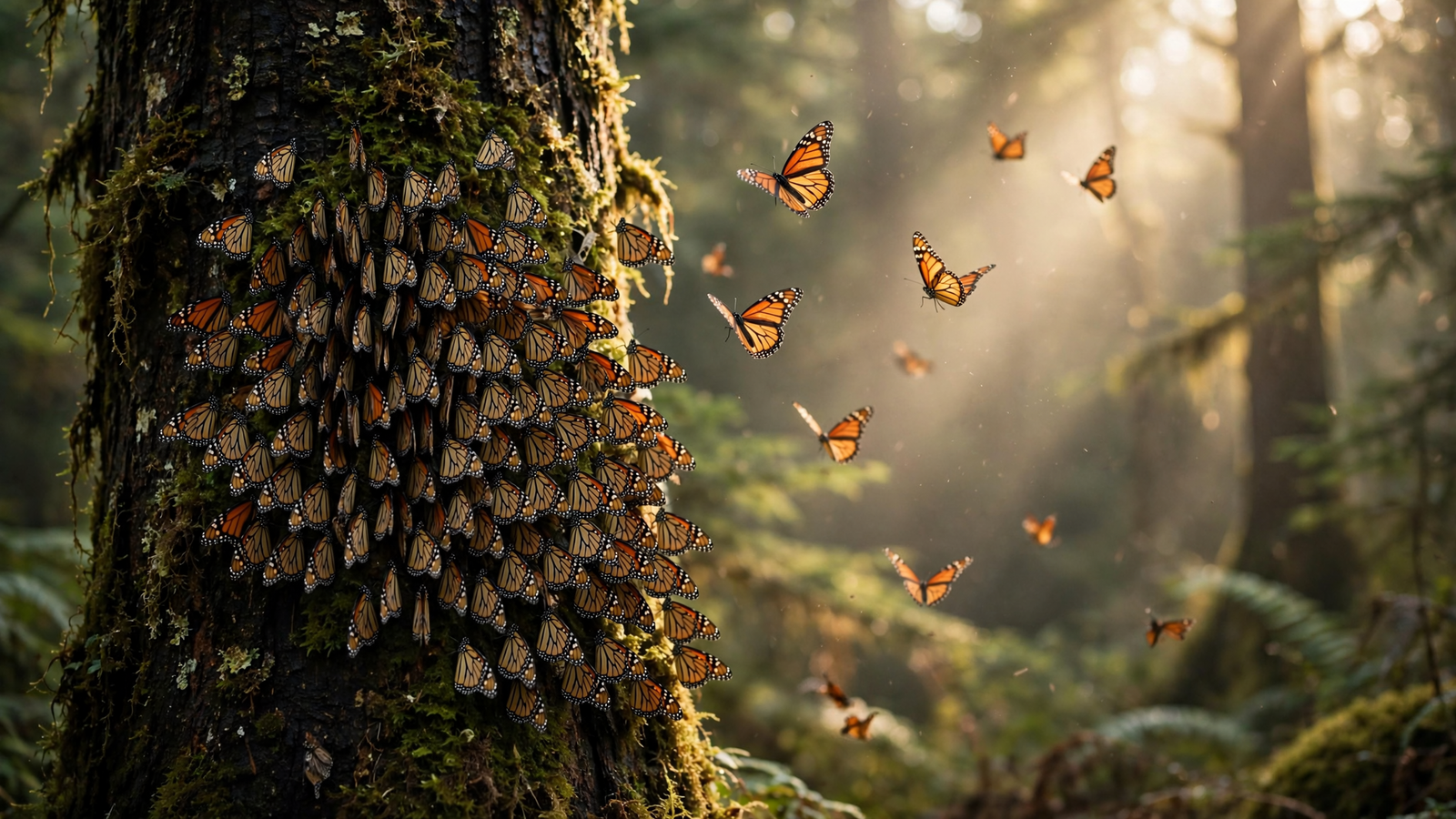
Every autumn, eastern monarch butterflies gather in the mountains of central Mexico. They arrive from across a continent, clustering on the branches and trunks of oyamel fir trees. Come spring, they begin moving north again. It is tempting to picture a single butterfly making that enormous round trip. But the journey works differently: it is a relay, carried forward by successive generations.
That distinction makes monarch migration more than a story of distance. It is also a story of timing: how a butterfly responds to changing seasons, how it finds its way, and how offspring continue a journey their parents began.
A migration with a changing cast
In the eastern North American population, most monarchs that migrate south spend the winter in a relatively small area of Mexico’s high-elevation forests. Their journey can span thousands of miles, depending on where it begins. But the butterflies heading south are not usually the same individuals that started the journey north months earlier.
In spring, monarchs leave their overwintering sites and move north. They lay eggs along the way, especially on milkweed, the plants monarch caterpillars need to eat. The adults that hatch from those eggs continue the expansion. They, in turn, produce another generation. Across the breeding season, several generations may contribute to the movement northward.
Later in the year, a distinct generation makes the southbound trip. These adults can live far longer than monarchs that reproduce during the warmer months. Rather than quickly mating and laying eggs, they conserve energy and travel toward the wintering grounds. Their offspring will help restart the northward journey after winter.
So the annual cycle is not a neat out-and-back route for one butterfly. It is a sequence of generations, each responding to conditions in its own part of the year. The migration’s continuity depends on their timing lining up with the plants and places they need.
Why the autumn generation is different
Monarchs born during the breeding season generally have a short adult life. The generation that migrates south enters a different biological state, often called reproductive diapause: reproduction is delayed while the butterflies travel and overwinter. That extended lifespan gives them time to complete a journey that would outlast the lives of many other adult monarchs.
Seasonal cues help shape this change. Day length and temperature shift as summer ends, and those signals are part of the conditions associated with migration and delayed reproduction. The result is not simply a butterfly following a map. It is an animal whose development and behavior change with the season.
During the journey, monarchs need opportunities to rest and feed. Nectar supplies energy for flight, while suitable weather affects when travel is possible. At the wintering sites, the forest itself matters: the trees and mountain conditions create a sheltered setting where butterflies can gather through the colder months.
Finding direction under an open sky
A monarch does not have a road or coastline to follow all the way south. Research on monarch navigation has shown that the butterflies use a time-compensated sun compass. In simple terms, they can use the sun’s position in the sky alongside an internal sense of time to maintain a direction as the sun appears to move throughout the day.
That combination is important. A compass based only on the sun’s position would point in a different direction as the hours passed. An internal clock helps a butterfly interpret that changing position and adjust its course. Experiments on the monarch’s compass have helped scientists investigate how the butterfly’s nervous system combines these signals.
Navigation is only one part of the challenge. Monarchs also have to arrive at the right place at the right time. The wintering area in Mexico is limited compared with the broad region where eastern monarchs breed. Their annual movement connects widely scattered breeding grounds with these concentrated winter sites, then begins the process of spreading north again.
A journey that depends on places along the way
Because the migration passes through many landscapes, it depends on more than the butterflies’ ability to fly. Milkweed is essential for caterpillars, while flowering plants can provide nectar for adults. Breeding habitat, stopover areas and overwintering forest all play different roles in the cycle.
That does not mean every monarch follows the same route or that the journey is identical from year to year. Weather and local conditions vary. But the broad pattern remains striking: a long-lived autumn generation travels south, spends the winter in a particular region, and is followed by generations that carry the movement north.
There is a useful lesson in the relay. The monarch migration is not a single feat performed by one extraordinary butterfly. It is a recurring achievement shared across generations, each inheriting a seasonal task. A butterfly that emerges in spring may never reach the northern edge of the breeding range, and a butterfly born there may be part of the generation that heads south. Together, their lives connect a continental landscape to a small set of mountain forests.
When monarchs gather on fir trees in Mexico, they are not simply arriving at the end of a trip. They are reaching one stage in a cycle whose next leg will be flown by descendants. The migration’s scale is measured not only in miles, but in the handoff from one generation to the next.