For centuries, the carved signs on ancient Egyptian monuments were visible but largely unreadable. Temples, tombs, statues, and obelisks carried messages in a writing system whose meaning had faded from living knowledge. The symbols remained everywhere—in stone doorways, royal names, and painted burial chambers—but they had become a lost language written in plain sight.
Then, in the summer of 1799, a group of French soldiers found a damaged black stone near the Egyptian town of Rashid, known to Europeans as Rosetta. It was not a treasure in the usual sense. The slab was broken, incomplete, and discovered during construction work for a military fort. Yet its inscription would become one of the most important archaeological discoveries in history.
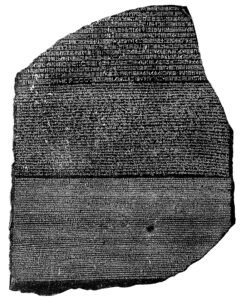
The Rosetta Stone did not contain a secret message or a forgotten map. Its importance came from something more practical: the same decree appeared in three forms of writing. By comparing the known Greek text with the two Egyptian scripts, scholars eventually found a way back into the written language of the pharaohs.
A discovery made during a military campaign
The stone was found in July 1799 by soldiers serving with Napoleon Bonaparte’s expedition to Egypt. The French campaign had begun the previous year as both a military venture and a scientific enterprise. Alongside the army came engineers, artists, naturalists, mathematicians, and scholars who recorded Egypt’s landscape, monuments, plants, animals, and antiquities.
During work on Fort Julien, near Rashid on the Nile Delta, soldiers encountered the inscribed slab being reused as building material. The exact circumstances of the find were later surrounded by competing accounts, but the object itself was quickly recognized as unusual. Three bands of text covered its surface, and the lower Greek section could be read by scholars familiar with the language.
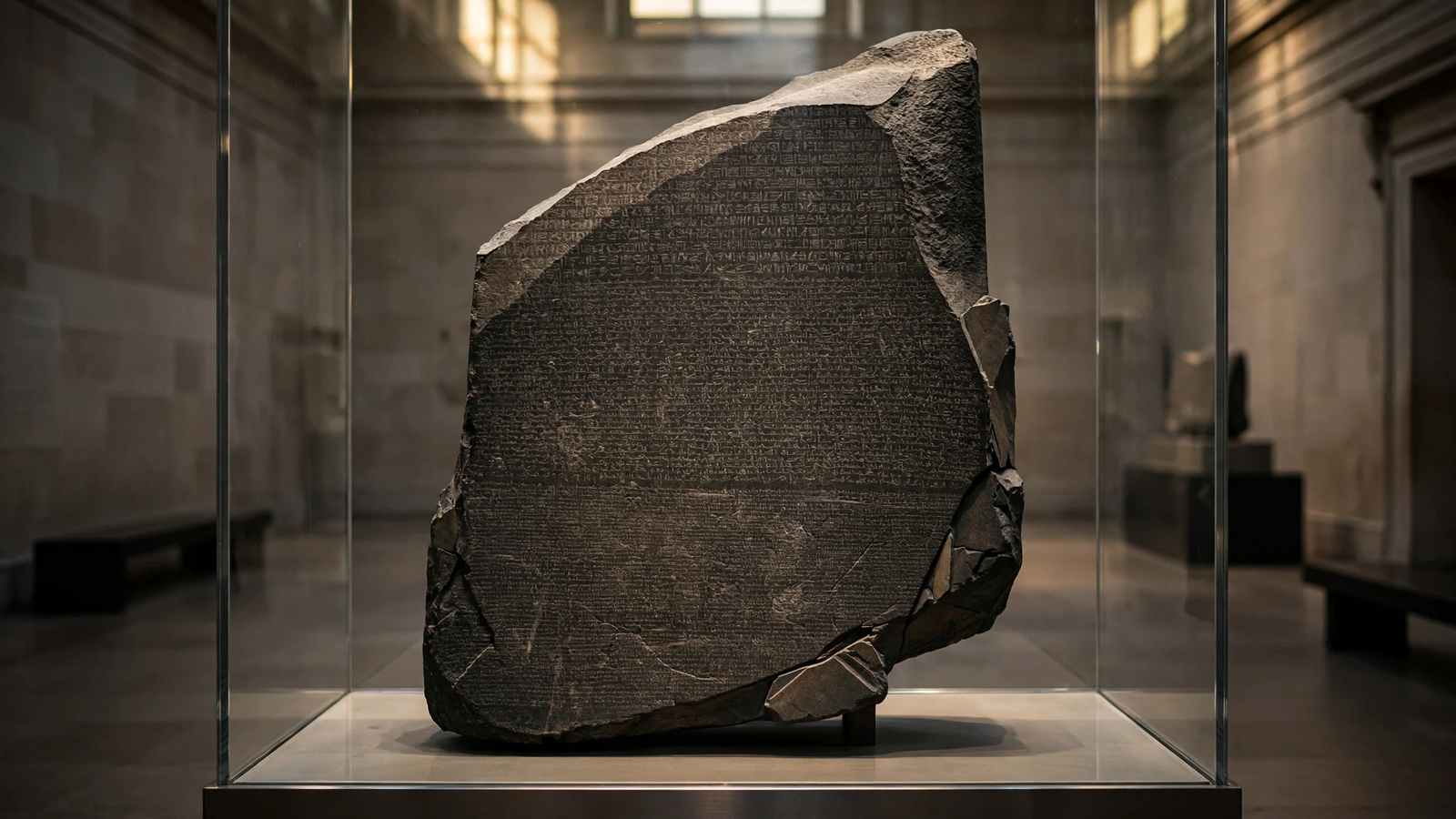
The stone was not intact. Its upper portion, containing much of the hieroglyphic inscription, was missing, and the surviving text had suffered damage. Even so, the relationship between the three scripts was clear enough to create a rare opportunity. The Greek section could serve as a reference point for studying the Egyptian writing above it. For related reading, see The Rosetta Stone: How One Broken Monument Reopened Ancient Egypt.
The inscription was a decree issued at Memphis in 196 BCE during the reign of Ptolemy V. It honored the young king and described decisions made by Egyptian priests. The decree was written in hieroglyphs, in demotic—a more everyday administrative form of Egyptian writing—and in ancient Greek, the language of the ruling Ptolemaic administration.
Why three scripts mattered
Before the Rosetta Stone, scholars already knew some facts about Egyptian writing. Ancient Greek and Roman authors had described hieroglyphs, and a few Egyptian signs had been used symbolically in later traditions. But there was no dependable method for reading long inscriptions or understanding the grammar behind them.
The three scripts on the stone changed the problem. The Greek text provided a readable version of the decree. Demotic offered a form of Egyptian closer to the language used in ordinary documents. Hieroglyphs preserved the formal monumental version. Because the texts expressed the same official decision, scholars could search for corresponding names and phrases across the three sections.
That did not make translation immediate. The scripts were damaged, the wording did not survive equally in each section, and scholars initially disagreed about how hieroglyphs worked. For a long time, many European thinkers assumed the signs were mainly symbolic pictures representing ideas. That interpretation made the writing system seem mysterious and resistant to systematic reading.
The breakthrough came when researchers began to recognize that hieroglyphs could represent sounds as well as concepts. Egyptian writing used several kinds of signs: some represented sounds, some indicated ideas, and others helped clarify the meaning of neighboring signs. Understanding that combination was essential. The pictures were not simply a collection of visual riddles; they formed a complex writing system tied to the Egyptian language.
The long road to decipherment
The stone’s discovery sparked immediate scholarly interest. Copies and translations circulated among European researchers, allowing them to study the inscription even when the original remained under military control. The eventual transfer of the stone to British custody followed the French defeat in Egypt. Under the terms of the 1801 Capitulation of Alexandria, the Rosetta Stone and other antiquities taken by the French became British property. The stone arrived in London in 1802 and was soon placed in the British Museum, where it remains.
Its physical location changed, but the intellectual work continued across Europe. The English scholar Thomas Young made important advances in the early nineteenth century. He showed that some groups of hieroglyphs inside oval shapes—known as cartouches—represented royal names. By comparing these names with the Greek references to Ptolemy and other rulers, he demonstrated that hieroglyphic signs could encode sounds. For related reading, see The Dead Sea Scrolls: How a Cave Discovery Opened a Window on the Ancient World.
Young also made progress with demotic and identified connections between demotic signs and hieroglyphic forms. His work supplied important pieces of the puzzle, although he did not produce a complete reading of the Egyptian script.
The final breakthrough is most closely associated with the French scholar Jean-François Champollion. Champollion had studied ancient languages from an early age and understood the importance of Coptic, the later Egyptian language written mainly with Greek letters. Coptic gave him evidence about Egyptian vocabulary and pronunciation that could be connected to the older scripts.
In 1822, Champollion announced that he had made decisive progress in understanding hieroglyphs. His method combined the stone’s Greek text, the evidence of royal names, comparisons with other inscriptions, and knowledge of the Egyptian language. He recognized that hieroglyphic writing could work phonetically not only in foreign royal names but also within native Egyptian words.
Champollion’s achievement was not a moment in which one person simply “read” the stone from top to bottom. It was the result of years of comparison, argument, correction, and work by multiple scholars. The Rosetta Stone served as the most famous bridge, but the decipherment also depended on inscriptions elsewhere and on the growing understanding of Egyptian history and language.
A doorway into a civilization’s own record
Once Egyptian writing could be read with increasing confidence, the ancient civilization changed from an object described mainly by outsiders into a society that could speak through its own records. Historians and archaeologists could study royal decrees, religious dedications, legal documents, letters, medical texts, tax records, funerary inscriptions, and ordinary accounts of work and family life.
The change was especially important because written evidence revealed more than the names of kings. Egyptian inscriptions recorded the organization of temples, the movement of goods, the responsibilities of officials, and the beliefs surrounding death and the afterlife. They also showed that ancient Egypt was not a static world preserved only in grand monuments. It was a place of administration, labor, argument, devotion, invention, and everyday routine. For related reading, see The Antikythera Mechanism: How a Shipwreck Revealed the Ancient World’s Mechanical Cosmos.
The stone itself is a particularly vivid example of political communication. The decree was created during the Ptolemaic period, when a Greek-speaking dynasty ruled Egypt while presenting itself through the country’s traditional religious and royal forms. Using three scripts made the decree legible to different audiences: priests and temple communities, administrators, and the wider political world shaped by Greek rule.
That multilingual quality also explains why the stone became so valuable to modern scholars. It preserved a moment when languages and political traditions overlapped. The object was not merely a translation exercise; it was evidence of how power communicated across a culturally diverse kingdom.
The stone’s unfinished story
The Rosetta Stone is often described as the key to deciphering hieroglyphs, but the metaphor can hide the difficulty of the work. The stone is incomplete. The three sections are not perfectly identical, and the hieroglyphic portion is the most damaged. Scholars had to compare it with other inscriptions and refine their understanding over time.
Its modern history is also part of the story. The stone was found during a European military campaign and removed from Egypt after the French surrender. It became one of the British Museum’s best-known objects, while questions about ownership and the return of Egyptian antiquities have continued into the present. Its fame therefore carries two histories at once: the history of an extraordinary scholarly breakthrough and the history of how ancient objects were collected, transferred, and displayed during the age of empire.
Still, the stone’s deepest importance lies in what happened after its discovery. A broken slab from the Nile Delta helped transform Egyptian antiquities from silent monuments into readable historical evidence. It gave researchers a method for comparing scripts, but it also encouraged a wider understanding of the ancient world as something recoverable through patient attention.
The Rosetta Stone did not unlock Egypt’s past by itself. It became powerful because people learned to connect fragments: Greek with demotic, demotic with hieroglyphs, royal names with sounds, and ancient words with the surviving Coptic language. Its lesson is both archaeological and human. Lost knowledge may survive in damaged form, waiting not for a miracle, but for careful comparison.
Use: Object details, discovery context, dimensions, date, materials, inscription, and museum history.
Use: Historical overview of the stone, Thomas Young, Champollion, and the decipherment process.
Use: Independent reference checking for the stone’s discovery, inscription, and role in decipherment.
Use: Additional historical context on Champollion, Egyptian language, and the 1822 breakthrough.