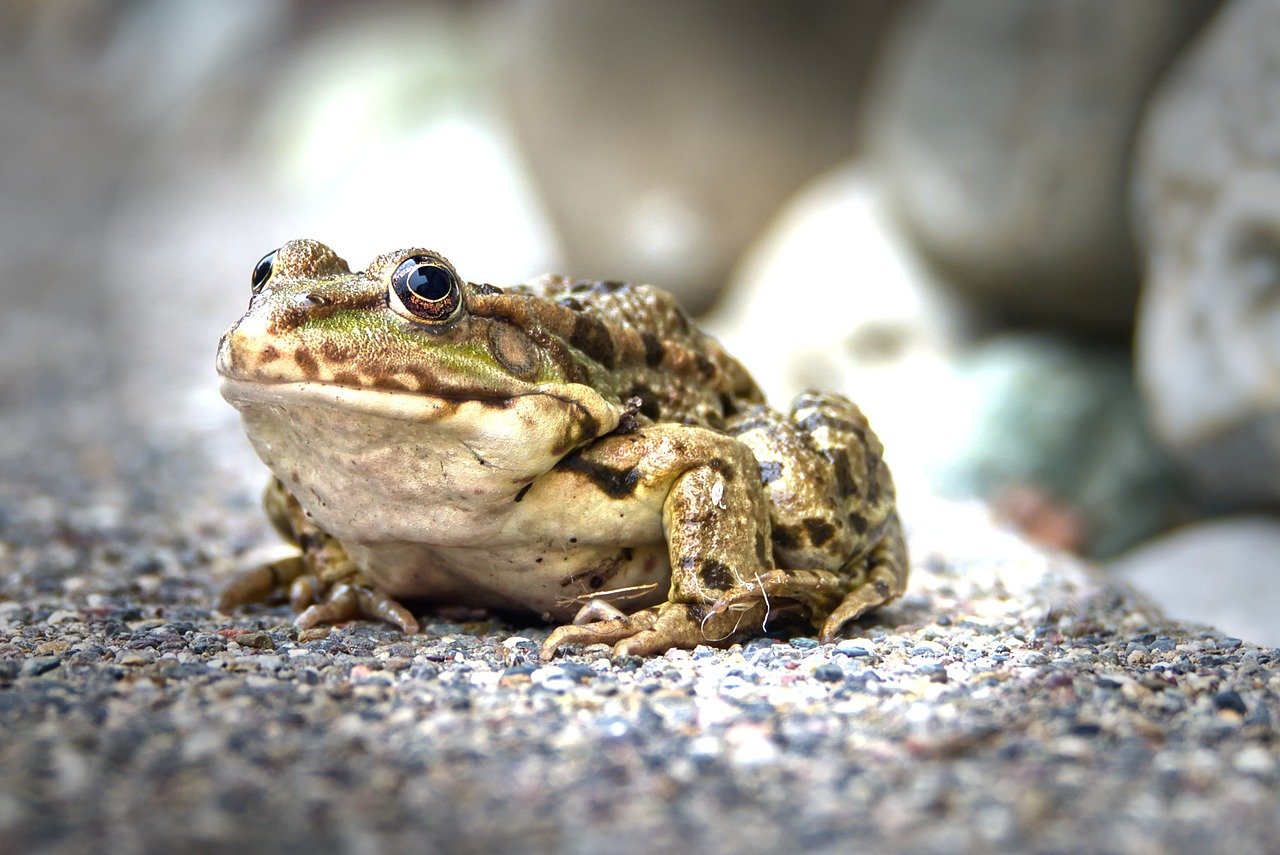
When an Alaska wood frog settles in for winter, it does not simply hide from the cold. Ice forms in its body, its heart stops beating, and it stops breathing. Months later, as temperatures rise, the frog thaws and resumes activity.
This is not a trick of appearance or a brief chill from which the animal must immediately warm itself. The wood frog (Lithobates sylvaticus) is freeze-tolerant: it can survive having a substantial portion of its body water turn to ice. Its survival depends on carefully managing where that ice forms and how its cells cope with the cold.
Ice outside the cells
Freezing is dangerous to living tissue. Ice crystals can damage cells, while freezing also draws water out of them and concentrates the substances left behind. The wood frog’s response does not prevent ice from forming altogether. Instead, it helps keep the process from destroying the cells the animal needs to survive.
As temperatures fall, ice forms first in spaces outside the frog’s cells. The frog’s liver releases large amounts of glucose into the bloodstream, distributing this sugar through the body. Glucose acts as a cryoprotectant: it helps limit the damage associated with freezing and the movement of water out of cells. It is a biological safeguard, not antifreeze in the ordinary sense, and it does not make the frog immune to every temperature or every kind of cold exposure.
During this frozen state, the frog’s heartbeat and breathing can stop. Its metabolism slows dramatically, reducing the need for oxygen and energy while normal activity is suspended. The animal is not carrying on as usual under a layer of ice; it is enduring a period in which essential processes are paused or greatly reduced.
A northern frog with a remarkable range
Wood frogs live across a broad stretch of North America, including Alaska and other regions with severe winters. That range makes their winter strategy especially striking: a small amphibian that depends on damp environments can persist in places where the ground freezes for long periods.
Not every wood frog experiences winter in precisely the same way. Local conditions matter, including how cold the site becomes and how quickly temperatures change. The species’ freeze tolerance is an adaptation to seasonal conditions, not a guarantee that any individual will survive any freeze. Its body must enter the cold gradually enough for its protective responses to take effect, and the conditions must remain within its physiological limits.
That qualification matters because “frozen frog” can sound like a simple superpower. It is better understood as a finely tuned survival strategy: the animal’s body changes its chemistry, tolerates ice in particular locations, and drastically reduces its activity. A sudden or extreme temperature shift may pose a different challenge from the gradual seasonal cooling the frog is adapted to face.
Spring restarts the system
When the surroundings warm, ice melts and the frog’s body returns to function. Its heartbeat resumes, breathing starts again, and it can move. The animal must restore ordinary physiological activity after a period when circulation and respiration were interrupted—an impressive transition, but one supported by specialized adaptations rather than by a single dramatic moment.
That timing connects winter survival to the frog’s wider life cycle. Wood frogs breed early in the year, often in shallow ponds and other temporary water bodies. In spring, adults gather to reproduce, and their eggs develop in water. A seasonal pool can be useful habitat precisely because it may be temporary, though conditions still need to suit the frogs’ eggs and tadpoles.
For the frog, then, surviving winter is only one part of the annual challenge. It must also make it to breeding habitat, reproduce, and spend the warmer months feeding and storing energy. The winter freeze strategy buys time through the cold season; it does not remove the other demands of life.
What the frog teaches scientists
Wood frogs give researchers a natural example of how vertebrate tissues can withstand freezing and then recover. Studying their chemistry and physiology can help scientists understand the limits of cold tolerance and the ways cells respond to water loss and ice. That is not the same as saying the frog’s adaptations can be directly copied into human medicine. The animal’s survival is a product of many coordinated responses, and translating those mechanisms into practical applications would require separate evidence.
The story is remarkable without turning the frog into a miniature medical device. Its body meets winter with a sequence of changes that protects vital tissues while the animal becomes temporarily inactive. When the season turns, it can start again.
In a landscape that may look lifeless under snow, the wood frog’s winter is not an absence of biology. It is biology operating at the edge of what a vertebrate can endure—then returning, with the thaw, to the brief and busy work of spring.