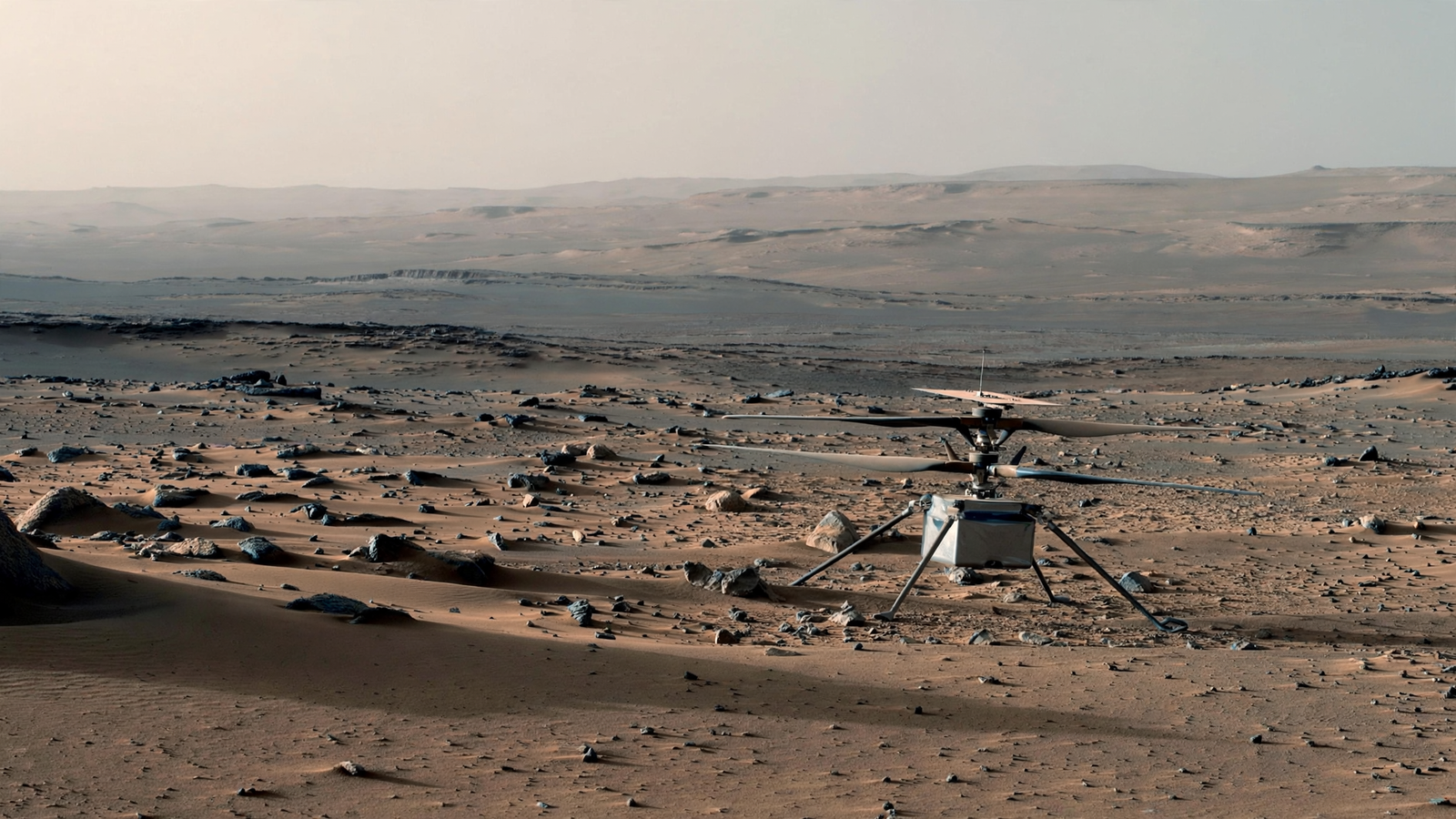
When NASA’s Ingenuity Mars Helicopter lifted off in April 2021, its assignment was deliberately modest: demonstrate that powered, controlled flight was possible in the thin atmosphere of Mars. The small helicopter was expected to attempt as few as five flights.
Instead, Ingenuity kept flying.
Over nearly three years, the helicopter completed 72 flights, traveled about 17 kilometers across the Martian surface and spent more than two hours airborne. Its mission became one of the clearest examples of how a carefully designed experiment can grow into something much more ambitious.
A first for another world
Ingenuity’s first flight on April 19, 2021, was a historic achievement. The helicopter rose roughly three meters above the surface, hovered briefly and landed near NASA’s Perseverance rover. Although the flight lasted less than a minute, it marked the first powered, controlled flight on another planet.
That accomplishment was far from guaranteed. Mars has a much thinner atmosphere than Earth, making it difficult for conventional helicopter blades to generate lift. To compensate, Ingenuity used lightweight construction and rapidly spinning rotors. Because signals between Earth and Mars take too long for real-time control, the helicopter also had to navigate autonomously, using onboard sensors and instructions sent in advance.
From demonstration to exploration partner
After proving the basic idea, Ingenuity moved beyond its original technology demonstration. NASA used it as an aerial scout for Perseverance, helping mission planners understand the terrain ahead and identify routes the rover could investigate.
The helicopter flew over ridges, sand ripples and rocky ground that would have been difficult to assess from the rover’s viewpoint. Its images gave scientists and engineers a broader perspective on Jezero Crater, the ancient lakebed where Perseverance is searching for signs of past environments that may once have supported life.
Each additional flight also offered practical information about operating an aircraft far from Earth. Ingenuity encountered changing seasons, challenging terrain and navigation problems, including areas with too little visual texture for its systems to track reliably. The mission team adapted flight plans as conditions changed, turning setbacks into information for future exploration.
A lasting achievement
Ingenuity’s 72nd flight, completed on January 18, 2024, was its last. NASA later determined that the helicopter’s rotor blades had been damaged during the flight, leaving it unable to fly again. The aircraft remained upright on the Martian surface and continued to communicate with Perseverance for a time while the mission team gathered data.
The end of flight operations did not erase the achievement. Ingenuity completed more than 14 times as many flights as originally planned and demonstrated that aerial exploration can work on another world. Its success is already influencing how scientists and engineers think about future missions, including aircraft that could survey landscapes too rugged, distant or dangerous for a rover.
There is an inspiring lesson in Ingenuity’s story: major breakthroughs do not always begin as grand promises. Sometimes they begin with a small machine, a difficult test and a goal that sounds just barely possible. On Mars, that first cautious hop became a sustained exploration campaign—and opened the sky for future worlds.