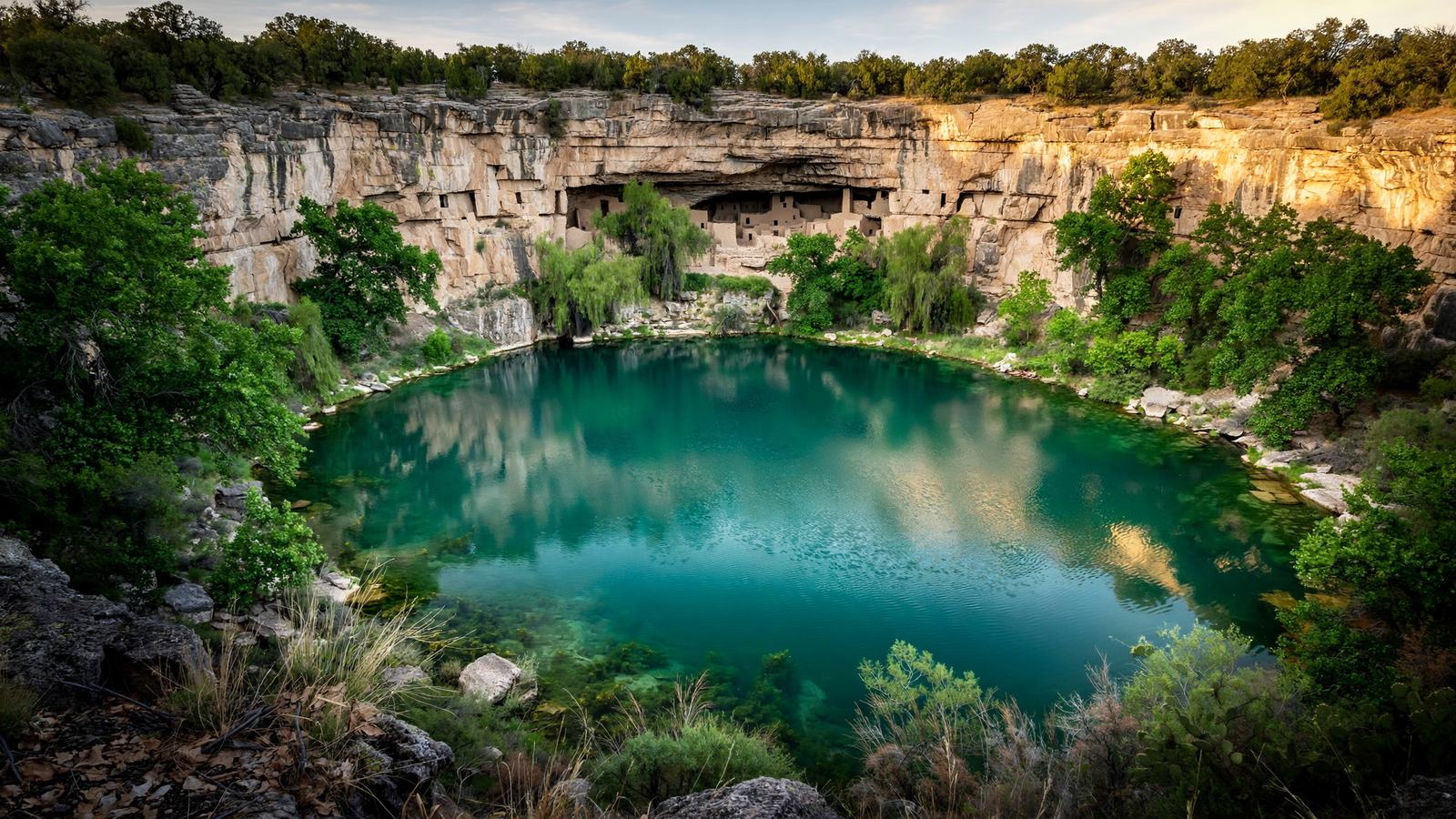
In the high desert north of Camp Verde, the landscape opens around an unlikely sight: a broad, dark pool set inside a limestone bowl. It looks like a small lake from the rim, but Montezuma Well is not a lake in the usual sense. It is a spring-fed limestone sink, a natural reservoir that has supplied water to people, plants and wildlife for thousands of years.
The well is part of Montezuma Castle National Monument, but it has its own character. There is no cliff dwelling rising above the Verde Valley here. Instead, the story is written in water: where it emerges, how it moves, and how earlier communities shaped the surrounding land to make use of a dependable desert source.
A “well” made by geology
Montezuma Well formed when underground water dissolved parts of the limestone beneath the surface. Over time, the roof of the underground chamber collapsed, leaving a roughly oval basin about 368 feet across and approximately 55 feet deep.
Its water comes from an underground aquifer rather than from rainfall collected in the basin. That distinction helps explain why the pool remains remarkably steady in a region where surface water can fluctuate dramatically. The spring releases roughly 1.5 million gallons of water each day, according to the National Park Service.
The water is also unusually warm, staying close to 74 degrees Fahrenheit. It is not safe for swimming or drinking: naturally occurring arsenic makes the water hazardous to people. Yet the same chemistry and isolation have helped create a small ecological world found nowhere else.
Several organisms in and around Montezuma Well are endemic, meaning they occur naturally only in this immediate environment. Visitors may not notice them from the rim, but they are part of what makes the site scientifically important. The well is not simply a scenic pool; it is a long-running natural experiment in adaptation.
The name tells the wrong story
Montezuma Well was named by Euro-American settlers who associated impressive ruins in the Southwest with the Aztec ruler Moctezuma. The name is misleading. There is no evidence that Moctezuma or the Aztec Empire had a connection to this place.
The people who built homes and irrigation works near the well belonged to Indigenous communities who lived across central Arizona long before the arrival of Europeans. Archaeologists have often used the term “Sinagua” for the region’s ancestral culture, although the people themselves did not use that later archaeological label. Their descendants include present-day Native communities, including the Hopi and Yavapai peoples.
That longer view matters. Montezuma Well is sometimes presented as a mysterious ruin in an empty desert, but it was not an isolated curiosity. It was part of a lived landscape, one in which people understood seasonal movement, soil, water and the possibilities of a particular place.
Turning a spring into a water system
The most revealing feature at Montezuma Well may be the irrigation network that leaves the basin. Ancient builders created channels that carried water away from the spring and onto nearby fields. Some channels remain visible today, while later settlers modified portions of the system for their own use.
Because the spring flows continuously, it offered something precious in the Verde Valley: a source that did not depend entirely on a storm arriving at the right time. The water could be directed toward crops, allowing people to cultivate land in an otherwise dry environment.
That achievement did not require transforming the entire landscape. The canals followed the contours of the ground, connecting the natural spring to human-scale agriculture. Their presence is a reminder that infrastructure does not always look like a dam, a reservoir or a modern pipe. Sometimes it is a shallow channel carefully fitted to the land.
Visitors can still see how close the relationship between geology and daily life was here. The spring created the possibility; people built a system around it. The result was neither a purely natural landscape nor a fully engineered one, but a place shaped by both.
A quiet refuge for unusual life
Montezuma Well’s water is inhospitable to people, but it supports a specialized community of plants and animals. Some species evolved in the isolated spring environment, adapting to water chemistry that would be dangerous elsewhere.
The well’s outflow also creates a narrow ribbon of greener habitat through the surrounding dry country. That contrast is one of the defining visual experiences of the site. From the rim, visitors can see the dark water, the pale limestone and the vegetation gathered around the spring’s outlet.
Such places are especially valuable to scientists because they preserve evidence of how life responds to unusual conditions. A small spring can hold a large scientific story. Changes in water level, chemistry or surrounding land use may affect organisms that have nowhere else to go.
The National Park Service manages Montezuma Well as part of a protected national monument, helping preserve both its archaeological remains and its fragile biological community. Protection here is not only about keeping a scenic overlook intact. It is also about maintaining the conditions that allow a rare ecosystem to continue.
What a visit reveals
Montezuma Well is well suited to a slower kind of visit. Short trails and overlooks bring visitors to the rim and toward the spring’s outlet, where signs explain the geology, archaeology and wildlife. The scale is manageable, but the layers of the place reward attention.
Start by looking at the water itself. Its surface can appear almost still, even though millions of gallons are moving through the system each day. Then follow the land outward. The ancient canals, nearby ruins and green corridor make more sense when seen as parts of one water story.
The site is also a useful stop for travelers exploring the Verde Valley. It lies near Camp Verde and can be visited alongside Montezuma Castle National Monument, although the two units offer different experiences. Montezuma Castle emphasizes cliff architecture and the remains of a large ancestral settlement. Montezuma Well emphasizes water, engineering and the way a single spring influenced a wider community.
Before traveling, visitors should check the National Park Service’s current hours, fees, accessibility information and trail conditions. Desert heat can be intense, and the monument’s rules are designed to protect both visitors and the site. Swimming, wading and collecting natural or archaeological materials are not appropriate here.
A place that makes water visible
Many desert landscapes teach their lessons through absence: dry washes, distant mountains and plants built to conserve every drop. Montezuma Well teaches through presence. Water is right there, held in a stone chamber and moving steadily into the valley.
That visibility gives the site its lasting power. The spring shows how geology can create an opportunity, how communities can build around it, and how life can specialize in conditions that seem hostile at first glance. It also changes the way visitors read the Verde Valley. What might look like an empty stretch of dry country becomes a connected system of springs, fields, trails and settlements.
Montezuma Well is therefore more than an unusual natural feature and more than an archaeological site. It is a compact record of cooperation between land and people: limestone opened a basin, groundwater filled it, Indigenous engineers guided the flow, and a living community adapted to the water’s strange chemistry. In Yavapai County, that quiet sequence remains visible from a short walk along the rim.