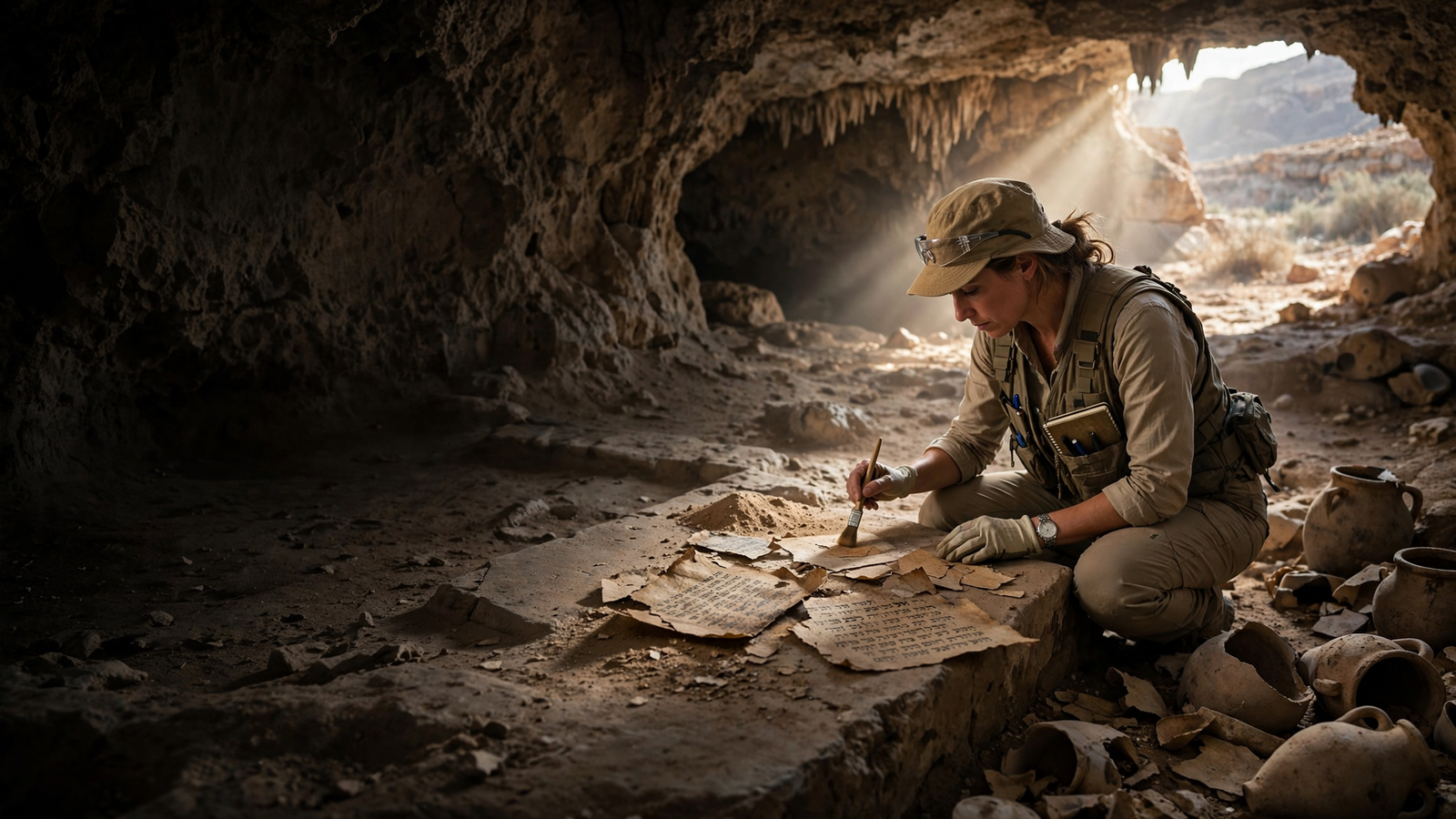
In 1947, a group of Bedouin shepherds searching for a missing goat entered a small cave above the northwest shore of the Dead Sea. Inside, they found clay jars containing ancient leather scrolls.
The discovery did not look like the beginning of a scholarly revolution. Some of the first scrolls were carried to Bethlehem and sold through the antiquities market. Their importance became clearer only after scholars examined the writing and recognized that the manuscripts were extraordinarily old.
Over the next decade, archaeologists and local searchers explored more caves in the cliffs near Qumran. They recovered thousands of fragments representing hundreds of manuscripts, written mostly in Hebrew and Aramaic, with some Greek texts as well. Together, the finds became known as the Dead Sea Scrolls—one of the most important archaeological discoveries of the 20th century.
A discovery made by accident
The first cave, later called Cave 1 at Qumran, contained seven relatively well-preserved scrolls. Among them were a nearly complete copy of the Book of Isaiah, a rule text describing the organization and practices of a religious community, and a commentary on the biblical Book of Habakkuk.
The scrolls changed hands several times before scholars understood their age. Four eventually came into the possession of the Hebrew University of Jerusalem, while three were acquired by the Syrian Orthodox Metropolitan of Jerusalem and later purchased by Israel. Today, several of the best-preserved manuscripts are displayed at the Shrine of the Book in Jerusalem.
The initial find also triggered a wider search. Between 1947 and 1956, scrolls and fragments were identified in 11 caves in the Qumran area. Some manuscripts were nearly intact; others had been reduced to tiny pieces that required years of sorting, conservation, photography, and translation.
What the scrolls contain
The Dead Sea Scrolls are not one single book or even one uniform collection. They include biblical manuscripts, prayers, legal interpretations, calendars, wisdom literature, poetry, community rules, and works that were previously unknown to modern scholars.
Copies of books that became part of the Hebrew Bible form a central part of the collection. The Great Isaiah Scroll, for example, preserves the complete text of Isaiah and dates to roughly the second century BCE. Other fragments represent biblical books including Genesis, Deuteronomy, Psalms, and the Minor Prophets.
These manuscripts are centuries older than the earliest previously known complete copies of the Hebrew Bible. Comparing them with later versions allowed scholars to study how texts were copied, transmitted, translated, and interpreted over long periods of time.
The comparison did not produce a simple story of either perfect preservation or wholesale change. In many passages, the wording is remarkably close to later traditional versions. Elsewhere, the scrolls preserve different readings, spelling conventions, arrangements, or additions. The evidence shows that ancient Jewish textual culture was both careful and diverse.
A community beside the desert
The caves lie close to the remains of an ancient settlement at Qumran. Archaeologists have connected many of the scrolls with the people who lived there, often identified with the Jewish sect known from ancient writers as the Essenes. The community appears to have followed strict rules, shared certain resources, and maintained distinctive ideas about purity, worship, time, and the end of history.
But the connection between the settlement and every scroll found nearby remains a subject of scholarly debate. Some manuscripts may have been produced by the Qumran community. Others could have been brought from elsewhere, perhaps during periods of conflict when people sought to protect valuable religious texts.
That uncertainty is part of the discovery’s importance. The scrolls did not reveal a single, uncomplicated voice from ancient Judaism. Instead, they opened access to a wider landscape of Jewish thought during the centuries surrounding the beginning of the Common Era.
Why the discovery mattered beyond archaeology
The scrolls transformed several fields at once. For biblical scholars, they supplied early witnesses to the development of scripture. For historians of religion, they provided evidence of debates over law, ritual, messianic expectation, community discipline, and the interpretation of sacred writings.
They also offered context for understanding the world in which Christianity emerged. The scrolls do not contain Christian documents, and they do not prove that Jesus or the first Christians belonged to the Qumran community. Their value is broader: they show that many ideas later associated with the religious history of the period—such as apocalyptic expectation, ritual purity, scriptural interpretation, and hopes for redemption—were already part of a varied Jewish environment.
The manuscripts also changed the practical science of historical preservation. Conservators had to stabilize fragile leather and parchment, assemble fragments without damaging them, and develop methods for reading faded writing. Modern imaging has revealed letters that are difficult or impossible to see with the naked eye, allowing researchers to revisit pieces that once seemed unreadable.
From hidden caves to public knowledge
For decades, access to the scrolls was limited by a slow and sometimes controversial publication process. As photography and digital technology improved, institutions began making high-resolution images available online. The Leon Levy Dead Sea Scrolls Digital Library now allows researchers and the public to examine many manuscripts without handling the originals.
That shift reflects one of the discovery’s lasting lessons. Ancient knowledge can survive in unexpected places, but finding it is only the beginning. The meaning of a discovery depends on careful conservation, open scholarship, patient comparison, and a willingness to revise old assumptions.
The shepherds who entered that first cave could not have known that the jars held a record of intellectual and religious life from more than two thousand years earlier. Their find turned a remote stretch of desert into one of the world’s most closely studied archaeological landscapes—and brought the ancient history of texts into view with an intimacy scholars had never before possessed.