Nearly a thousand years after it was made, the Domesday Book still reads like an argument about power.
Its pages name landholders, describe property, count livestock, record mills and fisheries, and estimate the value of estates across much of medieval England. It was not written to entertain, and it was never intended as a personal diary or a work of literature. Yet as a book, it changed how a kingdom could see itself.
The survey was commissioned by William the Conqueror after the Norman victory at Hastings in 1066. By the time the work was completed, scribes had created an extraordinary administrative portrait of England: a record of who held land, what that land contained, and what it had been worth before and after the conquest.
The Domesday Book is often described as a medieval census. That comparison is useful, but incomplete. It did not count every person in England, and it was not designed primarily to measure population. Its central concern was property, ownership and revenue. The survey helped the king understand the resources of his realm—and helped make his authority visible in writing.
A kingdom that needed to be counted
William’s conquest created a political problem as well as a military victory. The new king had defeated Harold Godwinson and established Norman rule, but England was not an empty territory waiting for new administration. It was a wealthy, densely settled land with its own aristocracy, institutions and local arrangements.
Much of the English elite was displaced after the conquest. Land passed into the hands of Norman nobles and others who supported William. This transfer of property made accurate information especially valuable. The crown needed to know which estates existed, who controlled them, what they produced and what obligations were attached to them.
The pressure became more urgent after years of resistance and warfare. Rebellions in the north, conflict with neighboring powers and the cost of maintaining royal authority all required money and organization. In 1085, according to the Anglo-Saxon Chronicle, William held a major council at Gloucester and ordered a survey of his kingdom.
The surveyors traveled through counties, gathering testimony from local landholders and officials. Their questions focused on estates and resources. Who held the manor before the conquest? Who held it now? How much land was cultivated? How many plough teams were available? How many villagers, smallholders and enslaved people lived there? What livestock, woodland, meadow, pasture, mills or fisheries belonged to the estate?
The answers were not simply private statements. In many places, local juries were asked to confirm the information. That process gave the survey a legal and political force. The book was not merely describing the kingdom; it was creating a durable record against which claims could be tested.
Why the name “Domesday” mattered
The survey was originally known as the Great Survey. The name “Domesday” appeared later, probably because people compared the book’s final authority to the biblical Day of Judgment. On that day, according to Christian belief, every deed would be known and no appeal would be possible.
The nickname captured the anxiety surrounding the record. If an estate appeared in Domesday, its ownership and obligations had been placed into a powerful royal framework. The book could be consulted in disputes, and its entries could help establish what the crown believed to be true.
That does not mean every line was perfectly accurate or that the survey was accepted without resistance. Medieval administration depended on testimony, memory and local negotiation. Some information may have been shaped by the interests of those giving it. Some areas were described in different levels of detail. The book is therefore both a record of land and a record of how power gathered information.
Two volumes, different landscapes
The finished survey survives mainly in two volumes. Great Domesday covers most of the English counties included in the project. Little Domesday covers Norfolk, Suffolk and Essex, but it preserves more detail for those areas.
The difference appears to reflect the survey’s working process. The information for the eastern counties was collected and recorded in greater depth, while the material for much of the rest of England was later condensed into a more compact form. The result is not a single uniform database but a layered manuscript shaped by the speed and methods of medieval government.
Despite its name, Domesday does not cover every part of the kingdom in the same way. Some northern areas are absent or represented differently, and the survey’s main focus was England. The manuscript also reflects the administrative boundaries and categories of the eleventh century, which do not map neatly onto modern counties.
Its language is another reminder of the world in which it was made. The main text was written in Latin, the language of formal administration and the Church. But the manuscript preserves many Old English place-names and personal names, along with terms that reveal how local society was organized.
What the entries reveal
A Domesday entry can be brief, but it often opens onto a whole landscape. A manor may be described through its arable land, woodland, meadow, pasture and water-powered mill. The record may distinguish between different classes of rural inhabitants, including villagers, smallholders and enslaved people.
These categories are not neutral snapshots of medieval life. They reflect a society in which status and landholding determined economic obligations. The survey’s terminology can be difficult to interpret, and historians continue to debate the exact meaning of some terms. Even so, the entries provide evidence unavailable from almost any other source on the same scale.
Domesday can show how conquest altered ownership. It can reveal the concentration of estates in the hands of powerful tenants-in-chief. It can help historians trace the locations of mills, churches, markets and settlements. It also preserves place-names that connect modern communities to their medieval predecessors.
But the book has limits. It was not intended to describe domestic life, personal beliefs or individual experience in detail. Most people appear only as categories within an estate. The poorest and most vulnerable residents are present in the record, but usually through the language of ownership and labor rather than their own voices.
That silence is part of the book’s meaning. Domesday tells us what a conquering state wanted to know. It is rich in evidence about land, obligations and authority, while offering only indirect glimpses of the people who worked the fields and maintained the settlements.
The technology of making a record
Domesday’s achievement was not only the information it gathered. It was also the system required to turn local testimony into a portable royal record.
Survey teams had to travel across difficult terrain, question communities, organize answers and send the results into a central process of compilation. Scribes then copied and condensed the material onto prepared parchment. The manuscript’s layout, abbreviations and formulas helped make thousands of separate observations manageable.
This was information technology in a medieval form. The book connected villages to counties, counties to royal administration and local property claims to a central authority. It allowed the kingdom to be imagined not only as a collection of places but as a network of measurable resources.
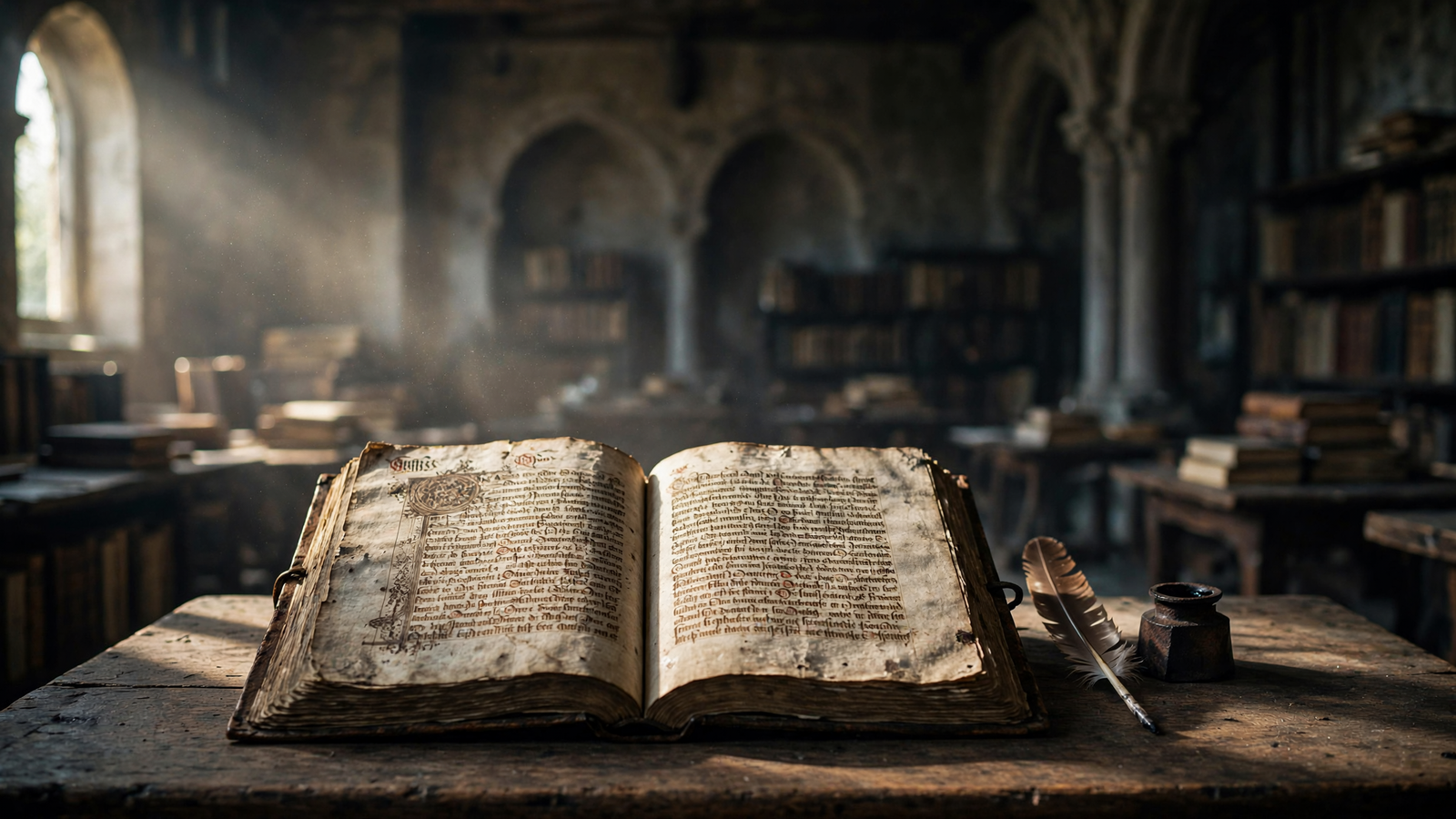
That transformation is easy to overlook because the finished volumes look quiet. Their pages contain dense lines of text rather than dramatic illustrations. Yet behind those lines was a huge logistical undertaking: travel, questioning, translation, calculation, judgment and copying.
A book that outlived its purpose
William’s government needed Domesday for practical reasons, especially taxation and the administration of land. But the manuscript outlasted the immediate political moment. Later generations treated it as evidence in disputes over property and rights. Historians came to use it as one of the central sources for understanding eleventh-century England.
Its survival also changed the history of ordinary places. Many towns and villages can locate themselves in its pages. A modern community may find an early written reference to its name, an indication of its medieval economy or evidence that its settlement existed long before the modern map was drawn.
The book has therefore become both a national archive and a local resource. Its scale gives historians a view of the kingdom, while its individual entries can anchor the history of a single parish or landscape.
Today, the Domesday Book is held by The National Archives at Kew, where the manuscripts remain part of Britain’s documentary heritage. Digital projects and scholarly editions have also made its contents easier to search and study. The physical volumes are medieval objects, but the questions they generate remain current: Who owns land? What does a government choose to measure? Whose testimony becomes official history?
The Domesday Book was created to make a conquered kingdom legible to its ruler. Instead, it became something larger—a record through which later generations could encounter the structure of medieval England. Its pages show that nonfiction does not have to be written as a narrative to reshape our understanding of the past. Sometimes a list, assembled with enough ambition and authority, can become a story in its own right.