Some artists announce themselves with disruption. Harrison Begay did something quieter. Across more than half a century, he painted people walking, working, dancing, praying, and pausing beneath the broad skies of the Navajo Nation. His pictures were often calm in mood, carefully composed, and unmistakably rooted in Diné life. For related reading, see The Book of Hours: How Medieval People Carried a Daily Life Guide in Their Hands.
That calm should not be mistaken for simplicity. Begay’s achievement was to make a world that outsiders had often treated as scenery or stereotype feel present, observed, and fully alive. Through paintings and prints, he carried Navajo experience into museums and private collections across the United States while maintaining a visual language connected to his own community.
Begay was born in 1917 near White Cone, in what is now northeastern Arizona. He grew up in a Navajo community where traditions, landscapes, animals, and ceremonial knowledge were part of everyday life. Later, he would draw on those experiences not as distant memories but as a continuing source of subject matter.
A young artist finds a direction
Begay attended the Santa Fe Indian School in New Mexico during the 1930s. The school’s art program, led by teacher Dorothy Dunn, encouraged Native students to develop a style based on Indigenous subjects and design principles rather than simply imitate European American painting.
That setting mattered. At a time when museums and commercial art markets often expected Native artists to produce romanticized images of an imagined past, Dunn’s students were encouraged to look inward and draw from their own cultures. The approach became associated with the Santa Fe Indian School’s Studio Style, a movement that helped establish a modern Native American art presence in the Southwest.
Begay became one of the best-known artists associated with that circle. His work generally used simplified forms, strong outlines, patterned surfaces, and carefully balanced groups of figures. The result could appear spare at first glance. But the restraint gave his subjects dignity. A dancer was not merely an exotic figure. A family gathering was not an illustration of “Indian life.” Each scene suggested a living society with its own rhythms and meanings.
Painting a living culture
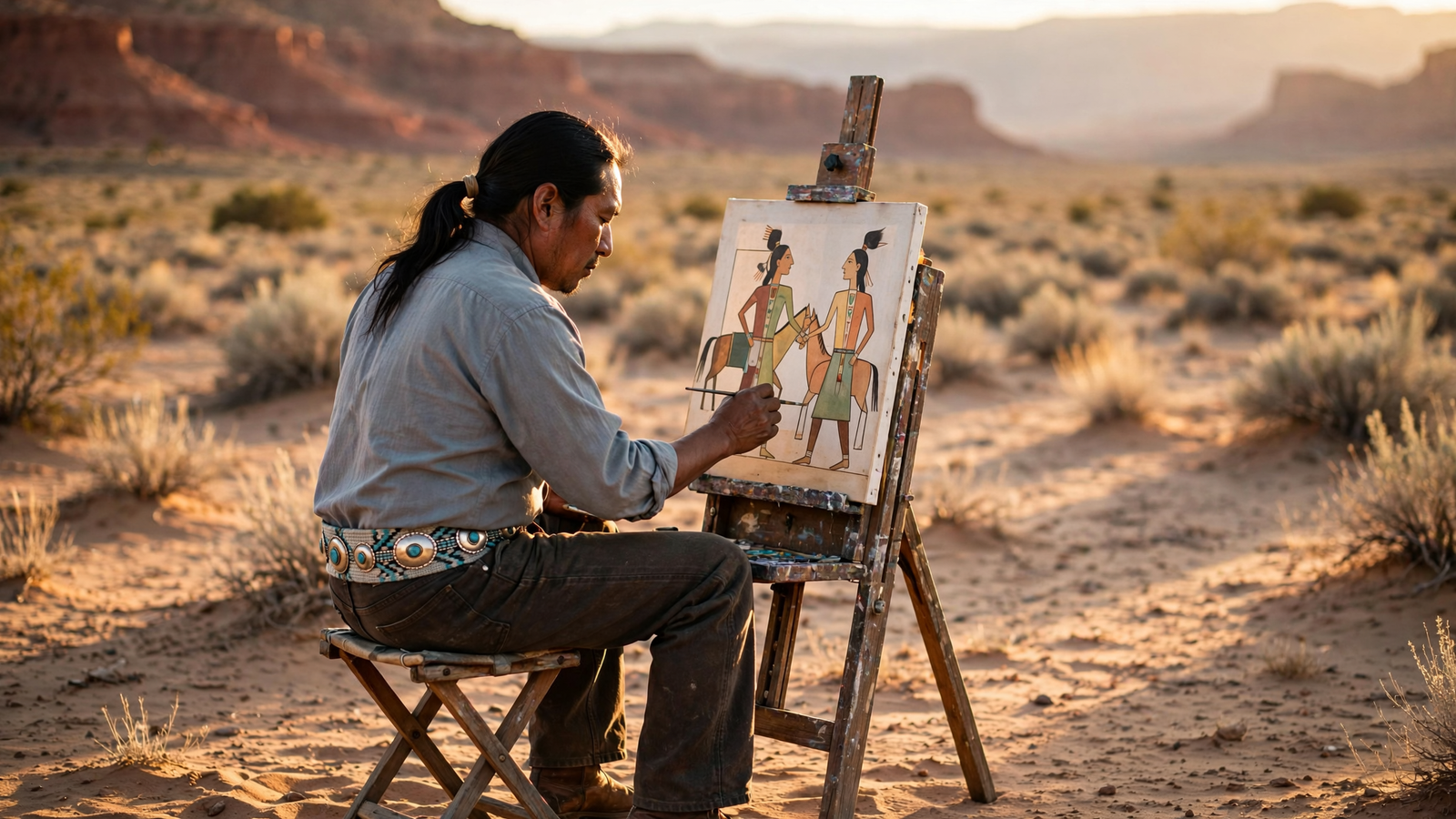
Many of Begay’s works depict Navajo ceremonies, dancers, hunters, families, animals, and desert landscapes. He also produced images of everyday activities, including riding, gathering, and community life. His work is recognizable not because every painting looks identical, but because he repeatedly returned to the relationship between people, place, and tradition.
The landscapes in his art are rarely empty backdrops. Open ground, mesas, plants, and sky help establish the emotional setting of the scene. A figure’s posture, the direction of a horse, or the spacing between dancers can make a painting feel still and meditative even when it represents movement.
That quality helped distinguish Begay from commercial images that reduced the American West to spectacle. His art could be beautiful without turning Navajo life into entertainment. It could present ceremony without explaining everything away for an outside audience.
There was also an important act of selection in what he chose to show. Begay was known for treating sacred and ceremonial subjects with care. The fact that a painting involved Navajo tradition did not mean every detail was available for public display. His art offered viewers an encounter with Diné culture, but it did not pretend that the culture existed for unrestricted consumption.
From local scenes to national collections
Begay’s work began circulating widely during the middle decades of the twentieth century. His paintings and prints entered museum collections, including institutions devoted to American art and Native American art. The Heard Museum in Phoenix has long been an important center for the study and presentation of Native art in the Southwest, and Begay’s work is part of that broader Arizona cultural landscape.
His presence in national collections also changed what many museum visitors encountered when they looked at American art. For generations, Native people had often appeared in American painting through the eyes of non-Native artists, frequently as symbols of a vanishing past. Begay’s work offered a different position: Native life represented by a Native artist who was not documenting a disappeared world, but describing a continuing one.
That distinction is central to his legacy. Begay’s paintings belong to the history of modern American art, but they cannot be separated from the history of Navajo self-representation. They show that Native art is not a single category frozen in an earlier century. It includes artists working within modern institutions while remaining accountable to their own communities and cultural knowledge.
The power of a restrained style
Begay did not need visual noise to make his point. His compositions often rely on a limited number of figures and a clear arrangement of shapes. The economy of the images invites attention to small things: the tilt of a head, the pattern of a blanket, the turn of a horse, or the distance between two people.
That restraint also made his work accessible to viewers who might not know the stories behind every subject. A painting could be appreciated for its design and atmosphere while still pointing toward meanings that required more knowledge. The art did not surrender its cultural identity in order to become understandable.
Printmaking extended that reach. Prints could circulate beyond the buyers of one-of-a-kind paintings, allowing Begay’s images to travel into more homes, classrooms, and public collections. In that way, his work helped build an audience for Native art at a time when the American art establishment still treated it as peripheral.
An Arizona legacy larger than a single career
Begay died in 2012, but his influence remains visible in the way museums and audiences understand Native artists of the Southwest. He is remembered not only for the number of works he made, but for the consistency of his purpose: to create art grounded in Navajo life and shaped by an Indigenous point of view.
His career also offers a useful correction to the way artistic breakthroughs are usually told. Change does not always arrive through a scandal, a manifesto, or a dramatic break with the past. Sometimes it comes through sustained attention. An artist returns to his people, his landscape, and his memories over many years, and in doing so makes them part of the country’s permanent visual record.
For Arizona, Begay’s story is especially meaningful. The state is often marketed through desert scenery, monumental landscapes, and generalized images of the Southwest. Begay’s work asks viewers to look more carefully. The region is not only a place to be photographed. It is a homeland filled with communities, obligations, ceremonies, and contemporary lives.
That is why his paintings continue to matter. They do not merely preserve a picture of Navajo culture. They insist that Navajo life belongs in the present tense—and that American art is richer when Native artists are allowed to define what the American landscape means.
Use: Used to verify Begay’s significance within the Southwest Native art landscape and the Heard Museum’s collection and exhibition context.
Use: Used to cross-check Begay’s presence in national American art collections and the cataloging of his work.
Use: Used for additional institutional context on Harrison Begay and Native American art collections.
Use: Provided background for the school and the Native student art tradition associated with the program. URL supplied as the institution’s main reference site.
Heard Museum — Search and Collections Resources — https://heard.org/?s=Harrison+Begay — Used to verify Begay’s significance within the Southwest Native art landscape and the Heard Museum’s collection and exhibition context.
Smithsonian American Art Museum — Collection Search — https://americanart.si.edu/collections/search?query=Harrison%20Begay — Used to cross-check Begay’s presence in national American art collections and the cataloging of his work.
Smithsonian National Museum of the American Indian — Collections Search — https://americanindian.si.edu/collections-search/search?edan_q=Harrison%20Begay — Used for additional institutional context on Harrison Begay and Native American art collections.
Santa Fe Indian School — History and Art Program Resources — https://www.sfis.k12.nm.us/ — Provided background for the school and the Native student art tradition associated with the program. URL supplied as the institution’s main reference site.