Public health is often described in the language of institutions: clinics, laboratories, agencies and programs. Annie Dodge Wauneka understood another part of the equation. Before people could use a health service, they had to trust it. Before a medical warning could change behavior, it had to be explained in words that made sense in everyday life. For related reading, see The Public Library: How America Turned Reading Into an Everyday Civic Habit.
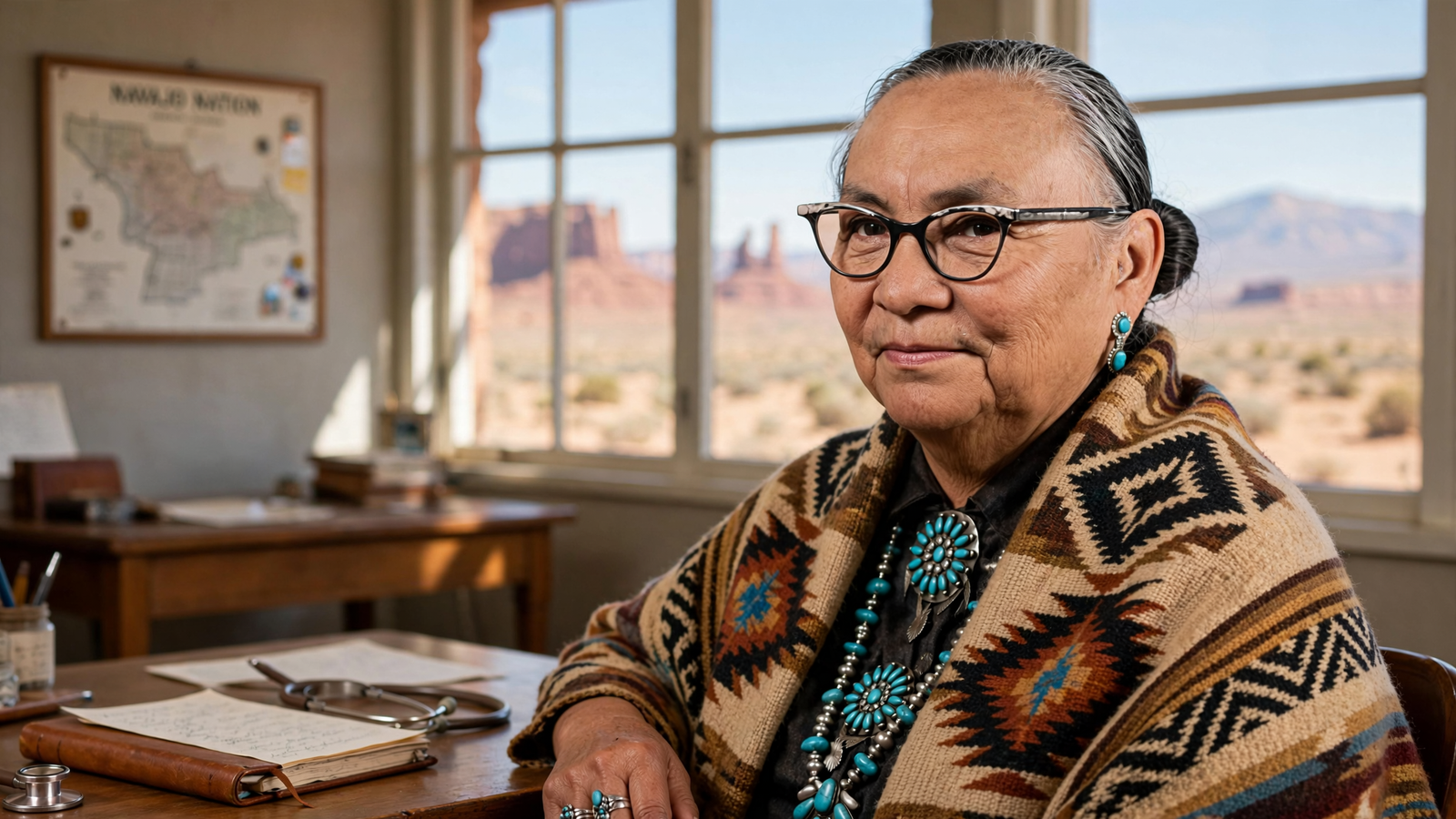
Wauneka spent much of her career building that bridge across the Navajo Nation. Born in 1910 at Sawmill, Arizona, she became a community health advocate, elected leader and translator of medical knowledge. Her work helped make subjects such as tuberculosis, sanitation and preventive care part of public conversation in Navajo communities. For related reading, see Luxembourg Made Everyday Travel Free—and Turned a Commute Into a Public Service.
In 1963, President John F. Kennedy named her a recipient of the Presidential Medal of Freedom. The honor recognized a career that had begun not in a national office or medical school, but in the communities of the Diné people, where Wauneka saw that public health had to be local before it could become effective. For related reading, see Cabo Verde’s Malaria-Free Milestone Shows What Long-Term Public Health Can Achieve.
A public-health problem that demanded more than medicine
During the middle decades of the 20th century, tuberculosis was a serious health concern across the United States. On the Navajo Nation, long distances, limited medical facilities, poverty and language barriers made prevention and treatment especially difficult. A person might live many miles from a clinic. Medical advice delivered only in English could be difficult to understand. Fear and misinformation could make an already dangerous illness harder to confront.
Wauneka approached the problem as both a health issue and a communication issue. She believed people needed clear explanations of how disease spread, why testing mattered and how treatment worked. That meant taking medical information out of the clinic and carrying it into homes, schools, chapter meetings and community gatherings.
Her approach was practical rather than abstract. She traveled widely across the reservation, spoke with families and worked to explain health information in the Navajo language. She also encouraged health workers to respect local knowledge and customs rather than treating communities as passive recipients of outside instruction.
That emphasis on trust became one of the most important features of her work. Wauneka did not present public health as something imposed from elsewhere. She helped make it a shared responsibility, explained through familiar language and connected to the daily choices of families.
Leadership in the Navajo Nation
Wauneka brought that experience into public life. In 1951, she was elected to the Navajo Tribal Council, becoming one of the first women to hold a seat there and, according to accounts from the National Women’s Hall of Fame and Arizona historical organizations, the first Navajo woman elected to the council.
Her position gave her a way to press for improvements beyond individual health education. She advocated for better sanitation, more effective health services and stronger communication between medical institutions and Navajo communities. Her work connected the decisions made by government with the realities faced by families far from major towns.
For Wauneka, leadership did not mean leaving community work behind. She continued traveling and speaking with people directly. The distances involved were immense, but that physical presence mattered. A public-health campaign could have a formal plan in Window Rock or Washington; its success still depended on whether families understood it and believed it applied to them.
Her work also demonstrated that language is not simply a vehicle for translating words. Medical terms carry assumptions about the body, illness and responsibility. Explaining those concepts well requires judgment. Wauneka helped develop Navajo-language health terminology and educational materials so that health information could be discussed in a way that was more precise, accessible and culturally grounded.
The power of explanation
Wauneka’s achievement was not the invention of a drug or the construction of a hospital. It was the creation of an information network built through relationships.
She used public meetings, personal visits, radio and educational campaigns to spread information. Her efforts addressed tuberculosis in particular, but the method reached far beyond one disease. The same principles could support discussions about immunization, hygiene, nutrition, prenatal care and the importance of seeking treatment early.
In this way, Wauneka helped redefine what a health leader could be. She was not a physician, yet she became an influential expert in the work of making medicine understandable. She was not merely a government official, yet she helped shape public policy. She was not only a spokesperson for her community, yet she made Navajo experience visible to national institutions.
That combination made her effective. She could explain community concerns to officials and explain public-health recommendations to community members. The two tasks were related: both required listening carefully and recognizing that an effective program must fit the people it is intended to serve.
A national honor for a local kind of work
The Presidential Medal of Freedom brought national attention to Wauneka’s career. At the time, the award was among the country’s highest civilian honors. Her recognition was especially significant because Native American communities had often been discussed by federal institutions without being given an equal voice in shaping policy.
Wauneka’s medal acknowledged more than personal perseverance. It recognized the value of community-based leadership and the importance of cultural knowledge in public services. She became widely known as the first Native American woman to receive the honor.
Yet the national award did not change the basic nature of her work. Her influence remained rooted in the Navajo Nation, where the success of a health message was measured by whether it reached people in a form they could use. Her example challenged the idea that expertise must always come from outside a community.
She showed that lived experience, language ability and public service could become a form of expertise in their own right.
A legacy that still belongs to Arizona
Wauneka died in 1997, but the questions at the center of her career remain familiar. How should medical institutions communicate with people who speak different languages? How can public agencies earn trust? What happens when a service is technically available but practically out of reach?
Her answer was to begin with the community. Go where people are. Listen before instructing. Explain difficult information clearly. Respect the knowledge people already possess. Then build programs that make participation possible.
Those ideas have relevance far beyond the Navajo Nation. Public-health officials, educators and community organizations still rely on culturally responsive communication when they address infectious disease, chronic illness and preventive care. The vocabulary may change, but the underlying lesson remains: information becomes useful only when people can understand it, trust it and connect it to their own lives.
Annie Dodge Wauneka’s story is therefore more than a chapter in Arizona history. It is a reminder that lasting public improvements often begin with a person willing to cross a distance that institutions cannot cross by themselves—the distance between a medical fact and a family’s understanding of it.
From her home region in northeastern Arizona, Wauneka helped turn health education into a form of civic leadership. Her work made room for Navajo language, Navajo experience and Navajo decision-making in a field that too often treated communities as an afterthought. That is why her legacy continues to matter: she did not simply carry health information into the Navajo Nation. She helped the community make that information its own.
Use: Biographical background, Wauneka's public-health work, Navajo-language education and national recognition.
Use: Arizona biographical context, her leadership in the Navajo Nation and public-health advocacy.
Use: Archival context for Wauneka's papers, career and role in Navajo public health.
National Women's Hall of Fame — Annie Dodge Wauneka — https://www.womenofthehall.org/inductee/annie-dodge-wauneka/ — Biographical background, Wauneka's public-health work, Navajo-language education and national recognition.
Arizona Women's Hall of Fame — Annie Dodge Wauneka — https://www.azwhf.org/annie-dodge-wauneka — Arizona biographical context, her leadership in the Navajo Nation and public-health advocacy.
University of Arizona Libraries — Annie Dodge Wauneka Papers — https://speccoll.library.arizona.edu/collections/annie-dodge-wauneka-papers — Archival context for Wauneka's papers, career and role in Navajo public health.