For much of the 20th century, the Iberian lynx seemed to be disappearing from Europe one patch of habitat at a time. The small wild cat, found only on the Iberian Peninsula, lost ground as forests and scrublands were converted, roads cut through its range, and its main prey—the European rabbit—declined sharply. For related reading, see The Iberian Lynx Is Coming Back From the Brink.
By the early 2000s, the situation was so serious that the Iberian lynx was considered the world’s most endangered cat species. Its remaining populations were concentrated in a few areas of southern Spain, with only a small number of animals surviving in Portugal. Conservationists were no longer asking how to manage a widespread species. They were trying to prevent a vanishing point.
Two decades later, the story is markedly different. The Iberian lynx has expanded into new territory, returned to Portugal, and built a population large enough for the International Union for Conservation of Nature to move it from Endangered to Vulnerable in 2024. The change does not mean the animal is safe. It means conservation has created room for recovery.
A cat built for the Mediterranean landscape
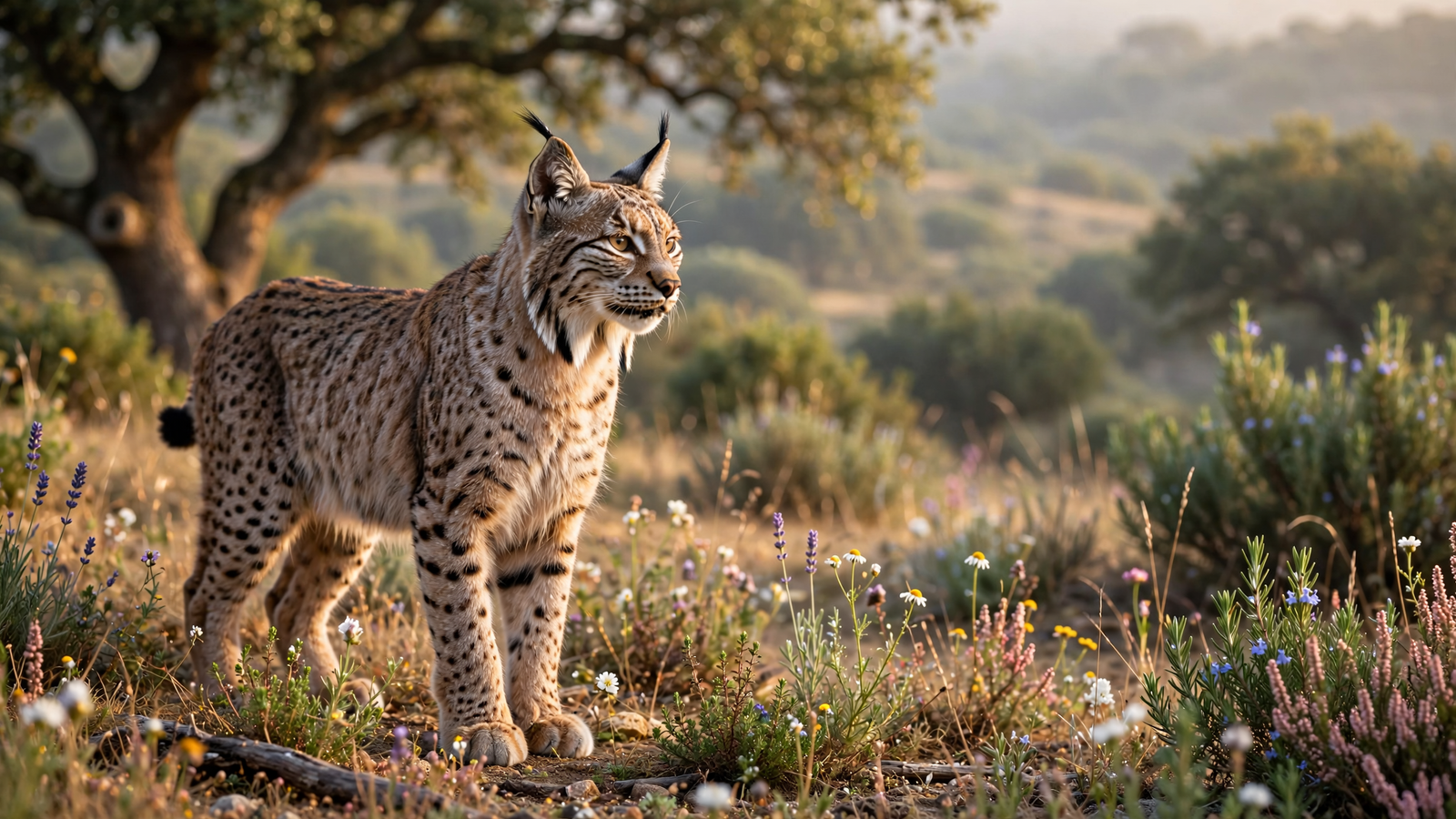
The Iberian lynx is smaller than the Eurasian lynx, but its appearance is unmistakable. It has a short tail tipped in black, long legs, a beard-like ruff around its face, and dark tufts rising from the tips of its ears. Its coat is marked with spots that help break up its outline among grasses, shrubs, and open woodland.
Unlike large predators that can rely on many kinds of prey, the Iberian lynx is closely tied to the rabbit. European rabbits can make up the great majority of its diet, especially where lynx are raising young. That dependence makes the species a useful indicator of the health of the Mediterranean landscapes where both animals live.
It also makes the lynx vulnerable to problems that may not initially look like a cat crisis. Rabbit hemorrhagic disease, habitat fragmentation, changes in land use, and severe weather can all reduce rabbit numbers. When the prey base falls, lynx reproduction falls with it.
How the decline became a conservation emergency
Historically, Iberian lynx ranged across much of Spain and Portugal. During the 20th century, however, their distribution contracted dramatically. Roads and development separated populations. Some traditional landscapes became less suitable for rabbits. Direct killing and accidental deaths also added pressure.
In 2002, researchers estimated that only about 100 adult Iberian lynx remained in the wild. The surviving animals were divided between a small number of isolated groups, making the species vulnerable to disease, inbreeding, and local disasters.
The conservation response had to address several problems at once. Protecting the cats alone would not be enough. Their prey needed help, fragmented habitat needed to be reconnected, and animals would eventually have to be moved between areas—or returned to places where the species had disappeared.
Recovery began with the rabbit
Conservation programs worked to improve habitat for both lynx and rabbits. In parts of Spain and Portugal, teams created or restored dense cover, managed open clearings, and established areas where rabbits could feed and shelter. Captive-bred rabbits were also released in selected locations to strengthen prey populations.
These measures reflected an important principle: endangered species recovery is rarely a single-species project. A lynx needs more than a protected reserve. It needs a functioning landscape, enough prey, places to raise kittens, and safe routes between territories.
Researchers also monitored the cats with camera traps, radio collars, and field surveys. Tracking individual animals helped conservationists identify breeding areas, locate dispersing juveniles, and understand where roads or other barriers were creating danger.
Breeding animals for a return to the wild
Captive breeding became another part of the strategy. Zoos, breeding centers, and government agencies in Spain and Portugal developed coordinated programs designed to preserve genetic diversity and prepare lynx for release.
The goal was not to create a permanent population in captivity. It was to produce animals capable of surviving in the wild and use them to reinforce existing groups or establish new ones. Young lynx selected for release had to learn to hunt and avoid excessive dependence on people.
Reintroductions began in areas where suitable habitat and prey could support them. Over time, lynx were released or translocated into parts of Portugal and into several Spanish regions, including landscapes where the species had disappeared. Some animals moved on their own, too, expanding the range beyond the sites chosen by conservation teams.
The return to Portugal became one of the clearest signs that the recovery was larger than a single reserve. After the species vanished from much of the country, conservation programs helped establish a breeding population in the Guadiana Valley. The cross-border nature of the work also made cooperation essential: lynx do not recognize national boundaries, and a healthy population may use landscapes on both sides of them.
A population that has grown from the brink
Recent monitoring shows the scale of the change. The 2023 population census coordinated by Spanish and Portuguese conservation authorities recorded more than 2,000 Iberian lynx in the wild, including breeding females. That is a dramatic increase from the tiny population documented at the start of the century.
The cats are also distributed across a much wider area than they were in 2002. The population is no longer confined to just two small strongholds. New groups have been established in several regions, giving the species more resilience against a single disease outbreak, wildfire, or severe decline in local prey.
In June 2024, the IUCN announced that the Iberian lynx had been reclassified from Endangered to Vulnerable. The organization described the change as a conservation success, while emphasizing that the species still faces serious threats and requires continued protection.
That distinction matters. A lower risk category is not a declaration of victory. It is an acknowledgment that the direction of travel has changed.
The dangers that remain
The Iberian lynx still depends heavily on rabbit populations, which can fluctuate because of disease, drought, habitat changes, and other pressures. Climate change may make those fluctuations more severe by increasing heat and altering vegetation across the Mediterranean region.
Road traffic is another continuing threat. As lynx expand into new areas, they encounter roads that did not exist in their former range or that now carry more traffic. Conservation authorities have responded with wildlife crossings, fencing, warning systems, and efforts to identify dangerous road sections.
Genetic management remains important as well. A population that grows from a very small base can carry limited genetic diversity. Moving animals between populations and planning releases carefully can help reduce the risks associated with isolation and inbreeding.
Finally, the recovery depends on local support. Lynx habitat often overlaps with working landscapes used for forestry, livestock, hunting, and agriculture. Long-term conservation is more durable when landowners, rural communities, researchers, and public agencies have a role in shaping it.
What the lynx recovery demonstrates
The Iberian lynx recovery is not the result of one dramatic intervention. It is the product of patient work repeated over many years: counting animals, protecting habitat, restoring prey, breeding cats, releasing them, monitoring their movements, and changing plans when the evidence demands it.
It also demonstrates why conservation gains are often difficult to see at first. For years, the most important achievements may have been invisible—a healthier rabbit population, a protected corridor, a new breeding center, or a safer road crossing. Only later do those individual actions appear in the form of more kittens and a wider range.
The lynx still needs that work. Vulnerable is not the same as secure, and a species can lose ground again if funding, habitat protection, or monitoring declines. But the recovery has changed what conservationists can reasonably imagine.
A cat once limited to a few isolated refuges is now moving through a larger, more connected Iberian landscape. Its survival is a reminder that endangered species are not defined only by how close they came to disappearing. They can also be defined by the carefully built systems that give them another chance.
Use: Conservation status change, population recovery, and remaining threats.
Use: Species biology, distribution, threats, and status context.
Use: European conservation cooperation and the role of LIFE-funded projects; the article uses the Commission’s LIFE program information as institutional context.
Use: Captive breeding, genetic management, and preparation of Iberian lynx for reintroduction.
Use: Habitat restoration, rabbit recovery, road mortality, and conservation challenges.
International Union for Conservation of Nature (IUCN) — Iberian Lynx Reclassified as Vulnerable — https://www.iucn.org/press-release/202406/iberian-lynx-reclassified-vulnerable-following-significant-conservation-success — Conservation status change, population recovery, and remaining threats.
IUCN Red List — Iberian Lynx Species Account — https://www.iucnredlist.org/species/12520/174111773 — Species biology, distribution, threats, and status context.
European Commission — LIFE Iberlince — https://environment.ec.europa.eu/topics/nature-and-biodiversity/life-programme_en — European conservation cooperation and the role of LIFE-funded projects; the article uses the Commission’s LIFE program information as institutional context.
Programa de Conservación Ex Situ del Lince Ibérico — https://www.lynxexsitu.es/ — Captive breeding, genetic management, and preparation of Iberian lynx for reintroduction.
WWF Spain — Iberian Lynx Conservation — https://www.wwf.es/nuestro_trabajo/especies_y_habitats/lince_iberico/ — Habitat restoration, rabbit recovery, road mortality, and conservation challenges.