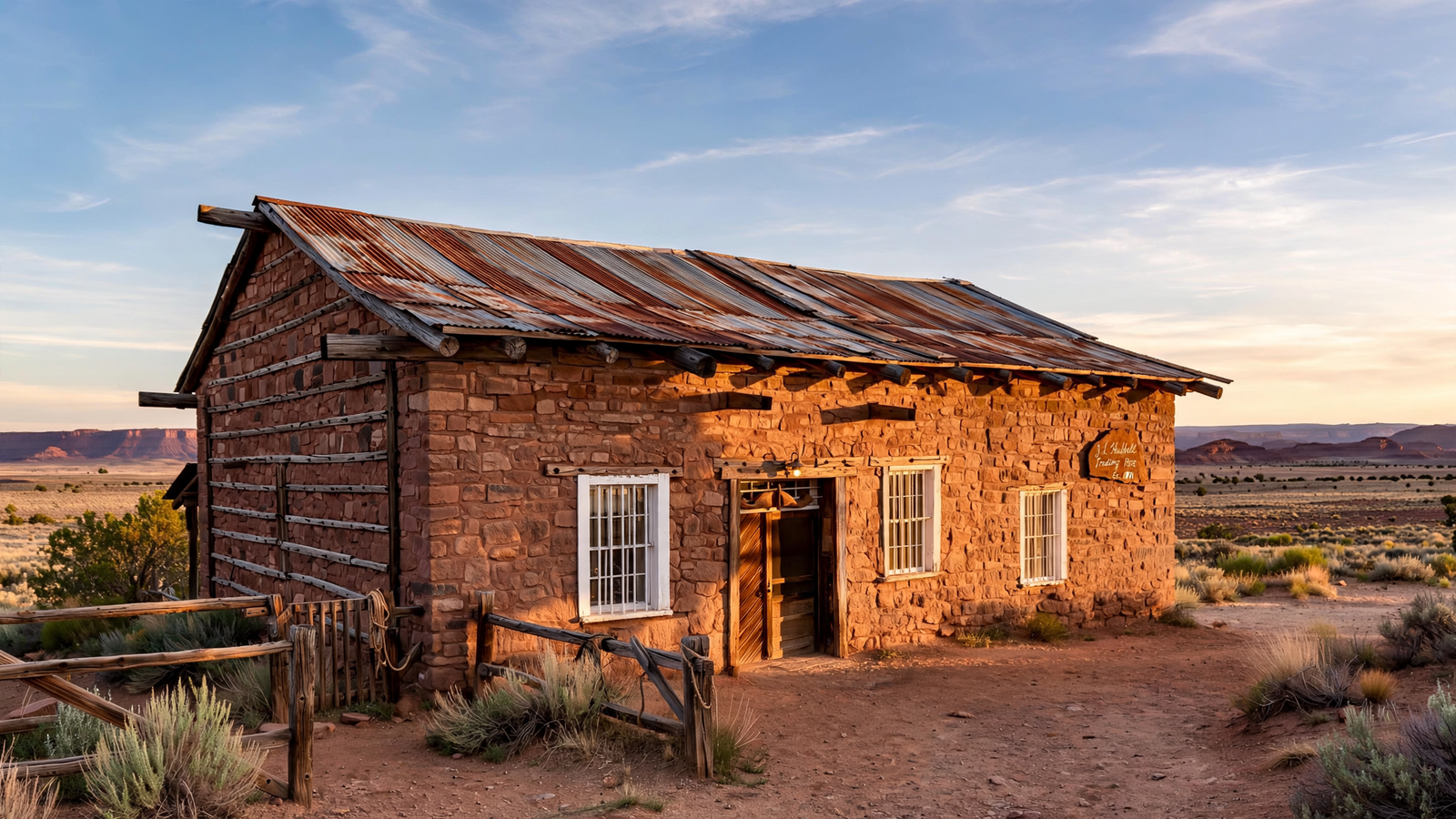
On a broad stretch of northeastern Arizona, where the high desert opens toward the Chuska Mountains, a low adobe building still carries the visual language of an older West. Its walls are thick. Its porch is shaded. Shelves hold woven rugs, jewelry, baskets, and other work made by Diné artists. Behind and around it are a family home, gardens, outbuildings, and the traces of a once-expansive ranching and trading operation. For related reading, see Hotel St. Michael: The Prescott Landmark That Has Kept a Downtown Corner Alive.
This is Hubbell Trading Post in Ganado, a place that has been part store, part community meeting point, part home, and part record of how people made lives in a region often described from the outside as remote. Established by John Lorenzo Hubbell in 1878, the trading post became one of the most important commercial centers in Navajo country. Today, as a National Historic Site, it remains unusually close to its original purpose: visitors can still encounter a place where Navajo-made work is presented and sold, rather than viewing the trading post only as an empty museum shell.
A business built around a community
Hubbell arrived in the Southwest during a period of major change. Diné communities were rebuilding after the forced removal to Bosque Redondo and the return to their homeland in the late 1860s. The reservation was expanding, livestock and farming were central to household economies, and families needed access to manufactured goods that were not readily available in isolated settlements.
Trading posts became important points of contact. They supplied flour, coffee, tools, cloth, ammunition, and other necessities. In return, traders purchased or accepted wool, livestock, hides, rugs, jewelry, and agricultural products. Credit could be extended when cash was scarce. That arrangement made a trading post more than a shop: it became a place where news traveled, relationships were negotiated, and people connected local production to distant markets.
Hubbell’s post grew within that system. He developed relationships with Diné families and bought the work of weavers and silversmiths. The business connected makers to customers beyond the reservation, including tourists and collectors who increasingly sought what they considered distinctive Southwestern art.
That history deserves more than a romantic picture of friendly exchange. Traders could hold significant economic power, especially when families depended on credit or had few nearby alternatives. Prices, debt, access to markets, and the growing outside demand for Native-made work all shaped the relationship. Hubbell Trading Post is valuable partly because it allows those tensions to remain visible: it was a place of cooperation and cultural connection, but also a commercial institution within an unequal frontier economy.
The house behind the counter
One reason the site feels different from a conventional historic store is that the trading post was inseparable from the Hubbell family’s home. The main residence stands close to the business, making it possible to understand the operation as a lived environment rather than a single commercial room.
John Lorenzo Hubbell and his family occupied the house while the post developed. The property included work areas, storage buildings, corrals, gardens, and other structures associated with ranching and daily life. The combination reflects the practical character of 19th-century trading posts. A trader needed to sell goods, store inventory, care for animals, host visitors, manage accounts, and maintain a household in a landscape where the nearest large towns were far away.
The rooms also preserve a particular kind of Southwestern ambition. The Hubbell family home contains furnishings, books, artwork, and objects collected over generations. Some are associated with the family’s life; others reflect the wider networks created by trade. The result is not a pristine reconstruction of an abstract frontier household. It is a layered home shaped by work, travel, family taste, Native artistry, and the business of meeting people from different worlds.
Why weaving matters here
Among the most important stories held at Hubbell Trading Post is the history of Navajo weaving. Diné weaving traditions predate the trading post, and weavers continually adapted designs, materials, and techniques in response to changing circumstances. Traders helped move rugs into larger markets, but the designs were created by Navajo artists whose knowledge was passed through families and communities.
At Hubbell, rugs are not simply decorative examples of a finished tradition. They are evidence of decisions: how a weaver arranged color, balanced a design, selected wool, and responded to what buyers wanted without surrendering control of the work’s identity. The famous regional styles associated with Navajo weaving developed through both continuity and change. Commercial demand could encourage certain patterns, while individual weavers continued to make choices within a living artistic practice.
The site’s collections and sales space help keep that distinction in view. A rug on a wall is a piece of art, but it also represents hours of preparation, spinning, dyeing, and weaving. The trading post’s history makes it possible to see Native art not as a mysterious product that appeared in the desert, but as skilled labor embedded in households, landscapes, and economies.
Preserving a working place
Hubbell Trading Post became a National Historic Site in 1965. The National Park Service acquired the property in 1967, helping preserve the buildings, furnishings, records, and landscape as a connected historic setting. That decision was important because the meaning of the site depends on relationships among its parts. The store alone could tell a story about commerce. The house adds family history. The surrounding grounds show how a trading operation depended on animals, gardens, storage, transportation, and labor.
Preservation at Hubbell is therefore not only a matter of repairing adobe walls or protecting old objects. It involves maintaining access to the stories represented by those objects. Account books, photographs, furniture, rugs, tools, and merchandise can show what the business sold and how it operated. Oral histories and community knowledge help explain what the records leave out.
The site also complicates the usual image of a historic property frozen at the moment its original owners left. The trading post’s continuing commercial function creates a direct link between past and present. Visitors can encounter contemporary Diné artists and craftspeople through work that is being made now, while learning about earlier generations who used the post as a market and meeting place.
A landmark with a wider view
Hubbell Trading Post sits within a larger network of Diné communities, roads, farms, grazing lands, chapter houses, schools, and cultural institutions. Its importance does not come from standing alone. It comes from showing how one place participated in a regional system that connected local life to national and international markets.
That perspective also changes how the site can be visited. The post is not merely an old business preserved for nostalgia. It is a place to ask who had access to goods, who carried the knowledge behind the products, who controlled prices and credit, and how Native makers maintained artistic authority in a market shaped partly by outsiders. Those questions do not diminish the site. They make its history more complete.
There is something quietly significant about a historic place that still makes room for exchange. The shelves and counters are part of the past, but the objects offered there are not only artifacts. They are contemporary work, connected to traditions that have adapted without disappearing. In Ganado, the trading post remains a meeting point between history and ordinary economic life.
That continuity is Hubbell Trading Post’s lasting lesson. A place can preserve the past without pretending that history ended there. It can protect buildings and collections while acknowledging unequal relationships. And it can honor the makers whose work gave the post its identity by allowing their art to remain part of the present.
Use: Site history, preservation status, visitor context, and the continuing identity of the trading post.
Use: Background on John Lorenzo Hubbell, the trading post, the Hubbell family, Diné arts, and the historic landscape.
Use: National Historic Site significance, historic resources, cultural context, and preservation framework.
National Park Service — Hubbell Trading Post National Historic Site — https://www.nps.gov/hutr/index.htm — Site history, preservation status, visitor context, and the continuing identity of the trading post.
National Park Service — Hubbell Trading Post History and Culture — https://www.nps.gov/hutr/learn/historyculture/index.htm — Background on John Lorenzo Hubbell, the trading post, the Hubbell family, Diné arts, and the historic landscape.
National Park Service — Hubbell Trading Post National Historic Site Foundation Document — https://www.nps.gov/hutr/learn/management/upload/HUTR_Foundation_Document_508.pdf — National Historic Site significance, historic resources, cultural context, and preservation framework.