Most historical documents announce themselves as important. They arrive with a famous signature, a government seal, or the name of a person whose life later became part of the national story. For related reading, see Montaigne’s Essays: How Thinking Aloud Became a Literary Form.
The 1950 Census is different. Its power begins with the ordinary.
A page may record a family in a rented apartment, a couple living above a shop, a farm household with several children, or an older person living alone. It may show a neighborhood filling with postwar families, a town losing residents to industrial work elsewhere, or a household whose members were born in different parts of the country—and sometimes in different countries altogether. For related reading, see The Tucson Loop: How a Desert Trail Became Part of Everyday Life.
Released by the National Archives in 2022 under the federal government’s 72-year confidentiality rule, the 1950 Census is now the most recent decennial census whose individual responses are available to the public. It is both a national record and a collection of millions of small domestic snapshots. For related reading, see The Caldecott Medal: How Picture Books Became a Serious Art Form.
A census that looks unusually close to home
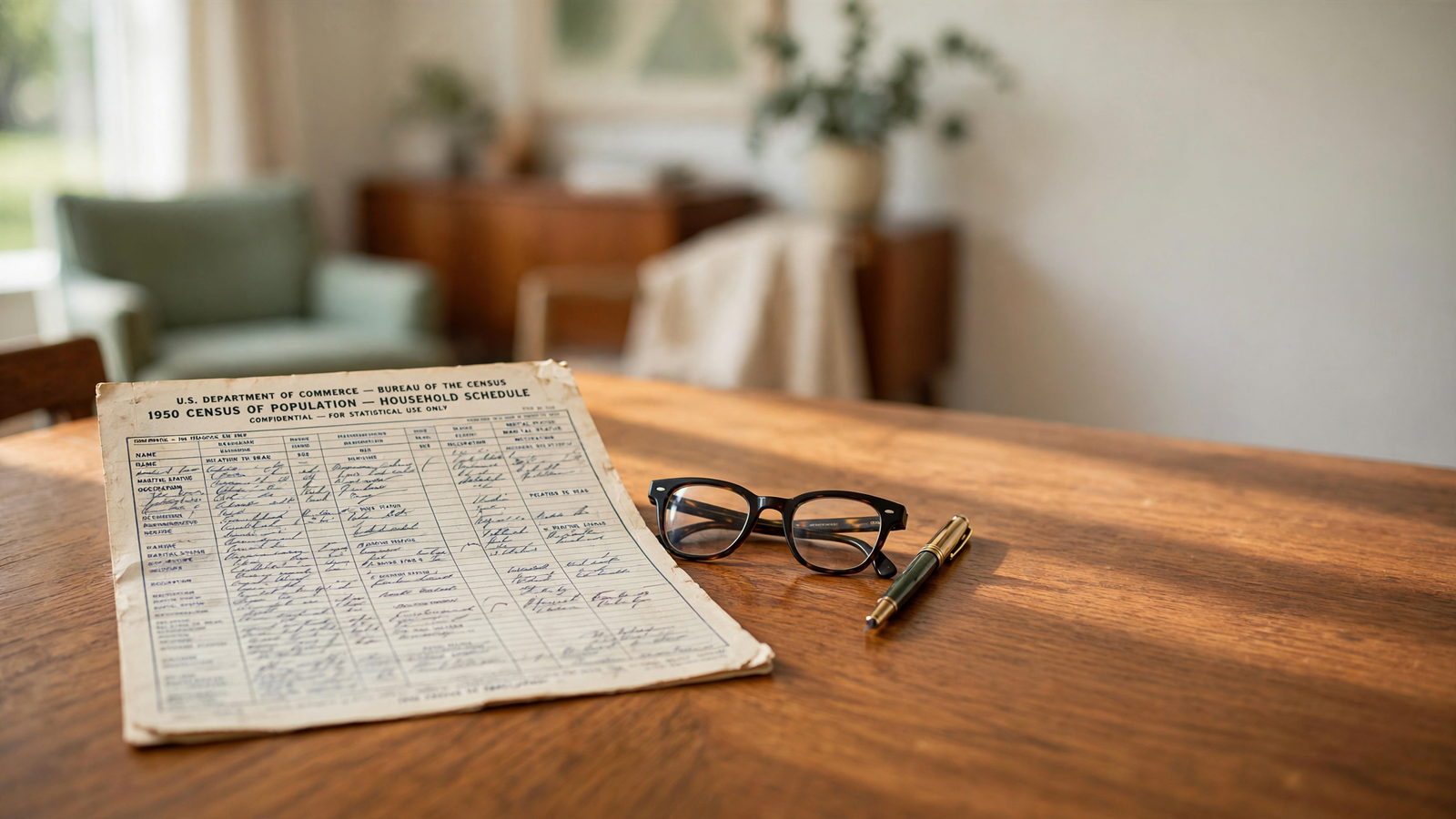
The decennial census is usually remembered through totals: population counts, maps, and tables showing how the United States changed. Those statistics remain essential. But the original 1950 schedules offer something more intimate. They preserve the questions asked about individual people and households at a moment when the country was moving from wartime mobilization into a new era of mass housing, expanded consumer life, and rapid demographic change.
Enumerators visited homes and recorded information for the people living there. The forms captured names, relationships within the household, sex, race, age, marital status, place of birth, and other personal details. They also gathered information about work, education, and income for selected questions and households.
Housing questions add another layer. The census asked about the dwelling itself, including features such as tenure, number of rooms, plumbing, and the presence of household equipment. These details turn a census page into more than a list of residents. They offer clues about what daily life required, what a family could afford, and how modern a home was by the standards of the time.
A single entry cannot tell the whole story of a household. Census answers could be approximate, names could be misspelled, and the person speaking to the enumerator may not have known every detail. Still, taken together, the pages create one of the broadest surviving portraits of American home life in the middle of the 20th century.
Why 1950 matters
The 1950 enumeration arrived at a pivotal point. The Second World War had ended only a few years earlier. Millions of service members had returned home, industries had shifted from military production, and families were entering a period associated with suburban growth, new construction, and rising household consumption.
But the national picture was not uniform. The census recorded rural communities as well as cities, boarding arrangements as well as nuclear families, and long-established residents alongside newcomers. It also documented segregation and the unequal distribution of housing and opportunity. A household record can therefore be comforting, surprising, or difficult to read. It is a record of ordinary life, but ordinary life was shaped by race, geography, gender, citizenship, employment, and access to housing.
That complexity is one reason the census is useful. It does not reduce a neighborhood to a single reputation. It lets researchers ask how people actually lived there.
From locked records to a searchable archive
Federal law protects personal information collected in the decennial census for 72 years. After that period, the National Archives receives and makes the individual records available. The 1950 Census was opened on April 1, 2022.
The National Archives created an online portal where users can search the records by name and location. The portal also provides access to digitized census images and tools for working through the enumeration districts used by census takers.
Searching is not always as simple as typing a surname into a box. Historical records contain variations in spelling, handwriting, indexing, and place names. A search may fail because a family member was listed under a nickname, a surname was transcribed incorrectly, or the household is easier to find by its address than by its residents’ names.
For that reason, location is often the most valuable starting point. Knowing a city, county, street, or enumeration district can narrow the search dramatically. If a researcher knows where a relative lived in 1950, the original page may be found even when the index is imperfect.
How to begin looking for a household
The best approach is to treat the census as a research project rather than a quick lookup.
- Start with what the family already knows. Write down full names, approximate ages, addresses, occupations, relatives, and likely places of residence in 1950.
- Try multiple name variations. Search for initials, alternate spellings, shortened first names, and nearby relatives who may have been easier to index.
- Use geography. If the name search fails, work from the state, county, city, street, or enumeration district. Maps and location tools can help identify the correct area.
- Read the entire page. Neighbors may reveal that the household is in the right place even before every name is clear. The surrounding entries can also show the character of the block or rural area.
- Compare with other records. Birth certificates, marriage records, city directories, military files, newspapers, and family papers can help confirm identities and explain apparent contradictions.
The page itself should be treated as evidence, not as an unquestionable biography. Ages may be rounded. Relationships may reflect how a household understood itself at that moment. A person who appears absent may have been away for work, in the military, in an institution, or temporarily staying elsewhere.
The household as a historical document
Family history often begins with prominent events: a marriage, an immigration, a military service record, or a property purchase. The 1950 Census helps connect those events to the physical setting of everyday life.
It can show whether several generations shared a home. It can suggest when a family moved from one region to another. It can reveal the presence of lodgers, domestic workers, boarders, or extended relatives whose names may not appear in a family scrapbook. It can also help explain why a later address, occupation, or school appears in another record.
For people researching a neighborhood rather than a family, the census works on a larger scale. A page-by-page walk through a street can show patterns that disappear in a single household: the mix of renters and owners, the concentration of particular occupations, the age of buildings’ residents, or the presence of businesses and institutions nearby.
Researchers should remember that the census reflects the categories and assumptions of its own era. Race was recorded using classifications defined by the federal government, not necessarily the language every person would have chosen for themselves. Household roles were also shaped by the expectations of the period. The record is valuable partly because it shows those official categories in use—but they should not be mistaken for a complete description of identity.
A public archive built from private answers
The 1950 Census makes a quiet argument for the value of public records. The people recorded on its pages were not famous because they appeared there. Most were simply living through work, family changes, moves, illness, schooling, and the daily maintenance of a home.
Decades later, those answers help descendants find missing connections. They help local historians reconstruct streets that have changed. They help scholars study migration, housing, work, and inequality. And they give curious readers a way to see national history at the scale of a kitchen table.
The archive is not a perfect window into 1950. It is a government document, created for a specific purpose, using the language and limits of its time. But that is precisely why it matters. Beside the famous speeches and major events, the census preserves the framework of ordinary life: who shared a roof, where they came from, what work they did, and what kind of home they inhabited.
For anyone willing to search carefully, a household form can become a beginning—a way to turn an address into a story and a distant decade into a place where real people once opened the door.
Use: Primary search portal for digitized 1950 Census records, name searches, location tools, and census images.
Use: Authoritative information about the release, scope, and use of the 1950 Census records.
Use: Historical context about the 1950 decennial census and its questions.
U.S. National Archives — 1950 Census — https://1950census.archives.gov/ — Primary search portal for digitized 1950 Census records, name searches, location tools, and census images.
U.S. National Archives — 1950 Census Records — https://www.archives.gov/research/census/1950-census — Authoritative information about the release, scope, and use of the 1950 Census records.
U.S. Census Bureau — 1950 Census — https://www.census.gov/programs-surveys/decennial-census/decade/1950.html — Historical context about the 1950 decennial census and its questions.