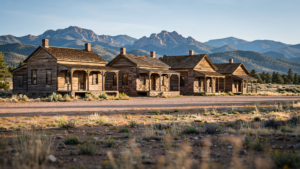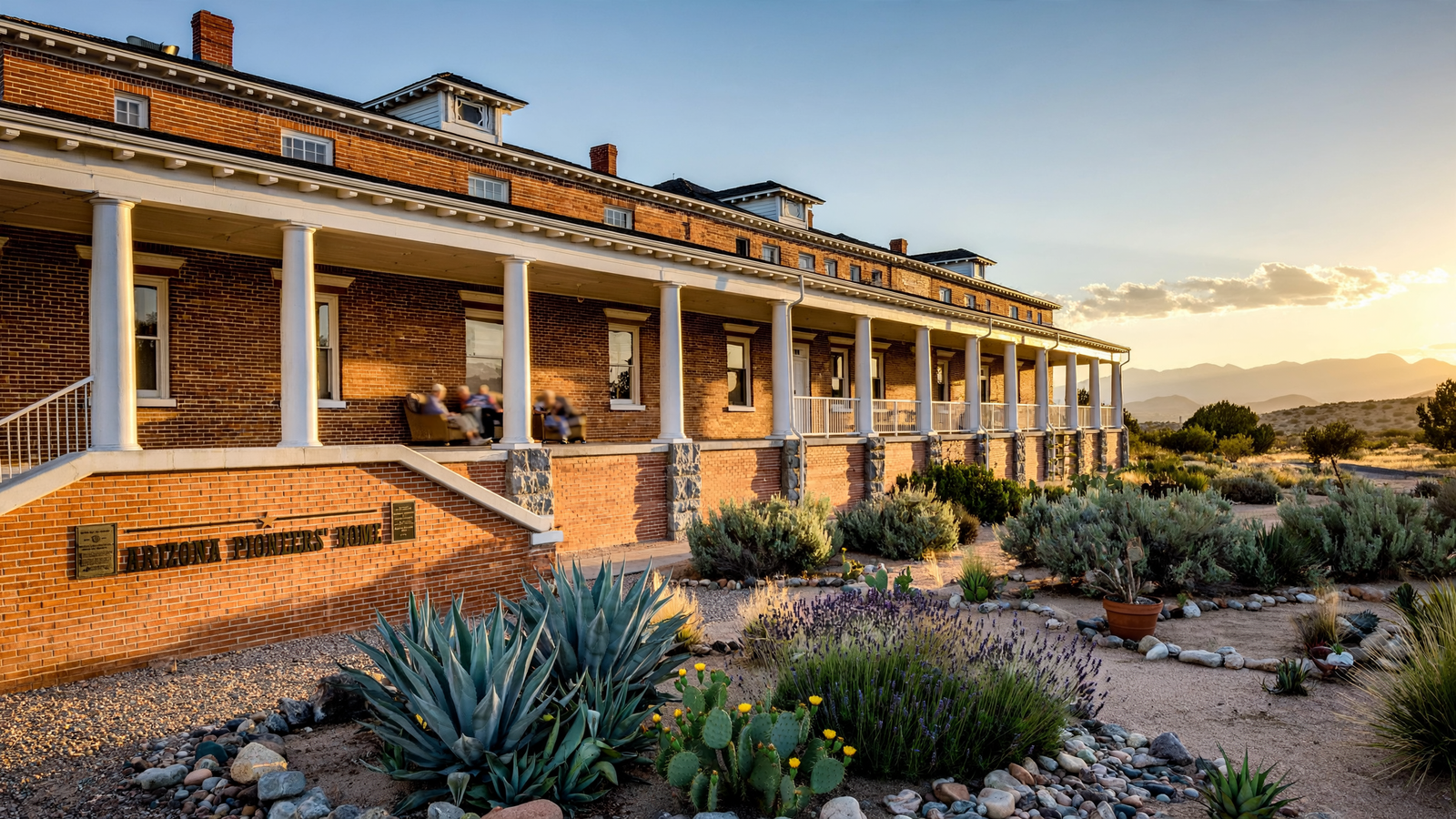
On a rise above downtown Prescott, a group of red-roofed buildings carries a remarkably practical idea about history: sometimes the best way to honor the people who came before is to give them a home.
The Arizona Pioneers’ Home was established in Prescott in 1889, while Arizona was still a territory. Its original mission was not to create a museum or a monument. It was to provide shelter and care for aging pioneers, widows, widowers, and others who had helped build Arizona but no longer had the means to live independently.
That purpose makes the campus unusual among Prescott’s historic places. The city is well known for its courthouse square, mining-era buildings, museums, and Western traditions. The Pioneers’ Home belongs to that history, but it has never been only an artifact. It has remained a living institution, adapting its services as the meaning of care, aging, and public responsibility has changed.
A territorial answer to an everyday problem
Arizona in the late 19th century was a young, sparsely settled territory with scattered mining camps, ranches, military posts, farms, and small towns. Many of the people who arrived during the territorial period were drawn by mining, transportation, commerce, or public service. Some became prosperous. Others did not.
There was no broad system of Social Security, Medicare, or publicly supported senior housing. An older person without family resources could face a difficult final chapter, particularly in a place where distance and limited transportation made informal support harder to count on.
The creation of a territorial home for pioneers reflected that reality. Arizona’s lawmakers were acknowledging that settlement was not simply a story of individual courage and self-reliance. Communities also had obligations to people who had spent their working lives helping create those communities. For related reading, see Arizona’s Pioneers’ Home: The Prescott Institution That Turned Frontier Memory Into a Civic Promise.
Prescott was a natural location. Founded during the territorial period and briefly established as Arizona’s first capital, it had a central place in the region’s early government and commercial life. Its mountain setting also made it a destination for people seeking a cooler climate than the desert lowlands.
The home opened in 1889, decades before Arizona achieved statehood in 1912. That timing gives the campus a special place in the state’s public history: it was already serving residents when Arizona’s government was still developing its basic institutions.
More than a monument
Historic buildings can make the past feel distant. The Pioneers’ Home does something different. Because it has continued to house residents, provide meals, organize activities, and deliver care, the site connects territorial history with ordinary routines.
A historic marker can tell visitors that a person lived through a particular era. A functioning residential community shows what it means to carry that era forward. The people who have lived at the home have not all had the same background, and the institution’s population has changed over time. But the central idea has remained recognizable: a community should not discard its older members once their labor is no longer visible.
That idea is easy to overlook when history is presented only through famous names and dramatic events. The Pioneers’ Home emphasizes a quieter part of the record—the work of people who ran businesses, raised families, traveled difficult roads, served in public positions, worked in mines, maintained farms, or supported the institutions of a growing territory.
In that sense, the campus is a kind of social archive. Its history is not stored only in documents or photographs. It is also held in the lives of residents and in the routines of staff members who care for them.
A Prescott landmark with a changing mission
The Pioneers’ Home has not stood still. Like other long-term-care institutions, it has had to respond to changing expectations about health, privacy, accessibility, medical needs, and resident independence. A home created in the 19th century could not simply preserve its original operating model and remain useful in the 21st century. For related reading, see The Rosson House: How a Phoenix Victorian Home Kept Territorial Arizona in View.
Its continuing value comes partly from that ability to change. The buildings and grounds connect the home to territorial Arizona, while modern care practices allow the institution to serve actual people rather than merely commemorate them.
The home’s role has also broadened beyond a narrow image of the lone pioneer. Arizona’s public history includes women who ran households and businesses, families who supported territorial communities, veterans, workers, immigrants, Native peoples, and residents whose contributions rarely appeared in official accounts. A living institution has room to reflect that complexity in a way a single monument often cannot.
That broader view matters in Prescott, where Western imagery can sometimes compress the past into a familiar set of symbols: prospectors, cowboys, sheriffs, and frontier entrepreneurs. The Pioneers’ Home adds a different question. What happened to those people after the exciting chapter was over? Who cared for them? What did a community owe them?
Why the place still matters
The campus offers a useful reminder that public history is not only about preserving old walls. It is also about preserving relationships between generations.
For visitors, the Pioneers’ Home can be understood as part of Prescott’s historic landscape even when it is not approached like a conventional attraction. Its significance lies in the way its setting, buildings, residents, employees, and institutional purpose meet in one place. The result is less like a display case and more like an ongoing civic promise. For related reading, see Prescott’s Courthouse Plaza: How a Territorial Square Became Yavapai County’s Shared Living Room.
That promise has a practical side. Long-term care is demanding work, and older adults need more than sentimental recognition. They need safe housing, medical attention, nutritious food, social connection, and respect for their choices. The history of the Pioneers’ Home is meaningful precisely because it links those needs to a public commitment.
It also gives Prescott a distinctive role in Arizona’s story. The city is not simply preserving memories of the territorial period for tourists. It is home to an institution born during that period that continues to make room for older Arizonans.
A living form of gratitude
Every historic city has places that explain how it began. Prescott has many of them. The Pioneers’ Home explains something more: how a community decided that its past should be cared for in human form.
Its story is not about freezing the frontier in place. It is about recognizing that the people who built roads, raised families, opened businesses, worked public jobs, and helped establish towns would eventually need help themselves. Arizona’s territorial lawmakers responded by creating a home. Later generations kept adapting it.
That makes the Pioneers’ Home one of Prescott’s most quietly significant places. Its historic value is real, but its deeper meaning comes from continued use. The campus does not merely ask residents and visitors to remember Arizona’s past. It demonstrates that remembrance can be expressed through care.
In a city filled with visible reminders of the Old West, the Arizona Pioneers’ Home offers a gentler and more durable lesson. A place earns its place in history not only by surviving, but by continuing to serve the people who come after it.
Use: Current institutional mission, services, and state administration.
Use: Historical context and digitized Arizona materials related to the territorial period and the Arizona Pioneers’ Home.
Use: Prescott’s broader historic context and preservation framework.