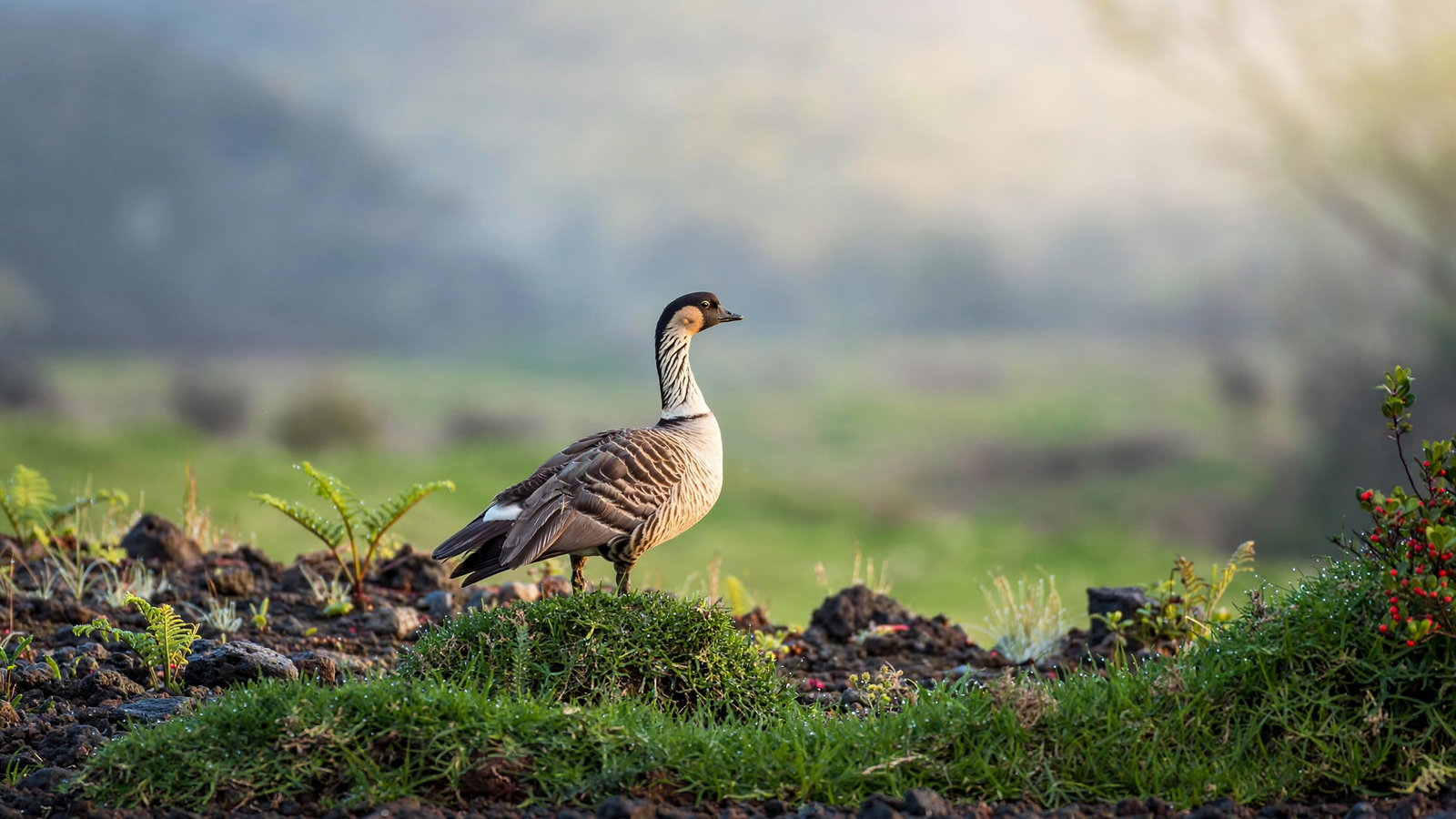
On Hawaiian slopes and grassy coastal plains, a goose with a black face, cream-colored cheeks, and a distinctive furrowed neck moves through a landscape shaped by volcanoes, ranches, roads, and introduced predators. The nēnē is not simply Hawaii’s state bird. It is a living record of how quickly an island species can be pushed toward disappearance—and how much patient conservation can accomplish.
In the middle of the 20th century, the Hawaiian goose had nearly vanished from the wild. Hunting, habitat changes, introduced mammals, and other pressures had reduced the population to about 30 birds by 1952. Today, more than 3,000 nēnē live across the Hawaiian Islands, according to federal wildlife officials. The species is no longer at the edge of extinction, although it remains protected and vulnerable.
That recovery did not come from one dramatic intervention. It grew from a long partnership among government agencies, zoos, conservation organizations, land managers, and local communities. Captive breeding provided birds for release. National parks and wildlife refuges protected habitat. Biologists monitored flocks and learned where young birds survived. Everyday decisions—keeping dogs under control, driving carefully, and protecting wetland and grassland areas—also became part of the species’ future.
A goose shaped by island life
The nēnē, or Hawaiian goose (Branta sandvicensis), is descended from ancestral geese that reached the Hawaiian archipelago long ago. With no native land mammals capable of hunting large birds, the species evolved in an environment where walking was often more useful than flying. Compared with many mainland geese, nēnē have longer legs and less webbing between their toes, adaptations that help them travel across rough volcanic ground and upland vegetation.
They are largely vegetarian, feeding on grasses, leaves, berries, and other plant material. Pairs can remain together for years, and breeding may begin in the fall or winter. Nēnē generally lay their eggs on the ground, often near water or in areas with protective vegetation. Goslings are able to walk and feed soon after hatching, but they remain exposed to predators and other hazards during their first months.
That combination of ground nesting, island isolation, and evolutionary familiarity with a predator-poor world made the bird especially vulnerable when people and nonnative animals transformed Hawaii. For related reading, see The Louisiana Black Bear: How a Bayou Bear Came Back.
How the population collapsed
People hunted nēnē for food and feathers after the arrival of Polynesians, and later changes brought additional pressure. Habitat was converted for agriculture, grazing, and development. Introduced animals—including mongooses, feral cats, rats, and dogs—could attack eggs, goslings, or adult birds. Vehicles became another danger as nēnē moved between feeding and nesting areas.
By 1952, the remaining wild population was concentrated mainly on Hawaii Island. The decline was severe enough that conservationists began looking for a way to rebuild the species outside its shrinking wild population.
The answer involved captive breeding, a method that was still developing as a modern conservation tool. Birds were collected for carefully managed breeding programs in Hawaii and abroad. The effort included the Wildfowl and Wetlands Trust in the United Kingdom, where conservationist Peter Scott helped establish a breeding population. Zoos and other institutions later became part of a wider network.
Captive breeding alone could not restore a self-sustaining wild species. The birds also needed suitable places to live, and conservationists needed to understand how released geese would behave. But breeding programs created something the wild population no longer had: a dependable source of young birds that could be returned to Hawaiian landscapes.
From aviaries back to the islands
Releases began in Hawaii in the 1960s, including efforts connected with Hawaii Volcanoes National Park. Over time, nēnē were established or reinforced on several islands, including Hawaii, Maui, Molokai, Kauai, and Oahu. Each island presented different conditions. Some offered protected parkland or refuge habitat; others required conservationists to work around farms, roads, houses, and invasive predators.
The recovery became a lesson in the importance of local knowledge. A bird released into a protected upland area still had to find food, avoid vehicles, locate a mate, and raise young. Scientists tracked movements and survival, while land managers improved habitat and worked to reduce threats around important nesting areas.
National parks played an important role because they preserved large areas where native vegetation and seasonal water sources could remain available. Hawaii Volcanoes National Park, for example, includes a range of habitats used by nēnē, from coastal areas to high-elevation landscapes. Other protected lands, including national wildlife refuges and state-managed areas, added pieces to the network. For related reading, see The Oyster Reef: How Chesapeake Bay Is Bringing Back a Living Shoreline.
Conservation breeding also became more sophisticated. Rather than treating every bird as interchangeable, programs maintained records of family lines and sought to preserve genetic diversity. That matters for any species recovering from a very small population: a larger number of birds is valuable, but so is retaining enough genetic variation for the population to remain resilient.
A recovery measured in generations
The nēnē’s rise from roughly 30 wild birds to a statewide population numbering in the thousands is one of the clearest examples of an endangered Hawaiian animal responding to sustained protection. In 2019, the U.S. Fish and Wildlife Service reclassified the Hawaiian goose from endangered to threatened under the Endangered Species Act.
That change recognized meaningful progress, not an end to the work. Federal officials concluded that the species still faced serious risks, including habitat loss, predation, disease, and collisions with vehicles. A threatened listing keeps legal protections in place while acknowledging that the population is in a stronger position than it was decades ago.
The distinction is important. A species can return from the brink without returning to its original abundance or range. In Hawaii, the nēnē’s recovery has been uneven across islands, and some populations remain more secure than others. Young birds are especially vulnerable, and a single predator or road crossing can matter greatly in a small, isolated flock.
Why the bird still needs people
Nēnē are increasingly familiar to residents and visitors, which creates both opportunity and risk. Their presence near roads, golf courses, farms, and developed areas can make conservation visible in everyday life. It can also expose the birds to traffic, unleashed dogs, feeding by people, and other hazards. For related reading, see The Sonoran Pronghorn: How Arizona Helped a Desert Runner Find Its Way Back.
Wildlife agencies advise drivers to slow down in areas where nēnē are known to cross, particularly during the breeding season when families may move between feeding and nesting sites. People are also encouraged not to feed wild birds. Artificial food can change behavior, draw geese toward roads, and create conflict with residents or businesses.
Those simple actions reflect a larger truth about island conservation: protected areas are essential, but they cannot contain every part of an animal’s life. A goose may nest in one place, feed in another, and cross a public road along the way. Recovery depends on how the whole landscape is managed.
A model with an unfinished ending
The nēnē story is hopeful because it shows that extinction is not always inevitable once a species has become rare. Conservationists had enough birds to begin a breeding program, enough habitat to support releases, and enough time to learn from setbacks. The result was not a quick rescue but a generational project.
It is also a reminder that success must be maintained. Hawaii has one of the highest concentrations of endangered species in the United States, and many island animals face the same pressures that once devastated the nēnē. Restoring one species does not remove invasive predators, rebuild every lost habitat, or make roads safe by itself.
But the nēnē demonstrates what persistence can look like in the field. A bird that once survived in only a tiny wild remnant now moves through multiple Hawaiian landscapes. Its return was built by captive care, protected habitat, scientific monitoring, and public attention working together.
When a nēnē family pauses beside a road or crosses a volcanic plain, the scene carries more than scenic value. It is evidence that a conservation plan can outlast the crisis that created it—and that an animal once nearly erased from its home can become part of that home again.
Use: Species status, recovery history, population context, threats, and Endangered Species Act protections.
Use: Natural history, habitat, behavior, and the species’ conservation history in Hawaii Volcanoes National Park.
Use: State conservation information, distribution, threats, and guidance for living responsibly around Hawaiian geese.