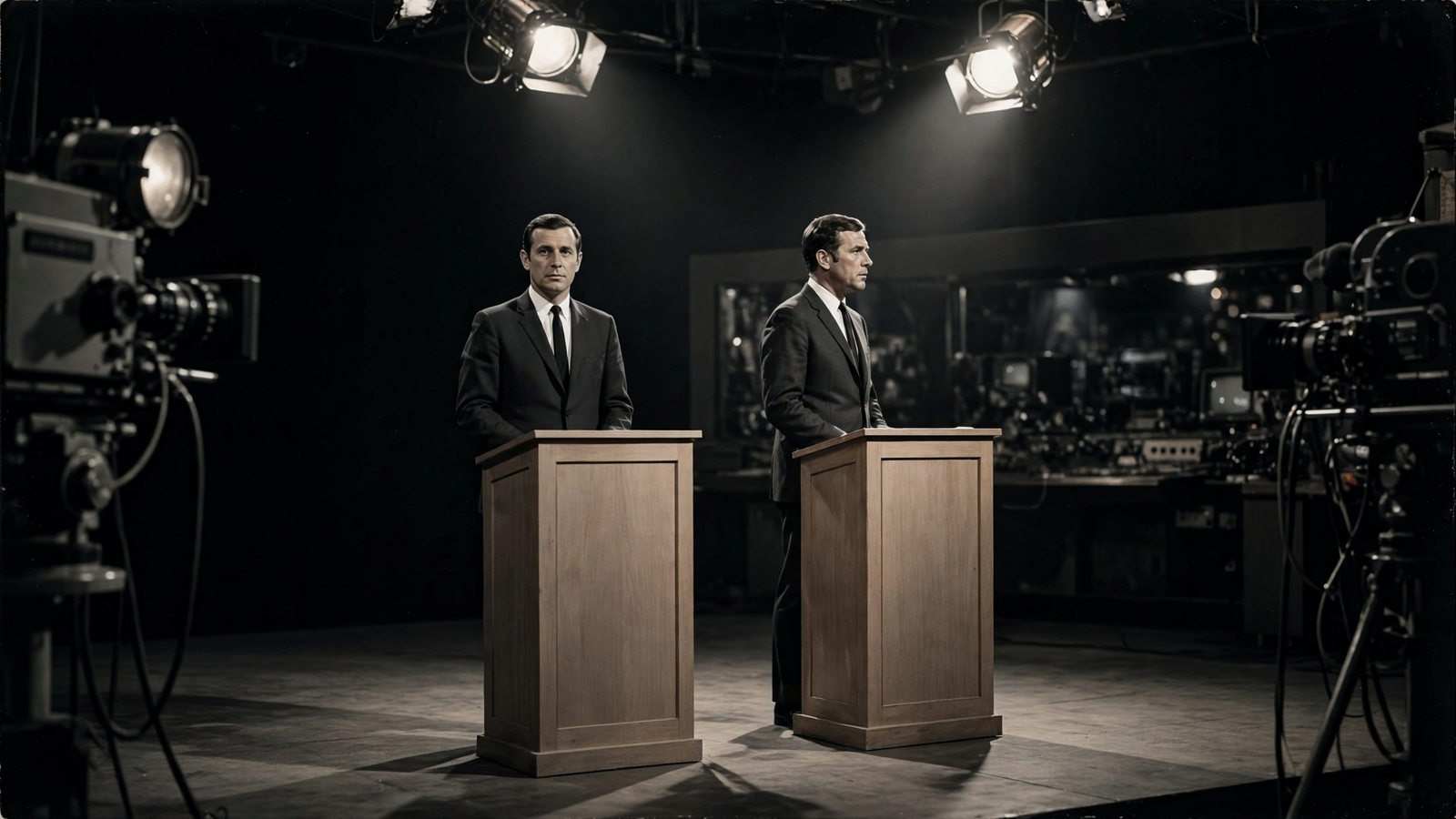
On the evening of September 26, 1960, millions of Americans watched two presidential candidates meet in a Chicago television studio. John F. Kennedy, the young Democratic senator from Massachusetts, and Richard Nixon, the Republican vice president, stood beneath the bright lights of CBS’s studio in downtown Chicago and answered questions from a panel of journalists.
The event was not the first time American politicians had appeared on television. It was not even the first televised debate between candidates. But it became a turning point because television transformed the debate from an exchange of arguments into a public encounter with faces, gestures, posture, clothing, and nerves.
For the first time, a national audience could compare presidential candidates in something close to real time. The comparison was not limited to what they said. Viewers also saw how they handled the camera.
A new medium enters the campaign
Television was already becoming a central part of American life by 1960. Families gathered around sets in living rooms, and political campaigns had learned to use filmed advertisements and carefully staged appearances. Yet the medium was still young enough that its influence on political judgment remained uncertain.
Radio had allowed voters to hear a candidate’s voice. Newspapers had provided space for detailed reporting and editorial interpretation. Television combined sound and image, but it also imposed its own rules. A television viewer noticed pauses, expressions, eye contact, and the physical relationship between a speaker and the frame.
The Kennedy-Nixon debate was arranged after Congress temporarily suspended a provision of federal broadcasting law that could have required stations to provide equal airtime to other presidential candidates. The change made it possible for the major-party nominees to appear together without creating the same obligation for every candidate seeking the office.
The format was direct. Four journalists asked questions, while the candidates delivered opening and closing statements and responded to one another. The first debate focused primarily on domestic issues, including the economy, national security, education, and the role of government. For related reading, see The Emergency Alert System: How Radio and Television Became America’s Public Warning Network.
The image viewers remembered
Kennedy arrived with several advantages that television made especially visible. He was younger, practiced before cameras, and had spent time preparing for the demands of the broadcast. He wore a dark suit that contrasted with the studio background and appeared comfortable addressing the lens.
Nixon had extensive political experience and was widely regarded as a formidable debater. But he had recently been ill, had lost weight, and was still recovering from a knee injury. He also had a five o’clock shadow and appeared uncomfortable under the studio lighting. He declined makeup, while Kennedy accepted routine television preparation.
None of those details directly answered a policy question. Yet they shaped what viewers experienced. The debate created a split audience: people who watched television could evaluate the candidates’ physical presentation, while people who listened on radio encountered mainly their words, voices, and arguments.
Later accounts often summarize the result by saying that radio listeners favored Nixon while television viewers favored Kennedy. That formulation is memorable but too simple to treat as a precise measurement of public opinion. The available evidence does show that the debate produced different impressions across media, but it does not prove that every radio listener preferred Nixon or that every television viewer preferred Kennedy.
The stronger historical point is that the same event could feel different depending on how it was received. Radio encouraged listeners to imagine the candidates. Television supplied an image for them to interpret.
Seventy million witnesses
The first debate drew an estimated 66 million viewers, according to the John F. Kennedy Presidential Library and Museum. At the time, the United States population was roughly 180 million. The broadcast therefore reached an extraordinary portion of the electorate in a single evening.
The audience size gave the debate a significance that campaign appearances could not easily match. A candidate speaking at a rally addressed the people in the room and perhaps a later news audience. A televised debate placed both nominees in living rooms across the country at the same moment. For related reading, see Blue Highways: How a Quiet Road Book Changed the Way America Travels.
That shared experience also gave Americans something new to discuss. People could argue not only about a candidate’s position on taxes, defense, or federal spending, but about whether one candidate appeared confident, evasive, calm, aggressive, or presidential.
Television did not eliminate the importance of political ideas. The debate contained substantive disagreements about the economy, Cold War policy, civil rights, and the responsibilities of the federal government. But television made presentation part of the political evidence. A candidate’s performance became inseparable from the content of the performance.
Four debates, not one
The first encounter is the most famous, but Kennedy and Nixon debated three more times during the 1960 campaign. The later debates addressed foreign policy, national defense, and other issues, and they gave voters additional opportunities to compare the nominees.
Remembering only the first broadcast can make the campaign seem as though it was settled by one visual impression. The election itself was extremely close. Kennedy won the popular vote by a narrow margin, and the final result reflected many factors, including party organization, regional politics, economic concerns, foreign policy, and the candidates’ broader campaigns.
It would be inaccurate to claim that the first debate alone determined the election. The debate’s lasting importance lies elsewhere: it demonstrated that television had become a national political arena.
After 1960, campaigns increasingly treated televised appearances as carefully managed events. Candidates paid more attention to lighting, camera angles, clothing, makeup, staging, and the timing of answers. Debate preparation became a specialized part of campaign strategy. A candidate still needed policies and arguments, but those ideas now had to survive the visual conditions of broadcasting.
The birth of the modern media candidate
The debate also helped establish a pattern that remains familiar. Voters would increasingly encounter candidates through mediated performances rather than through long speeches or personal meetings. A candidate might be judged in a town hall, a news interview, a campaign advertisement, or a short video clip repeated across broadcasts. For related reading, see Sandra Day O’Connor: How an Arizona Judge Changed the American Court.
This shift brought both democratic possibilities and new pressures. Television could introduce a candidate to people who would never attend a rally. It could give the public a direct look at an unscripted exchange. It also encouraged campaigns to focus on appearance and emotional impressions, sometimes at the expense of complex policy discussion.
The 1960 debate did not invent political image-making. Politicians had always used clothing, staging, voice, and ceremony to communicate authority. Television simply made those signals more immediate, more widely shared, and more difficult to ignore.
It also changed the meaning of preparation. In earlier campaigns, a candidate could deliver a speech to one audience and rely on newspapers to summarize it. On television, a single hesitation or visible reaction could become part of the public record. Performance was no longer confined to the room where it happened.
A template that still shapes elections
Presidential debates have evolved since 1960. Formats have changed, moderators have gained different responsibilities, and candidates now campaign in an environment filled with cable news, websites, smartphones, and social media. Yet the basic challenge remains familiar: candidates must make a case while being judged as people on a screen.
The first Kennedy-Nixon debate matters because it revealed that television was not merely another channel for political speech. It was a setting with its own grammar. Viewers read the image as well as the argument, and the image could influence how the argument was understood.
In that Chicago studio, American politics entered a more visual age. The candidates were still debating government and national priorities, but they were also being measured as television presences. From that point forward, winning an argument and looking ready to lead would become related—but never identical—political skills.
Use: Debate dates, format, historical context, and the estimated audience for the first debate.
Use: Historical record of the four 1960 presidential debates and their broadcast context.
Use: Background on presidential debates, political broadcasting, and the development of televised campaign communication.
Use: Media-history context on the first televised debates and the different viewing experiences created by television and radio.