When sponge divers reached the wreck of a large merchant ship near the Greek island of Antikythera in 1900, they expected the usual hazards of deep water: poor visibility, tangled equipment and the remains of a vessel lost beneath the sea. Instead, they found statues, glassware, coins and marble scattered across the seabed.
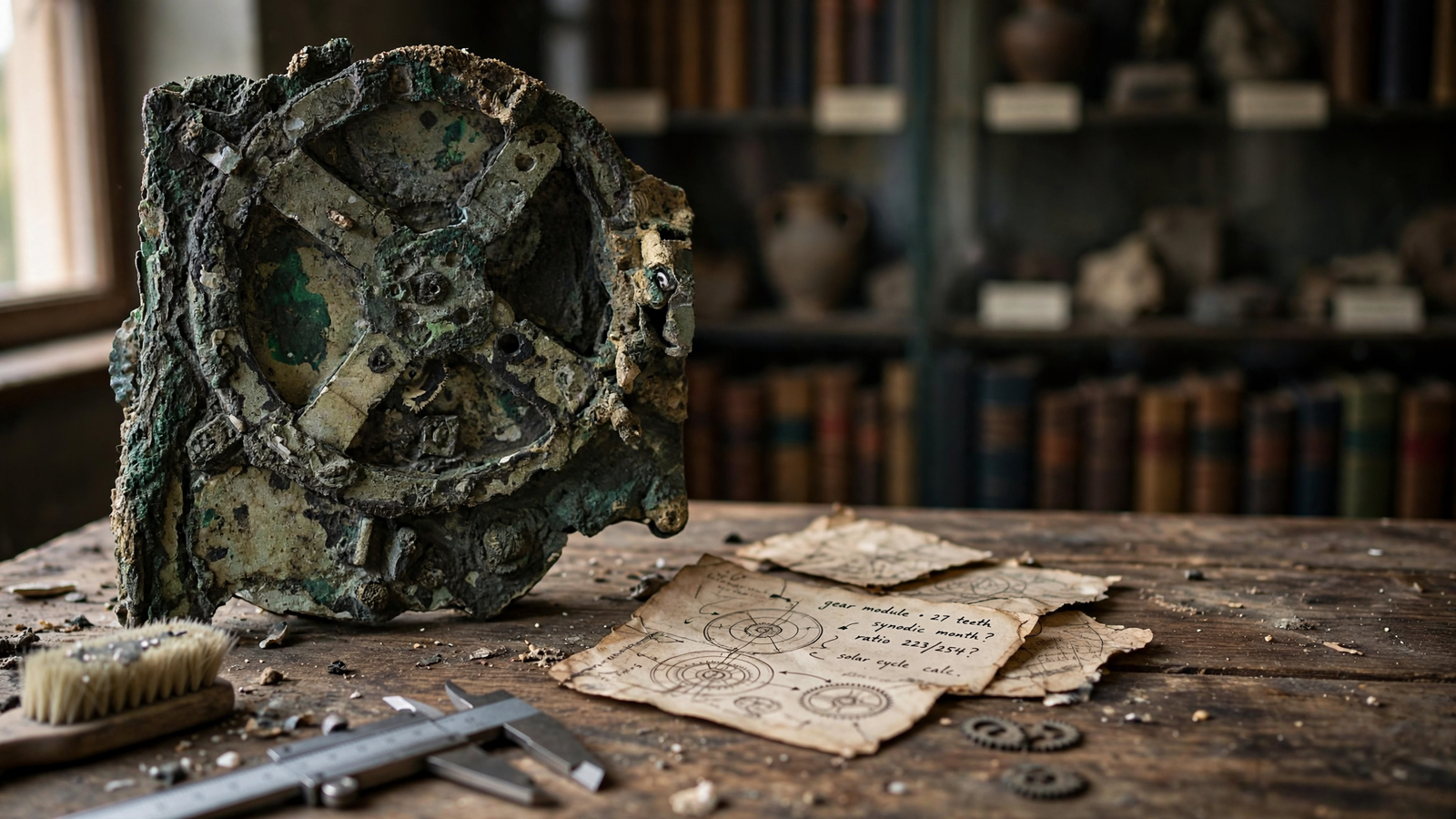
Among the corroded objects brought to the surface was something far less recognizable. It looked like a lump of bronze, broken into several pieces and covered with marine deposits. At first, it seemed to be little more than part of a damaged artifact. Then researchers noticed gear teeth.
That discovery eventually became known as the Antikythera Mechanism, one of the most remarkable surviving objects from the ancient world. Built more than 2,000 years ago, it used interlocking gears, precisely arranged scales and engraved instructions to represent repeating movements in the sky. It could track the cycles of the Sun and Moon, predict eclipses and display the timing of major Greek athletic festivals.
The mechanism did not make the ancient Greeks masters of time in the modern sense. It did something more revealing: it turned astronomical knowledge into a portable machine. Its existence shows that the history of computing did not begin with electricity, silicon or even the first modern clock. It also began with people asking whether the patterns of the universe could be represented through moving parts.
A discovery hidden in a shipwreck
The wreck lies off Antikythera, an island between the Peloponnese and Crete. The ship is generally understood to have been a large cargo vessel traveling through the eastern Mediterranean during the late second or early first century BCE. Its cargo included luxury objects associated with the Greek world, although the ship itself may have originated elsewhere in the Mediterranean.
Greek sponge divers located the wreck in 1900. The first recovery expedition, supported by the Greek state, brought up statues and other antiquities, but the work was dangerous. One diver died and others suffered decompression sickness during the operation.
The strange bronze fragments entered the collections of what is now the National Archaeological Museum in Athens. In 1902, archaeologist Valerios Stais examined one of the pieces and recognized a gear wheel. That observation challenged the prevailing assumption that ancient Greek technological achievement was mainly architectural, artistic or theoretical. This object had been designed to move. For related reading, see The Antikythera Mechanism: How a Shipwreck Revealed the Ancient World’s Mechanical Sky.
Over the following decades, corrosion obscured much of the mechanism’s original structure. The surviving fragments had split apart, and many of the bronze components had been crushed or lost. Yet the remains preserved an extraordinary amount of information: gear teeth, circular dials, pointers and hundreds of letters engraved into the casing and displays.
From curiosity to scientific investigation
For much of the twentieth century, the mechanism was difficult to understand because researchers could not see through its encrusted surfaces without damaging it. The investigation changed in the 1950s and 1960s, when the British science historian Derek de Solla Price used radiography to study its internal gears.
Price argued that the device was an astronomical calculator. His work revealed that the gears were not arranged randomly. Their tooth counts encoded relationships between astronomical cycles, including the Moon’s changing position against the background of the zodiac.
Later researchers combined traditional examination with increasingly sophisticated imaging. X-ray computed tomography allowed investigators to inspect the interior in three dimensions. Surface imaging captured inscriptions that were nearly impossible to read with the naked eye. The result was not a single moment of revelation but a long process of reconstruction, with each generation refining what the previous one had been able to see.
By the early twenty-first century, researchers had identified 82 separate fragments of the mechanism. Only about 30 of its original gear wheels survive, but those fragments retain enough evidence to reveal the device’s broad purpose and much of its design.
A machine for repeating cycles
The Antikythera Mechanism was built around the idea that celestial movements could be modeled through cycles. Its front displayed the Sun and Moon against a zodiac scale, along with a calendar scale. The Moon was not treated as a simple white disk: the mechanism included a rotating black-and-white lunar sphere that represented the Moon’s phases.
Its back contained two large spiral displays. One represented the Metonic cycle, a period of 19 years in which lunar phases return to approximately the same dates in the solar year. Another represented the Saros cycle, which tracks a repeating pattern of eclipses over roughly 18 years. For related reading, see The Dead Sea Scrolls: How a Cave Discovery Opened a Window on the Ancient World.
The eclipse display was especially significant. It did not merely show that eclipses occurred; inscriptions indicated the expected characteristics of individual events, including whether an eclipse would be solar or lunar and the approximate time of day. A smaller subsidiary display represented the Exeligmos cycle, which helped account for the shift in eclipse timing from one Saros cycle to the next.
The mechanism also included a display associated with the cycle of major athletic contests. This likely included the Olympic Games, but the ancient calendar used a broader system of festival names and regional events. The feature is a reminder that the device was not only about abstract astronomy. It connected the movement of the heavens to the social calendar of the Greek-speaking Mediterranean.
What the inscriptions changed
The gears are visually impressive, but the inscriptions are just as important. They functioned like an instruction manual written onto the machine itself. Researchers have used them to identify astronomical terms, understand the displays and reconstruct parts of the missing structure.
The language also places the mechanism within a particular intellectual tradition. Ancient Greek astronomers had developed mathematical models for the motions of the Sun, Moon and planets. The device translated some of that knowledge into a physical system that a user could operate by turning a handle.
That does not mean the mechanism was an ancient computer in exactly the same way as a modern digital device. It had no software, electronic memory or general-purpose programmability. Its gears were built to represent a selected group of known cycles. Even so, the comparison is useful when carefully made: like later calculating machines, it used a physical arrangement of components to generate information that would otherwise require repeated observation or calculation.
The mechanism’s sophistication also complicates the story of ancient technology. It is tempting to imagine technological progress as a straight line, with simple devices gradually becoming more complex. The Antikythera find points to a different history. Highly advanced mechanisms may have existed in workshops whose products were rarely preserved, while the knowledge needed to build them could disappear when skilled makers, institutions or traditions were lost.
Reconstructing a lost design
Modern researchers have produced several reconstructions, and they do not all agree on every detail. Some questions remain open, including the exact arrangement of missing gears and the mechanism’s full planetary display. A 2006 research team used high-resolution X-ray tomography and surface imaging to produce a more complete reading of the inscriptions and a clearer account of the device’s calendars and eclipse cycles. For related reading, see Gladys West: How a Quiet Mathematician Helped Give the World GPS.
In 2021, researchers published a new model of the mechanism’s front display. Their reconstruction proposed a coherent arrangement for showing the Sun, Moon and planets, while acknowledging that parts of the design remain hypothetical because the original components did not survive. The model was an interpretation grounded in the fragments and inscriptions, not a claim that every missing piece had been recovered.
That distinction matters. The Antikythera Mechanism is often presented as a solved mystery, but its real importance lies in the continuing conversation between evidence and interpretation. Every new scan, inscription reading or comparison with ancient astronomical texts can alter the picture.
A different beginning for the history of machines
The mechanism is now one of the best-known objects in the National Archaeological Museum in Athens, but its influence extends far beyond the display case. It has changed how historians think about ancient engineering, the circulation of scientific knowledge and the relationship between theory and craft.
It also gives the public a rare physical encounter with an ancient idea: the heavens are orderly enough to be modeled. A person turning the device’s handle would have seen cycles unfold through pointers and dials. Astronomy became not only something to observe but something to operate.
That is why the Antikythera Mechanism remains so compelling. It was not a prophecy of modern technology, and it was not an isolated miracle detached from its historical setting. It was a carefully engineered expression of Greek mathematical astronomy, made for a world of calendars, festivals, navigation and celestial observation.
Recovered from a shipwreck and reconstructed from fragments, it gives the ancient past a moving part. More than two millennia after its makers cut the first gear teeth, the mechanism still turns our understanding of technological history in a new direction.
Use: Museum background, discovery context and identification of the artifact.
Use: Peer-reviewed research on the mechanism’s fragments, inscriptions, gears and astronomical displays.
Use: Peer-reviewed reconstruction of the mechanism’s front display and its representation of celestial cycles.