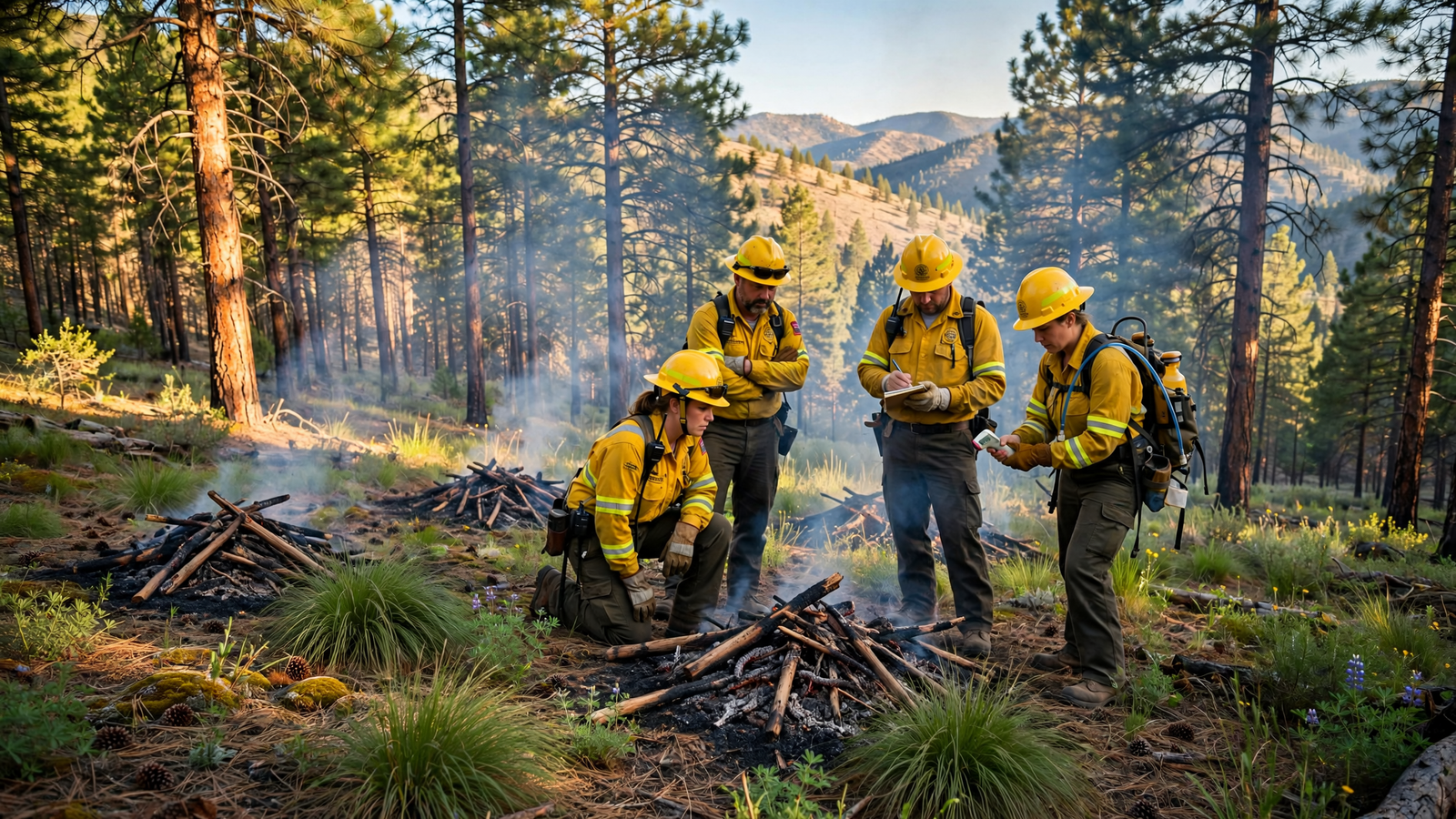
Residents around Prescott National Forest should expect to see smoke drifting from the hillsides and canyons surrounding the city through the end of August, as crews continue a round of prescribed pile burning tied to ongoing forest health work. Forest officials say the operations, already underway, are expected to continue into late summer as conditions allow.
What Pile Burning Involves
Pile burning is one of the most common tools used by the U.S. Forest Service to reduce wildfire risk after thinning projects. When crews remove overcrowded trees, brush and dead wood from a forest stand, the material is typically stacked into piles rather than left scattered across the forest floor. Those piles are later burned under controlled conditions, allowing the debris to be disposed of without leaving behind the kind of dense, dried fuel that can make wildfires burn hotter and spread faster.
Around Prescott, this kind of fuels work has been part of a broader, multi-year effort to reduce the risk of large, fast-moving fires in the forested terrain that surrounds the city. Because the pile burns happen in increments across many acres, officials have said the work will continue in stages rather than all at once, which is why the timeline extends through August.
Why Officials Are Burning Now
Timing matters for pile burning. Crews generally look for conditions where there is enough moisture in the surrounding vegetation and soil to keep a fire contained to the pile itself, without the risk of it spreading into untreated brush nearby. The arrival of Arizona’s summer monsoon season, with its periodic rain and higher humidity, can create a window where burning is less likely to escape control, even as it still requires careful monitoring by fire crews.
That doesn’t mean the work is without visible effects. Smoke from pile burns can settle into nearby neighborhoods, especially during the cooler, stiller parts of the morning and evening, and can occasionally reduce visibility along roads near burn units. Officials have said they try to account for wind direction and weather forecasts before authorizing individual burns, but smoke in the area should be expected as a normal part of the process through the rest of the summer.
A Season Marked by Extreme Weather
The pile burning schedule comes during a summer that has already tested the region’s relationship with fire and water. Earlier in July, a sudden and intense storm sent flash flooding through a Prescott Valley neighborhood, with reports of floodwaters reaching roughly five feet in some areas and residents describing significant damage to homes and property. The event was a stark reminder of how quickly monsoon storms can turn from welcome rain into a hazard in a landscape shaped by steep terrain and, in places, land recently affected by fire or heavy fuel.
Burned or heavily thinned areas can behave differently during intense rain than untouched forest, since the ground cover and root systems that normally slow runoff may be reduced. That dynamic is part of why land managers in the Prescott area have paid close attention to both fire risk and watershed health when planning fuels projects, even as the specific flooding in Prescott Valley was tied to a separate, intense storm cell rather than to the pile burning itself.
Forest Health and Water, Linked Issues
Fire and water management in the Prescott area are often discussed together, since the health of the forest canopy and soil has a direct bearing on how watersheds respond to both drought and heavy rain. That connection extends beyond Prescott National Forest itself. Further south, the Upper Verde River watershed has become the focus of a separate legal dispute, with a conservation group filing a second lawsuit this year over concerns that unauthorized cattle grazing is harming the river and species that depend on it. While unrelated to the current pile burning schedule, the case underscores how closely tied forest management, grazing practices and river health are across the broader region that Prescott sits within.
What Residents Can Expect
For people living near the forest boundary, the practical takeaway is straightforward: smoke is likely to be visible on and off through August, particularly on mornings when temperature inversions trap smoke closer to the ground. Those with respiratory conditions are often advised during prescribed burn periods to keep windows closed when smoke is heavy and to limit outdoor exertion if air quality noticeably worsens.
Officials have also noted that specific burn days depend on real-time weather conditions, meaning the schedule can shift if winds pick up, humidity drops too low, or storms move through. That flexibility is part of why land managers describe the operation as ongoing through the end of the month rather than tied to a single fixed date.
Looking Ahead
Once the current round of pile burning wraps up, the treated areas should be left with substantially less surface fuel than before the thinning work began, a change officials expect to reduce the intensity of any future wildfire that might move through those stands. For a community that has watched both wildfire risk and flash flood damage make headlines this year, the quieter, more controlled work of pile burning represents one of the steadier tools available for managing a landscape that can swing quickly between drought and deluge.
Use: Primary source confirming that Prescott National Forest officials expect pile burning operations to continue through August.
Use: Provided context on the intense monsoon flash flooding that recently affected the Prescott area, used to discuss the region's broader relationship with fire and water this summer.
Use: Used for brief context on a related Upper Verde River watershed dispute mentioned to illustrate broader regional forest and water management issues.