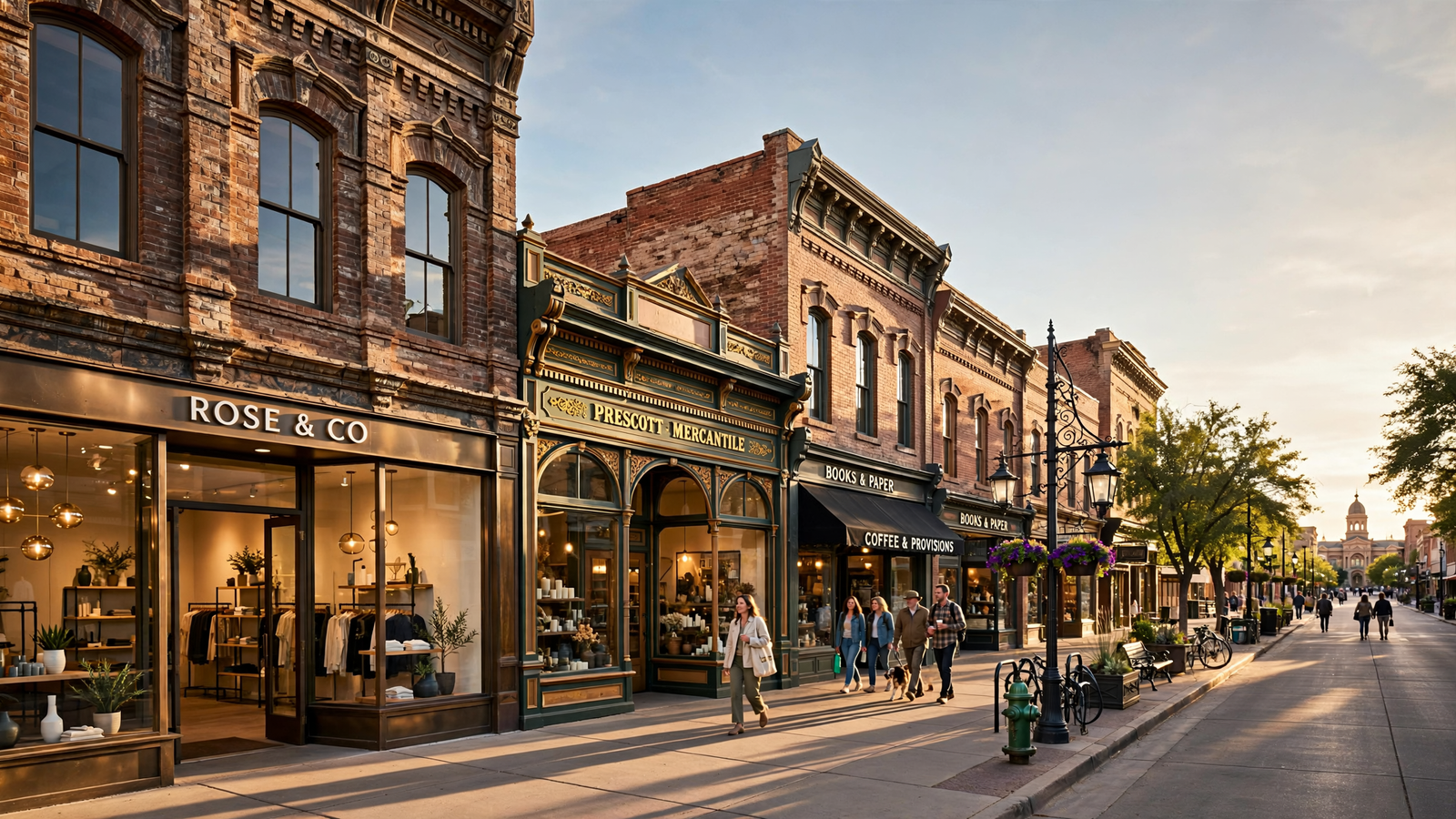
A downtown can be preserved so carefully that it feels untouched—or it can keep working as a place where people shop, eat, meet and run businesses. Prescott’s historic commercial center faces that familiar balancing act. Its older buildings give the city a distinctive sense of place, but their long-term value also depends on whether they can continue to serve modern needs.
That makes downtown Prescott a development story, even when the work is not a single major construction project. The decisions are often smaller and cumulative: how storefronts are maintained, how older spaces are adapted, how public areas support foot traffic, and how new investment fits into an established streetscape.
A commercial center with a long memory
Prescott’s downtown grew around a compact street grid and a civic center anchored by Courthouse Plaza. The city’s historic character is visible in its buildings and streets, but the business district is more than a record of the past. It remains a setting for commercial activity and public life.
The National Register of Historic Places recognizes the Prescott Historic District, documenting the area’s architectural and historical significance. That recognition helps explain why change downtown is not simply a matter of replacing an old building with a new one. The challenge is to keep buildings useful while respecting the features that make the district legible as a historic place.
Historic status does not mean that every building must remain frozen in its original use. In many older downtowns, a building’s next chapter depends on adapting its interior or operations while retaining important exterior details. A former retail space might serve a different kind of business; an upper floor may have a use different from the storefront below. The right approach depends on the building, applicable preservation rules and what local owners and customers need.
Why small decisions add up
Downtown development is often discussed through large projects: a new hotel, a major public facility or a major redevelopment site. But the health of a traditional business district can also turn on decisions that attract less attention. A repaired façade, an occupied storefront or a building brought back into active use can help sustain the feeling that downtown is a place to visit throughout the day, not just a collection of historic façades.
Those changes have to work for businesses as well as for visitors. Older buildings may require costly repairs or creative solutions to meet present-day needs. At the same time, a district’s historic character can be an economic asset: it gives shoppers and visitors an experience that is difficult to reproduce in a newly built commercial center. Preservation and business activity are not automatic allies, but thoughtful reuse can connect them.
For city leaders, the policy question is how public rules and investments can support that balance. Prescott’s planning and economic-development functions provide the framework for considering land use and business conditions. That framework matters because the costs and benefits of downtown change are shared: owners make building decisions, businesses choose where to operate, and public agencies shape streets, services and regulations.
Keeping the district useful—not just picturesque
A historic district can attract attention because of its appearance. Its staying power, however, depends on everyday usefulness. People need reasons to return, and businesses need conditions that make operating downtown viable. That means the conversation cannot end with a building’s age or architectural style. It also has to consider access, maintenance, building function and the mix of activities that keeps streets active.
Prescott’s downtown should not be treated as a museum exhibit with a single approved future. Nor does “development” have to mean sweeping demolition or a uniform new design. A district can change incrementally, with individual buildings and businesses adapting at different speeds. The result is less dramatic than a ribbon-cutting for a new complex, but it can be consequential: a historic place stays part of the city’s working economy.
That approach requires care. New uses need to respect the district’s character, while preservation efforts need to leave room for practical updates. If the balance tips too far toward strictness, buildings can become difficult to use. If it tips too far toward replacement, the distinctiveness that sets downtown apart may be lost.
A development story still being written
Prescott’s downtown business district is best understood as an ongoing negotiation between continuity and change. The historic buildings supply a strong foundation, but they do not guarantee a thriving commercial center. That depends on owners investing in their properties, businesses finding workable spaces and public decisions supporting a lively, accessible district.
The measure of success is not whether downtown looks exactly as it did in an earlier era. It is whether its historic fabric can remain visible while the district continues to serve present-day residents and businesses. In Prescott, that work happens one building, storefront and public decision at a time—a quieter form of development, but one that can determine what the city’s center is for in the years ahead.