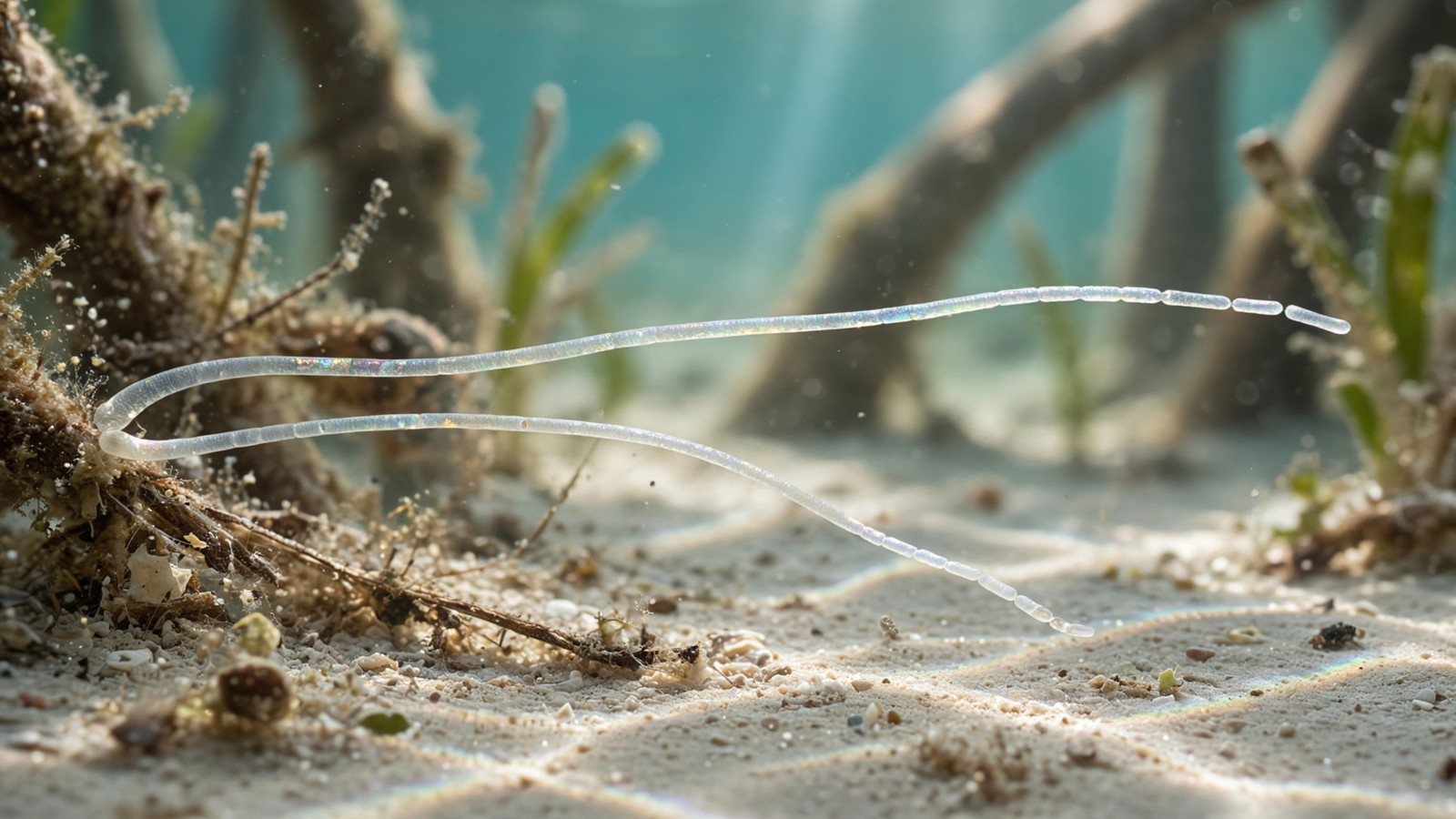
Most bacteria are too small to see without a microscope. Thiomargarita magnifica is an exception: some of its cells stretch longer than a centimeter, making them visible to the naked eye as fine, pale threads. Discovered in mangrove environments in the Caribbean, the organism is the largest bacterium described so far—and its size is only part of what makes it unusual.
When scientists examined the cells more closely, they found an internal arrangement that does not fit the simplest picture of a bacterium as a tiny, undivided sac. Its genetic material is organized inside membrane-bound compartments. The discovery does not make the bacterium a miniature animal or plant cell, but it does show that bacterial cells can be more varied in size and organization than familiar examples suggest.
A giant in the mangrove
The bacterium was found growing on submerged material in a mangrove ecosystem in the French Caribbean territory of Guadeloupe. Its long, slender cells attach to surfaces, including fallen leaves. Under a microscope, researchers could see that what looked like a thread was a single bacterial cell rather than a chain of many smaller cells.
The study describing the species reported cells averaging around 9,000 micrometers in length, with the largest observed specimens exceeding 20,000 micrometers. That is more than two centimeters. For comparison, many familiar bacteria measure only a few micrometers long. The species name, magnifica, is a fitting nod to its striking scale.
Large size poses a practical problem for a cell. Nutrients and waste products must move between the cell’s working interior and its surroundings. In many bacteria, small size helps keep those exchanges manageable. T. magnifica appears to manage its bulk in part through a large central vacuole—a fluid-filled space that occupies much of the cell. The researchers proposed that this arrangement leaves a relatively thin layer of active cytoplasm near the cell’s surface, where exchange with the environment can take place. That is a possible explanation for how the cell works at this scale, not a complete account of its biology.
DNA in “little seeds”
The most surprising feature emerged when the researchers investigated the cell’s DNA. In many bacteria, genetic material occupies a region of the cell without being enclosed in a nucleus. In T. magnifica, the DNA is packaged in numerous small, membrane-bound compartments distributed through the cell. The research team called them “pepins,” using a French word for seeds.
The compartments hold genetic material and other components of the cell’s molecular machinery. Their presence gives the bacterium a degree of internal organization that is uncommon among bacteria. But the finding needs a careful description: a pepin is not the same thing as the nucleus found in animals, plants and fungi. The bacterium remains a bacterium, and its compartments do not erase the fundamental differences between bacterial and eukaryotic cells.
Researchers also found many copies of the organism’s genome within an individual cell. Having multiple genome copies is not unique to this species, but in a cell this large it raises questions about how genetic instructions are distributed and used. Do different areas of the long cell perform specialized jobs? How does DNA activity vary along its length? The initial discovery opened those questions rather than settling them.
Why the finding matters
For decades, biology textbooks have used broad contrasts to introduce cell types: eukaryotic cells have a nucleus and internal compartments, while bacteria generally do not. Those distinctions remain useful, but discoveries such as T. magnifica make clear that nature does not always follow the simplest classroom sketch. Some bacteria are large; some have elaborate internal structures; and different lineages may solve cellular problems in different ways.
The discovery also illustrates why examining organisms in their natural settings can matter. T. magnifica was not first recognized as a spectacular cell in a standard laboratory culture. Its conspicuous threads drew attention in a mangrove environment, and researchers then used microscopy and molecular methods to investigate what they were seeing. Studying the organism in the lab can help answer questions, but its natural habitat is part of the story: the cell lives among the changing conditions and chemical resources of coastal mangrove sediments.
There is still much to learn. The original research established the organism’s extraordinary length and described its internal compartments, but it did not provide a complete picture of its life cycle, ecological role or the evolutionary history of its unusual features. Further work will be needed to understand how it grows, reproduces and functions in the wild.
For now, T. magnifica offers a useful reminder about scale in biology. A bacterium can be large enough to spot without a microscope and organized in ways that challenge familiar expectations—without ceasing to be a bacterium. The mangrove thread is not a small version of something better known. It is evidence that the microbial world still has forms of life that can surprise us.