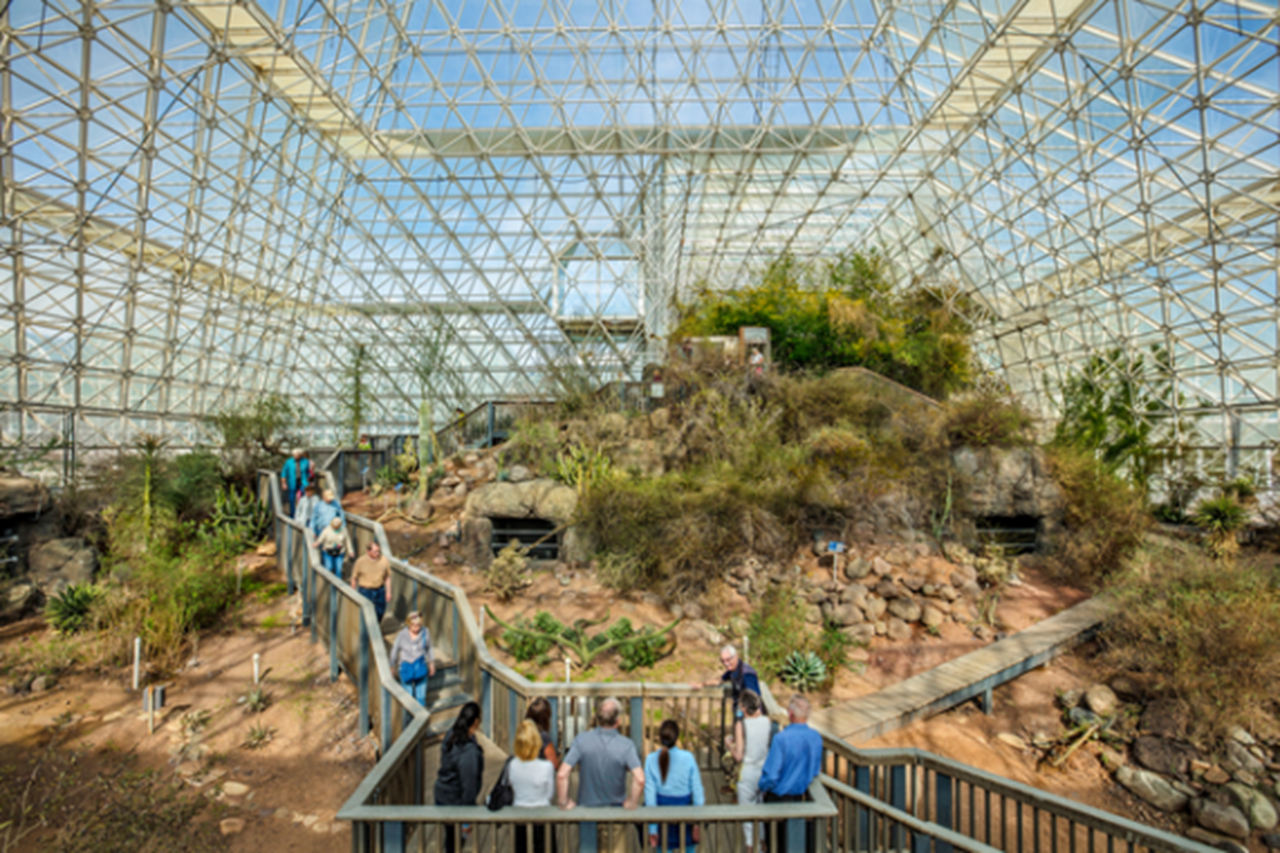
Just north of Tucson, a landscape sits beneath glass—not as a display of scenery, but as a working scientific instrument. At the University of Arizona’s Biosphere 2, researchers can control conditions inside large enclosures and study how water, soil, rock and living systems affect one another.
The site is best known for its sealed habitats and early experiments in living inside a closed environment. But its scientific life has broadened. One of its major research installations, the Landscape Evolution Observatory, turns a basic question into a long-running experiment: how does a landscape change as water moves through it?
That question matters well beyond the facility’s walls. In real watersheds, rainfall, geology, plants, microbes and climate interact at once. Researchers can measure what happens outside, but it is difficult to separate cause from effect. Biosphere 2 offers a way to observe those interactions under more controlled conditions.
A landscape built for measurement
The Landscape Evolution Observatory, or LEO, is made up of three large, engineered hillslopes inside dedicated enclosures. They are not natural mountainsides moved indoors. Rather, they are experimental landscapes assembled so that scientists can introduce water and monitor how it travels through the material.
That arrangement gives researchers access to details that are hard to capture across a broad outdoor watershed. Instruments can track changes in water and soil, while the experimental setting lets teams compare what happens when conditions are adjusted. The central aim is to understand linked processes: how water moves, how minerals weather, and how biological activity and chemical changes develop together.
In the open world, a storm can pass before a field team is ready. A hillside’s underground structure may be difficult to observe, and a nearby slope may have different soil, plants or exposure. In an enclosed experiment, researchers can apply water in a planned way and collect measurements across the hillslope. The facility does not reproduce every feature of a real watershed; it makes a defined set of processes easier to study.
Why follow water through rock and soil?
Water is more than a resource that runs downhill. As it enters soil and fractured rock, it transports dissolved substances, changes minerals and creates conditions for microbes and plants. Those processes help shape the chemistry of streams and the development of soils. They also influence how a landscape stores and releases water.
For Arizona, where water availability is a persistent concern, understanding these connections has practical relevance. Biosphere 2’s work is not a local water forecast, nor does a controlled hillslope tell researchers exactly what will happen in a particular Arizona basin. Its value is more fundamental: it can help scientists test how parts of a landscape system work, then compare those findings with observations and models from the field.
That distinction is important. A small number of carefully monitored experimental slopes cannot stand in for the state’s varied mountains, forests, deserts and river basins. But they can help researchers examine mechanisms that are otherwise tangled together. Results from controlled studies can improve the questions scientists ask outdoors and the assumptions they use when modeling environmental change.
From a sealed world to Earth-system research
Biosphere 2 opened public attention to the challenge of keeping people and ecosystems functioning inside a large enclosed environment. Today, the complex also supports research into Earth systems, including how land and water respond to changing conditions. Its glass architecture still gives the place an unusual visual character, but the facility’s scientific role is not limited to recreating habitats.
The Landscape Evolution Observatory makes that shift tangible. Instead of asking whether a small, closed world can sustain life, researchers use constructed terrain to investigate how a landscape’s components work together. The experiment is large enough to preserve meaningful spatial variation across a slope, yet contained enough for instruments and controlled inputs to reveal processes that are difficult to isolate in nature.
Such research takes patience. Landscape change is not always dramatic from one day to the next. Water can move through a slope, alter its chemistry and influence biological activity over time, with effects that only become clear through repeated measurements. The observatory is built to support that kind of sustained observation rather than a single demonstration.
A research site with a public face
Biosphere 2 is also a place visitors can encounter, which gives the research complex a role beyond the laboratory. Its striking scale can make abstract Earth-science questions visible: a hillside is not just dirt and stone, and a watershed is not simply a line on a map. Each is a connected system, with water linking physical, chemical and biological processes.
The Arizona facility cannot bring the whole planet indoors. Its value is that it can make selected parts of Earth’s complexity more observable. By building a landscape that can be measured closely, researchers have created a setting to test how water and terrain interact—work that may help sharpen understanding of landscapes far beyond Oracle.