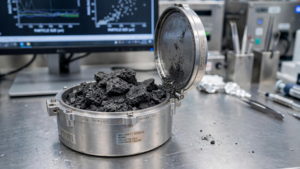
Material collected from the asteroid Bennu and brought back to Earth by a University of Arizona-led NASA mission contains a broad assortment of compounds associated with life, researchers reported in January 2025. The findings offer a close look at the chemistry of an ancient solar-system body—and a reminder that the ingredients for life are not the same thing as life itself.
Two studies published in Nature examined the returned material. Researchers reported amino acids, which living things use to build proteins, and all five nucleobases used by life on Earth to store genetic information. They also found evidence of salts left behind as water evaporated. Together, the results suggest Bennu’s parent body once had conditions in which water and organic chemistry interacted.
That is an important clue about the early solar system, but it does not show that Bennu—or the larger body from which it broke away—ever hosted organisms. The compounds can form through non-biological processes. The discovery is about the availability and history of chemical ingredients, not a fossil or a signal of extraterrestrial life.
A sample returned from a near-Earth asteroid
NASA’s OSIRIS-REx spacecraft launched in 2016 and reached Bennu in 2018. In October 2020, it briefly touched the asteroid’s surface and collected material. The spacecraft delivered its sample capsule to the Utah Test and Training Range on Sept. 24, 2023, before continuing on a new mission. NASA reported that the capsule held 121.6 grams of Bennu material—more than the mission’s minimum goal.
The mission is led by the University of Arizona in Tucson. Planetary scientist Dante Lauretta served as its principal investigator. NASA manages the mission, with Lockheed Martin responsible for building and operating the spacecraft. The returned material is curated by NASA, allowing researchers to study it with laboratory instruments that could not travel aboard the spacecraft.
That distinction matters. Bennu is not an Arizona asteroid, and the sample does not belong to one university alone. Arizona’s connection is the mission leadership and the scientific work that helped plan and carry out the collection. The results also depend on coordinated work by researchers and laboratories beyond the state.
What the chemistry can—and cannot—say
Among the findings, researchers identified 14 of the 20 amino acids used by life on Earth to make proteins, along with all five nucleobases that form the informational alphabet of DNA and RNA. Detecting these compounds in an asteroid sample supports the idea that some basic chemical ingredients of life can arise and persist in space rocks.
Researchers also found minerals consistent with brines—salty water that evaporated—as well as other salts. Those minerals preserve evidence of chemical activity in a watery environment on Bennu’s parent body. The asteroid itself is a small, rubble-rich object; the ancient water-related processes took place on the larger body before impacts broke material apart and Bennu formed.
Scientists cannot infer from these ingredients that life was inevitable. Amino acids and nucleobases are building blocks, not living systems. Their presence does not establish that they assembled into cells, reproduced or evolved. Instead, the samples let researchers ask more precise questions: how widespread these compounds were, how water changed their chemistry and whether similar materials could have reached young Earth.
Asteroids are useful records because they have generally undergone less geological alteration than planets. Earth’s active surface, oceans and biology have repeatedly changed or recycled its oldest materials. A carefully collected sample from a small asteroid can preserve traces of early chemistry that are difficult to isolate in terrestrial rocks.
Why bringing the material home mattered
OSIRIS-REx was designed not just to photograph Bennu but to collect a sample large enough for detailed study. Researchers can examine portions with different instruments and preserve some material for future scientists, who may have tools that do not yet exist. That long view is part of the value of a sample-return mission: the material remains available for new questions as methods improve.
Before the return, spacecraft observations had already shown that Bennu contains hydrated minerals, evidence that water had altered material in its past. Laboratory analysis of the returned grains adds a much finer view of the organic compounds and salts. Results from a sample are also different from measurements made at a distance: scientists can test its composition directly and compare independent techniques.
The January studies therefore sharpen, rather than settle, a major question about life’s beginnings. They strengthen the case that some prebiotic ingredients were present in the young solar system and could be delivered by asteroids. They do not determine how life began on Earth, or whether similar chemistry led to life anywhere else.
For Arizona, the work is a high-profile outcome of a mission conceived and led in Tucson. For planetary science, Bennu’s grains offer a rare laboratory archive: a small piece of an ancient world, returned intact enough to reveal both the reach and the limits of what chemistry alone can tell us.