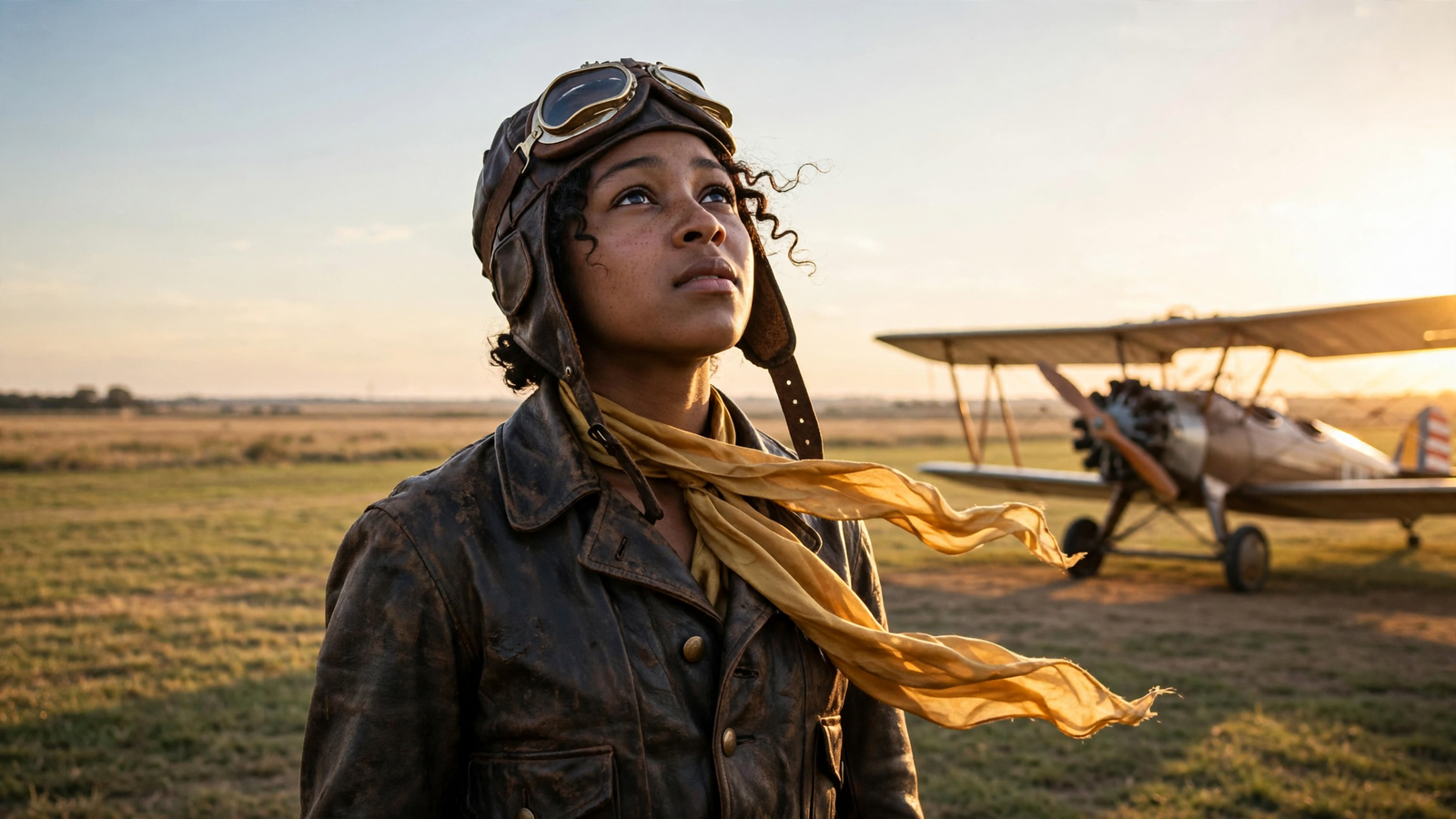
Before Bessie Coleman ever flew, she had to cross an ocean.
In the United States of the early 1920s, no American flight school would teach her. She was Black, she was a woman, and she had no wealthy family or aviation connection to open a door. So Coleman did something that would define her life: she found another entrance.
She learned French, traveled to Europe, and enrolled at the Caudron Brothers’ School of Aviation in Le Crotoy, France. On June 15, 1921, she earned an international pilot’s license from the Fédération Aéronautique Internationale. The achievement made her the first Black woman in the world to hold an international pilot’s license and the first woman of Native American descent to do so.
Coleman’s story is often remembered as a tale of individual determination. It was that, but it was also something larger. She understood that becoming a pilot would give her a public platform—and she intended to use it to challenge the narrow expectations placed on Black Americans and women.
A young woman looking for a wider life
Coleman was born on January 26, 1892, in Atlanta, Texas. She grew up in a large family, in a period when Black children in the rural South faced limited educational and economic opportunities. Her mother, Susan Coleman, worked to support the family. Her father, George Coleman, was of African American and Native American heritage.
The family later moved to Waxahachie, Texas. Coleman attended the local school for Black children and completed as much education as the family’s circumstances allowed. She eventually left Texas for Chicago, where several of her brothers had settled.
Chicago offered more possibilities, but it did not erase discrimination. Coleman worked as a laundress and manicurist before becoming a manicurist at the White Sox Barber Shop. The shop was near a community where pilots and veterans passed through, and aviation became a frequent subject of conversation. For related reading, see Lorna Lockwood: How an Arizona Judge Opened the Door to Women in Law.
Her interest grew after hearing her brothers talk about the opportunities they had seen during military service in Europe. One brother teased her that women were not expected to fly. Coleman took the challenge seriously. She wanted to fly, but she also wanted to build a life that was not restricted by other people’s assumptions.
When America’s doors stayed closed
During the 1910s and early 1920s, American aviation was still young. Flight training was expensive, and the field was dominated by white men. Black Americans who wanted to become pilots faced racial exclusion, while women confronted both formal and informal barriers.
Coleman’s own search for instruction showed how difficult the path was. She applied to American schools but could not find one willing to train her. Robert S. Abbott, the influential founder and publisher of The Chicago Defender, encouraged her ambition. Abbott and banker Jesse Binga helped her financially, allowing her to pursue training abroad.
French was not simply a subject Coleman studied for personal enrichment. It was a practical tool. She took lessons at a school in Chicago and learned enough French to apply to the Caudron aviation school in France. The journey required preparation, money, and a willingness to enter an unfamiliar professional world where she had no guarantee of success.
At Caudron, she trained in a Nieuport 82 biplane. The aircraft was small, light, and demanding to fly. Coleman learned the technical discipline of aviation, including takeoffs, landings, turns, and emergency procedures. Her international license recognized her as a qualified pilot at a time when few people—of any background—could claim that distinction.
Returning home as “Queen Bess”
Coleman returned to the United States with a rare credential and a clear plan. She did not want to fly only for private pleasure. She wanted to perform in air shows, where audiences paid to watch pilots execute daring maneuvers, and she wanted to use that visibility to create opportunities for others.
Because stunt flying could provide more income and publicity than ordinary passenger work, Coleman entered the world of barnstorming. She learned advanced maneuvers and became known for aerial performances that included figure eights, steep dives, and other feats. Newspapers and promoters gave her the nickname “Queen Bess.”
The name helped create a public image, but Coleman was careful about the kind of audience she would accept. She refused to appear at air shows that barred Black spectators. Her performances had to be open to Black audiences as well as white audiences, an unusually firm condition in the era of legal segregation. For related reading, see Mary W. Jackson: How a Hampton Engineer Opened NASA’s Doors From the Inside.
That decision connected her aviation career to a broader social message. Coleman was not merely proving that she could fly. She was insisting that Black Americans had the right to participate in modern public life—as professionals, performers, travelers, and citizens—and to be seen doing so.
A pilot who wanted to teach
Coleman’s ambition extended beyond her own career. She hoped to establish a flight school for Black pilots, particularly young Black men and women who lacked access to aviation training. She believed that Black communities should not be limited to watching aviation from the ground.
Her goal was part of a larger movement. In the years after World War I, Black newspapers, civic organizations, and community leaders promoted education, business ownership, skilled professions, and public achievement as tools of self-determination. Aviation represented modernity and freedom, but it was also an industry where race and gender barriers were highly visible.
Coleman’s public appearances therefore carried meaning beyond the spectacle itself. A Black woman in the cockpit challenged the assumption that technical knowledge, physical courage, and professional authority belonged mainly to white men. She became a role model before the phrase had become common language.
Her career was not free from risk. Early aviation had few of the safety systems later generations would take for granted. Aircraft were fragile, weather could change quickly, and stunt flying required extraordinary precision. Coleman understood those dangers but continued to fly because she saw aviation as both a livelihood and a form of public argument.
A legacy larger than a short career
Coleman died on April 30, 1926, in Jacksonville, Florida, while preparing for an air show. She was conducting a test flight in a Curtiss JN-4 aircraft when it went into a dive. Coleman was not wearing a parachute or secured by a seat belt, and she was thrown from the aircraft. She was 34 years old. For related reading, see The Harlem Renaissance: How Black Artists Built a New American Culture.
Her death ended a career that had lasted only a few years, but it did not end the example she had created. Black newspapers reported on her life, and aviators and civil rights advocates continued to invoke her name. In Chicago, a memorial service organized by the city’s Black community drew attention to the importance of her achievement.
Decades later, Black women pilots and aviation organizations helped bring Coleman’s story to new audiences. The Bessie Coleman Aviators Club, founded in 1995, supports and encourages Black women interested in aviation. The U.S. Postal Service honored Coleman with a commemorative stamp in 1995, and the Federal Aviation Administration has included her among the pioneers whose work expanded the nation’s understanding of who could fly.
Her influence is also visible in the continued presence of Black women across aviation: commercial and military pilots, aerospace engineers, instructors, mechanics, and astronauts. Their careers are shaped by many people and institutions, but Coleman remains an early, unmistakable symbol of possibility.
The meaning of taking the first step
Bessie Coleman did not wait for aviation to become welcoming. She entered while it was still guarded by money, race, gender, and custom. When one country refused to train her, she learned the language and traveled to another. When public events tried to separate audiences by race, she used her participation to demand something better.
That is why her story remains more than a record of a first. The license she earned in France was a document, but the larger achievement was the example she carried home: expertise could be claimed, barriers could be challenged, and a person excluded from the cockpit could still become one of the most memorable figures in early American aviation.
Coleman wanted a flight school of her own. She did not live to build it. But by becoming a pilot in a world that told her she could not, she helped make the sky a more imaginable place for everyone who followed.
Use: Career, pilot’s license, aviation training, performances, and historical significance.
Use: Biographical background, childhood, move to Chicago, and barriers to flight training.
Use: Aviation biography, public career, legacy, and role as an early aviation pioneer.
Smithsonian National Air and Space Museum — Bessie Coleman — https://airandspace.si.edu/stories/editorial/bessie-coleman — Career, pilot’s license, aviation training, performances, and historical significance.
National Women’s History Museum — Bessie Coleman — https://www.womenshistory.org/education-resources/biographies/bessie-coleman — Biographical background, childhood, move to Chicago, and barriers to flight training.
Federal Aviation Administration — Bessie Coleman — https://www.faa.gov/about/history/pioneers/media/Bessie_Coleman.pdf — Aviation biography, public career, legacy, and role as an early aviation pioneer.