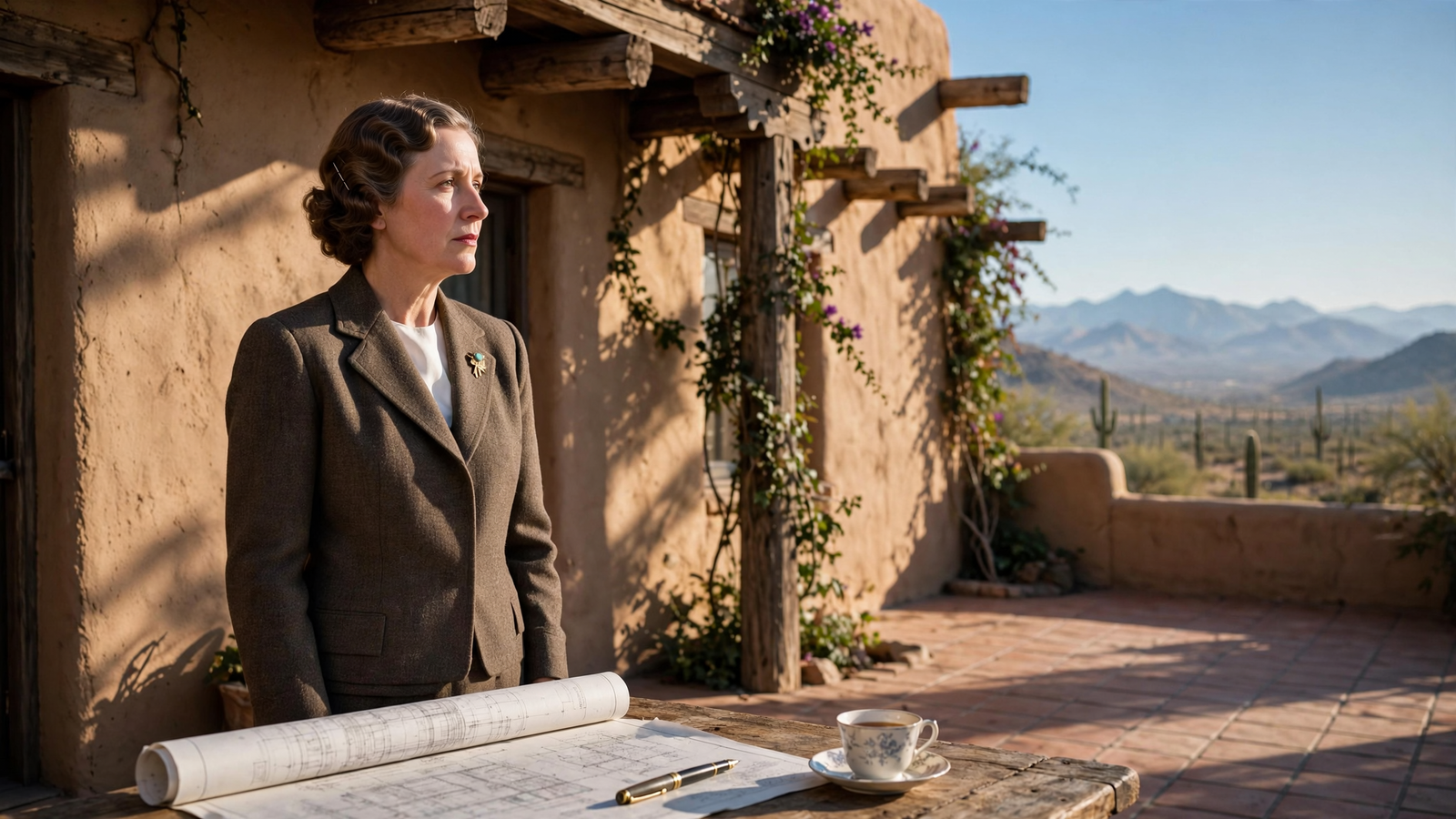
Before Arizona became known for sprawling suburbs, high-speed growth, and winter visitors, Isabella Greenway imagined a different kind of public life for the state—one built around hospitality, useful work, and civic responsibility. For related reading, see The WPA Poster: How the New Deal Put Art in Public Life.
Greenway is often remembered in brief descriptions: Arizona’s first woman elected to Congress, a friend of Eleanor Roosevelt, or the founder of Tucson’s Arizona Inn. Each description is accurate, but none is complete. Her importance lies in the way those roles connected. Greenway treated public service as an extension of everyday problem-solving. A hotel could create jobs. Furniture could be designed around workers’ abilities. A political office could be used to bring overlooked needs into national view. For related reading, see The Interstate Highway System: How America Built a New Kind of Road.
Her story also complicates the usual image of an Arizona pioneer. Greenway was not simply a frontier survivor or a political first. She was an entrepreneur, designer, advocate for disabled veterans, and legislator who helped define what an Arizona public figure could be in the twentieth century. For related reading, see Acker Park: The Prescott Preserve That Makes Room for a Wilder Kind of City Life.
A new life in the Southwest
Isabella Selmes was born in 1886 in Kentucky. She came west after marrying Robert Ferguson, an Arizona rancher and former Rough Rider associated with Theodore Roosevelt. The couple settled in Arizona, where Greenway became part of the state’s small but changing political and social world.
Her early life in Arizona was shaped by both privilege and hardship. The Ferguson family had connections, but Greenway also experienced the instability that could accompany ranching, travel, illness, and sudden loss. After her husband’s death, she was left to raise children and manage the responsibilities of a family in a state still developing its institutions.
Those experiences appear to have influenced the practical style that later became her signature. Greenway did not approach public life primarily through grand speeches or ideological declarations. She tended to focus on whether a community had work, housing, transportation, health care, and places where people could gather.
Work designed around ability
One of Greenway’s most distinctive projects grew from her concern for wounded and disabled veterans. After World War I, many veterans returned home with injuries that made previous occupations difficult or impossible. The challenge was not only medical treatment. It was also the question of how people could regain independence and meaningful employment.
Greenway helped establish a furniture enterprise that employed disabled veterans and adapted production to the abilities of its workers. The effort reflected a broader shift in thinking: rehabilitation did not have to end with medical care. It could include training, craftsmanship, income, and a renewed place in community life.
The furniture itself also carried a regional identity. Pieces associated with Greenway’s work used Southwestern motifs and materials, helping turn Arizona design into something more intentional than a collection of tourist images. The project joined social reform with design. It asked what objects should look like, but also who should have the opportunity to make them.
That combination was unusual for its time. Veteran assistance was often discussed in terms of pensions or hospitals. Greenway’s approach emphasized production and participation. A workshop could be both a business and a form of rehabilitation.
The Arizona Inn as a civic experiment
In 1930, Greenway opened the Arizona Inn in Tucson. It was a moment when the country was entering the Great Depression, and the hospitality industry faced serious economic uncertainty. Yet the inn was not conceived merely as a resort for visitors seeking warm weather.
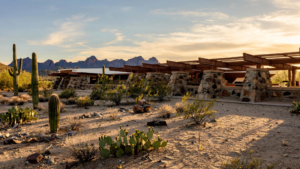
Greenway helped shape the inn as a coherent environment: low buildings, gardens, courtyards, Southwestern design, and a scale that encouraged guests to move through the property rather than simply occupy a large hotel tower. Its character depended on the relationship between architecture and daily life.
The inn also reflected Greenway’s belief that a business could serve as an instrument of local development. It created employment, gave regional artisans a market, and presented Tucson as a place with its own visual and cultural identity. The goal was not to imitate an Eastern hotel or erase the desert setting. It was to make the landscape part of the experience.
That idea helped distinguish Greenway from developers who saw Arizona mainly as a blank space for expansion. At the Arizona Inn, the desert was not treated as an obstacle to be covered over. It became part of the design vocabulary.
From local builder to national officeholder
Greenway entered electoral politics during a period when women were still relatively new to national political office. The Nineteenth Amendment had established women’s constitutional right to vote in 1920, but representation remained limited. Arizona had granted women voting rights before the federal amendment, and the state’s political culture provided an early opening for women’s civic participation.
In 1932, Greenway won election to the U.S. House of Representatives. She became the first woman elected to Congress from Arizona and served from 1933 to 1937. Her arrival in Washington coincided with Franklin D. Roosevelt’s first term and the expansion of federal programs during the New Deal.
Greenway’s background made her an unusual member of Congress. She was not primarily a career politician. She came from the worlds of ranching, business, design, and regional development. That experience shaped the subjects she brought to public office, including veterans’ affairs and the economic needs of the West.
She also belonged to a political generation that understood public administration as something tangible. Government was expected to build, organize, employ, and repair. For Greenway, that practical orientation was connected to what she had already attempted in Arizona. Her furniture work and inn were small-scale institutions; Congress offered a larger platform for similar questions.
Her congressional career was relatively brief, but its symbolic importance was considerable. Arizona’s first woman representative was not presented as a figure detached from the state’s economic life. She carried into Washington the perspective of someone who had managed a business, raised a family, worked with veterans, and helped create a regional design identity.
A legacy larger than a first
Historical “firsts” can make a person easier to remember and harder to understand. Greenway’s election is an important milestone, but the more revealing story is the network of projects around it.
She demonstrated that public leadership could emerge from places not usually treated as political institutions. A workshop could expose the limits of existing ideas about disability. A hotel could influence the cultural image of an entire city. A legislator could draw authority from practical experiments carried out before entering office.
Her career also shows how Arizona’s history was shaped by people who linked the state to national movements. Veteran rehabilitation, women’s political participation, New Deal policy, regional architecture, and the growth of tourism all met in Greenway’s life. None of those developments belonged exclusively to Arizona, but each took on a particular form there.
The Arizona Inn remains the most visible part of her legacy, while her congressional service gives her a firm place in the history of women in American politics. Yet the fullest picture is found between those landmarks: in the idea that economic life, design, and public responsibility did not have to be separate pursuits.
Isabella Greenway’s Arizona was still becoming itself. Through workspaces, gardens, furniture, and legislation, she helped argue that growth could be more than expansion. It could mean building institutions that gave people a reason to participate in the future.
Use: Congressional service, election history, and Greenway’s status as Arizona’s first woman representative.
Use: Arizona biography and historical context for Greenway’s public career.
Use: Historical context for the Arizona Inn and its regional architectural significance.
Use: Background context on Arizona’s twentieth-century civic, political, and cultural history.
U.S. House of Representatives, Office of the Historian — Isabella Greenway — https://history.house.gov/People/Detail/13956 — Congressional service, election history, and Greenway’s status as Arizona’s first woman representative.
Arizona State Library, Archives and Public Records — Isabella Greenway — https://azlibrary.gov/sla/agency_histories/greenway — Arizona biography and historical context for Greenway’s public career.
National Park Service — Arizona Inn Historic District — https://www.nps.gov/places/arizona-inn-historic-district.htm — Historical context for the Arizona Inn and its regional architectural significance.
Arizona Historical Society — https://arizonahistoricalsociety.org/ — Background context on Arizona’s twentieth-century civic, political, and cultural history.