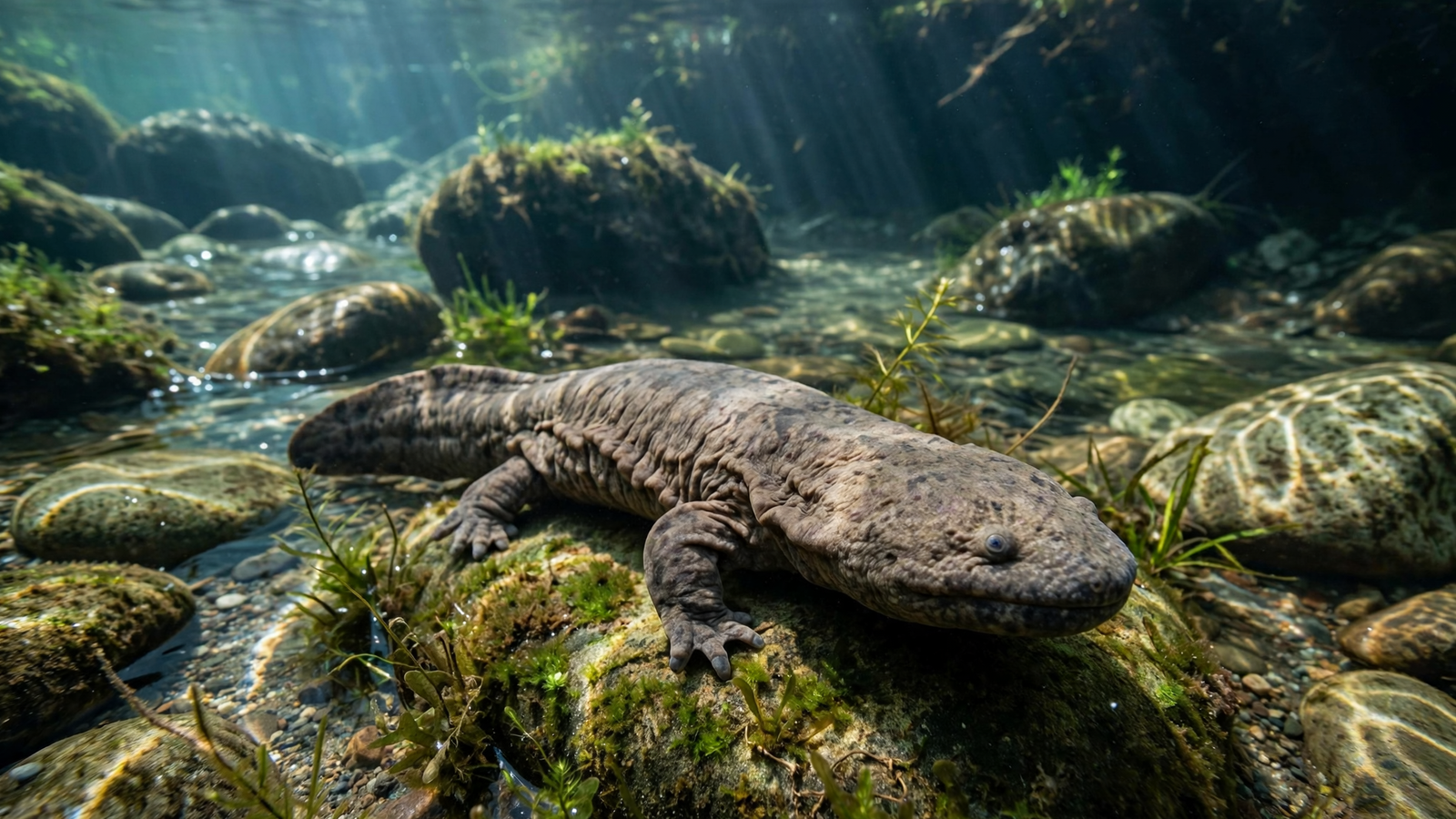
In the clear, cold rivers of the eastern United States, a strange-looking animal hides beneath flat stones. It has a broad head, tiny eyes, a flattened body, and loose folds of skin running along its sides like a fringe. Its appearance has earned it unflattering nicknames, but the hellbender is not a monster. It is a highly specialized river salamander—and one of the most revealing animals in an American stream.
The hellbender depends on a particular kind of habitat: clean, well-oxygenated water flowing over a bed of large rocks, with spaces underneath where the animal can shelter. When those conditions disappear, the salamander struggles. When they return, the hellbender can become part of the river’s recovery.
That is why conservationists across the Appalachian and Ozark regions are working to give this ancient amphibian a future. Zoos, state wildlife agencies, universities, and federal biologists are raising young hellbenders, protecting breeding sites, improving stream habitat, and learning which interventions give released animals the best chance to survive.
A salamander built for the river
The hellbender is the largest salamander in North America. Adults can reach roughly two feet in length, although individuals vary. Unlike many familiar salamanders, it spends its entire life in water. It does not transform into a land-dwelling adult.
Its skin is central to the way it lives. The folds along its body increase surface area, allowing the hellbender to absorb oxygen from moving water. The arrangement is especially useful in the cool, oxygen-rich streams where the species evolved. The animal also has lungs, but its skin does much of the work of respiration.
Hellbenders are generally active at night. They move across the streambed in search of crayfish, fish, insects, and other small aquatic animals. During the day, they can disappear beneath rocks so completely that even people looking directly at a suitable stream may not see one. For related reading, see NASA’s X-66A Is Redesigning the Airliner Wing for a Lower-Carbon Future.
Breeding brings a different kind of hidden drama. In late summer or early fall, a male prepares a nest beneath a submerged rock or ledge. A female deposits a long strand of eggs, and the male fertilizes them. He then guards the nest, fanning the eggs with his tail and defending the space from predators and other hellbenders. After hatching, the young remain small and vulnerable for a long period before taking on the appearance of adults.
Why the species began disappearing
Hellbenders are not simply affected by water pollution in the broadest sense. They are sensitive to a combination of changes that can alter an entire stream: muddy runoff, warmer water, lower oxygen levels, barriers that change natural flow, and the loss of large rocks that provide nesting and shelter sites.
Sediment is particularly damaging. Soil washing into a river can fill the spaces beneath rocks where hellbenders hide and breed. Fine material can also settle over eggs and reduce the flow of oxygenated water around them. Agricultural runoff, road construction, mining, and poorly managed development can all contribute to the problem.
Dams and other structures can change the character of a stream even when they do not directly block a hellbender’s movement. Water released from deep reservoirs may be colder or less oxygenated than the natural river flow. Elsewhere, impoundments replace the fast, rocky habitat with deeper, slower water.
The animal’s biology makes recovery difficult. Hellbenders grow slowly, mature late, and produce relatively few offspring compared with many other amphibians. A population can therefore decline for years before the loss becomes obvious. Its secretive habits add another challenge: a stream may still contain hellbenders, but at numbers too low to sustain itself.
Conservation began with learning the animal’s needs
One of the most important developments in hellbender conservation has been a shift from treating the species as an isolated curiosity to understanding it as part of a whole river system.
Biologists now examine water quality, stream temperature, rock structure, food availability, and the presence of suitable nesting sites. Surveys may involve turning rocks carefully, using underwater searches, marking individual animals, or applying newer monitoring techniques such as environmental DNA. Because a hellbender leaves traces of genetic material in the water, researchers can sometimes detect its presence without capturing the animal.
The information helps conservationists identify streams where remaining populations are strong, locations where animals may be hanging on in small numbers, and places where habitat improvements could make a meaningful difference. For related reading, see Octavia E. Butler: How a Pasadena Writer Made the Future Speak to the Present.
In some rivers, crews have installed artificial shelters made from carefully positioned blocks or other materials. These structures are intended to recreate the dark, protected spaces hellbenders use for shelter and nesting. They do not replace healthy natural habitat, but they can provide an important bridge while stream conditions improve.
Raising young hellbenders for release
Captive breeding is another part of the strategy. Facilities such as the Saint Louis Zoo have worked with state agencies and other partners to raise hellbenders under controlled conditions. The goal is not to keep the species in zoos indefinitely. It is to produce healthy young animals that can be returned to appropriate rivers, while also developing knowledge about hellbender reproduction and early survival.
Young hellbenders are challenging to raise. They require carefully managed water, appropriate food, and conditions that support normal development. Hatchery and zoo staff must also consider how to prepare animals for life outside human care. An animal that has never encountered natural shelter or river currents may need a gradual introduction to the physical conditions it will face after release.
For that reason, some conservation programs use a “head-starting” approach. Young animals are protected during their most vulnerable early period and released when they are larger and more likely to withstand predators, competition, and the demands of the river.
Releases are not judged by a single dramatic moment. Biologists may track animals with markings, tags, or other methods to determine whether they remain near the release site, grow normally, find shelter, and eventually reproduce. Those results can influence future releases and help researchers distinguish between a promising technique and one that merely looks promising at first.
A recovery effort with benefits beyond one salamander
Hellbender conservation is valuable because it protects more than a rare amphibian. The same measures that help hellbenders can improve conditions for native fish, crayfish, aquatic insects, and other wildlife. Stable stream banks reduce sediment. Shaded waterways stay cooler. Connected floodplains absorb high flows. Clean, oxygen-rich water supports a much wider community. For related reading, see Casgevy: How CRISPR Gave Sickle Cell Medicine a New Future.
The species also gives people a memorable way to understand the health of rivers. It is difficult to overlook an animal that can grow as long as a person’s arm and breathe through its skin. That visibility can turn an abstract discussion about erosion or water quality into a question with a living answer: Could a hellbender survive here?
In parts of the Ozarks, the Ozark hellbender has received especially intensive attention because of severe population declines. In the Appalachian region, eastern hellbenders remain the focus of surveys, habitat work, and breeding programs. The details differ from one watershed to another, but the larger lesson is consistent: recovery depends on both animals and habitat.
What success looks like
There is no single national moment when the hellbender will be declared safe. Its range crosses many states, and each population faces a different mixture of pressures. Some rivers may need improved wastewater treatment or erosion control. Others may need better protection for breeding rocks, restoration of streamside forests, or changes in how water is released from dams.
Success may first appear in small ways: a young hellbender surviving after release, a nest found beneath a restored shelter, or a survey showing that a population is stable rather than continuing to shrink. Over time, the most encouraging sign would be natural reproduction in places where conservationists once had to provide the next generation themselves.
That kind of recovery is slow, but slowness is not the same as failure. The hellbender’s long life and specialized habits mean that conservation must be patient enough to measure progress over years. Every protected stream reach, every restored riverbank, and every animal that returns to the wild adds another piece to the larger effort.
The hellbender has survived for millions of years by finding what it needs beneath the moving water. Now people are learning how to make more American rivers suitable for it again. The result could be a future in which this unusual salamander is not merely remembered as a creature that once lived in clean mountain streams, but seen there—quietly, unexpectedly, and very much at home.
Use: Species biology, habitat needs, threats, and conservation status.
Use: Hellbender behavior, reproduction, habitat, and conservation information, including the Ozark hellbender.
Use: Captive-breeding, head-starting, and release efforts involving hellbenders.
Use: Natural history and the species’ relationship to healthy freshwater ecosystems.