There are places in Yavapai County that announce themselves immediately. Jerome clings to its mountainside. Sedona turns every road toward red rock. Prescott gathers people around a historic square and a web of trails.
Mingus Lake is quieter than all of them.
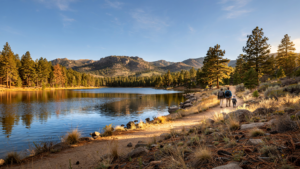
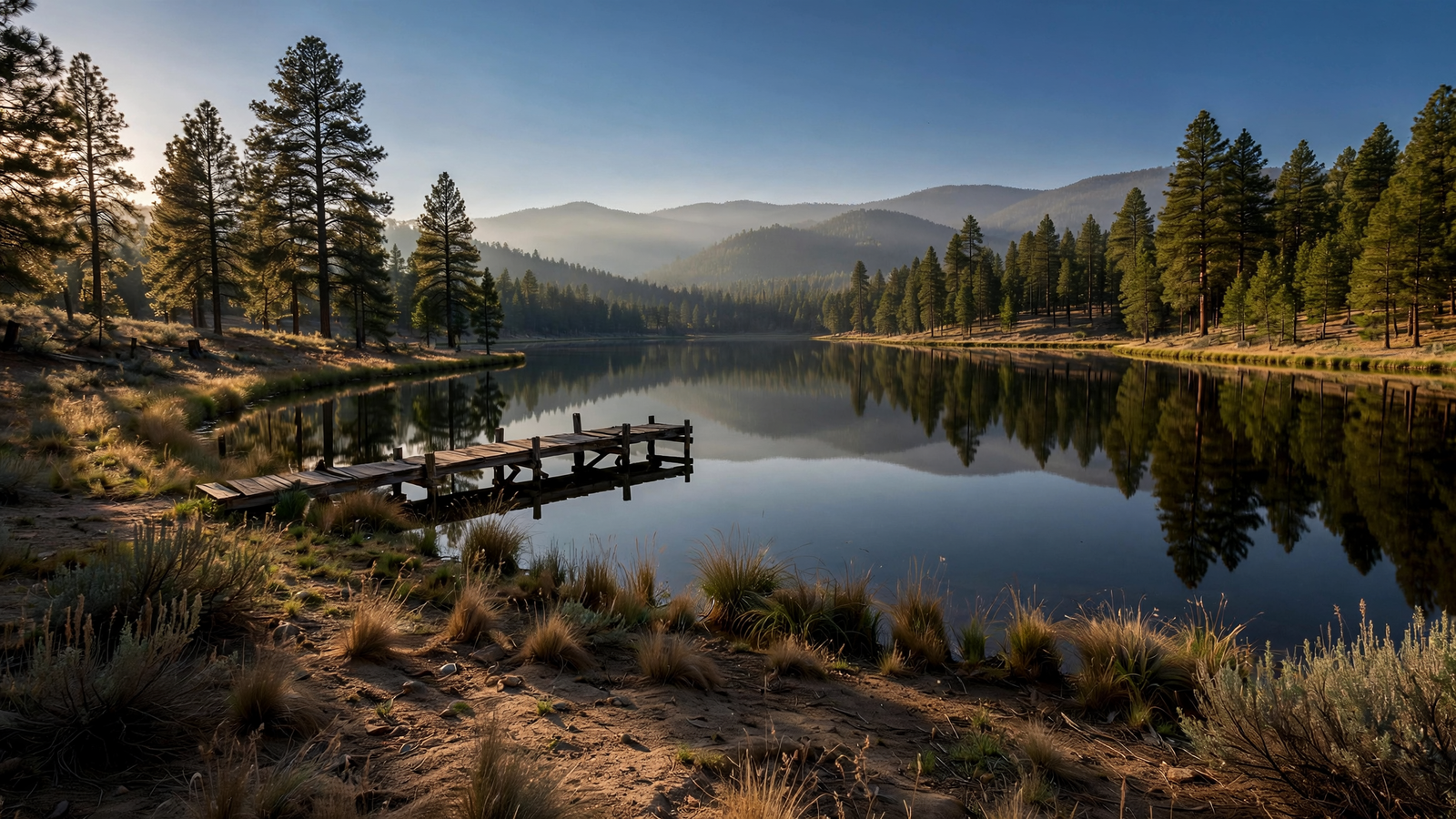
Set high on Mingus Mountain in the Prescott National Forest, the small lake is not a destination built around spectacle. It has no grand canyon view, no famous downtown and no long list of attractions competing for attention. Its appeal is more elemental: cooler mountain air, a forested shoreline, a fishing rod resting beside the water and enough distance from the valley to make an ordinary afternoon feel different.
That modest scale is part of what makes Mingus Lake worth noticing. In a county known for dramatic landscapes, it represents another kind of public place—one designed less for sightseeing than for slowing down.
A mountain lake above the Verde Valley
Mingus Lake sits on the broad summit of Mingus Mountain, between the Prescott area and the Verde Valley. The mountain forms part of the transition between two very different Arizona environments. Below are the warmer, drier communities of Cottonwood, Clarkdale, Jerome and Camp Verde. Higher up, the landscape becomes a forest of ponderosa pine, oak and other high-elevation vegetation.
The climb matters. A visit to Mingus Lake is not simply a trip to another body of water; it is a change in elevation and climate. On a hot valley day, the mountain can feel like a separate season. That does not make conditions predictable—weather can change quickly in the high country—but it gives the lake a practical role as well as a scenic one.
For residents of central Arizona, nearby mountain places can be valuable precisely because they do not require a major vacation. Mingus Lake is close enough to fit into a day trip, yet far enough from the valley’s heat and routine to create a clear sense of arrival.
A small lake with a clear purpose
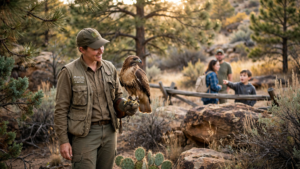
The lake is compact, and that helps define the experience. Visitors are not arriving at a resort or a large recreational complex. They come for a handful of compatible activities: fishing, picnicking, camping, wildlife watching and quiet time near the water.
Arizona Game and Fish identifies Mingus Lake among the state’s community and recreation fishing waters, and the lake is known for trout fishing when conditions and stocking schedules support it. Anglers still need to follow the state’s current rules, including licensing requirements, species regulations and any limits that apply at the time of a visit. Those details can change, so checking the agency’s current regulations is part of planning responsibly.
Fishing gives the lake a useful rhythm. It rewards patience rather than speed. A person can walk to the shoreline, cast for a while and discover that the main activity is not constant action but attention: watching the surface, reading the weather and noticing the movement of birds in the surrounding trees.
That makes Mingus Lake accessible to more than experienced anglers. A family can picnic without fishing. A visitor can bring binoculars instead of tackle. Someone passing through can simply sit near the shore and let the landscape do what it does best—reduce the number of things demanding immediate attention.
The forest is part of the attraction
It would be easy to describe Mingus Lake as though the water were the entire destination. In practice, the forest gives the lake much of its character.
The surrounding Prescott National Forest provides the larger setting: open mountain country, stands of pine, changing light and the sense of room that comes from being away from dense development. The lake is a focal point within that setting, but it does not dominate it. The shoreline, trees and sky work together.
That relationship is especially noticeable in the changing seasons. Summer brings the strongest contrast with the lower elevations. Autumn can bring color to the deciduous trees mixed through the mountain forest. Winter may introduce snow and more difficult travel conditions. Spring arrives unevenly at higher elevations, with lingering cold and changing access even after the valleys have warmed.
These seasonal differences are a reminder that Mingus Lake is a mountain place, not a year-round backyard pond. Visitors should check weather, road conditions, fire restrictions and forest alerts before leaving home. A destination can be peaceful and still require preparation.
A public place built around staying awhile
Many popular outdoor destinations are experienced in motion. People hike through them, drive to viewpoints or photograph them from a marked stop before continuing to the next attraction. Mingus Lake invites a slower pattern.
The lake’s value comes from the combination of simple facilities and natural surroundings. A picnic table, a shoreline, a campsite or a short walk can be enough. The experience does not depend on a tightly scheduled itinerary. That is increasingly meaningful in a region where heat, traffic and crowded recreation sites can make outdoor time feel surprisingly hurried.
There is also a social quality to a place like this. People share the same small landscape without necessarily participating in the same activity. One group may be fishing, another preparing lunch and another exploring the edge of the forest. The lake accommodates different versions of recreation while asking everyone to respect the same limited space.
That means the usual outdoor courtesies matter. Visitors should keep food and trash secured, avoid disturbing wildlife, follow posted fire rules, use established facilities and leave the shoreline as they found it. On a small lake, the effects of careless behavior are harder to hide. Stewardship is not an abstract principle here; it is what allows the place to remain pleasant for the next person.
Why small destinations matter in Yavapai County
Yavapai County’s identity is often carried by its best-known places. Those landmarks bring tourism, support local businesses and give the region a recognizable image. But a county is also shaped by less famous public landscapes—the places residents return to because they are manageable, familiar and quietly dependable.
Mingus Lake belongs to that second category.
It offers a different answer to the question of what an Arizona outdoor destination should be. It does not depend on vast scale. It does not need a dramatic geological story. Its promise is that a small mountain lake, properly cared for, can provide contact with water and forest in a state more commonly associated with desert, rock and wide-open dryness.
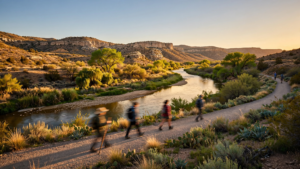
That contrast is especially important in Yavapai County, where several ecological worlds meet. A short drive can connect desert grasslands, riparian corridors, red-rock country and pine-covered mountains. Mingus Lake makes that variety tangible. The journey to the lake is part of the experience because it reveals how quickly the county’s landscape can change.
Planning a responsible visit
Before visiting, check the Prescott National Forest’s current recreation information and the Arizona Game and Fish Department’s fishing rules. Confirm whether the road, campground or facilities are open, and prepare for limited services. Bring water, food, sun protection and layers, even when the valley forecast looks warm. Cell service and amenities should not be assumed.
Visitors should also remember that high-country recreation carries risks that are easy to underestimate. Afternoon storms can develop quickly. Wildlife is present in the forest. Fire restrictions can alter what is permitted. Wet or snowy roads may be difficult, and a quiet site can become crowded on a pleasant weekend.
The best approach is uncomplicated: arrive prepared, use the place lightly and give the lake time to work its small magic.
Mingus Lake will not compete with Yavapai County’s headline attractions—and it does not need to. Its strength is the pause it creates between the valley below and the busy world beyond the trees. At the water’s edge, the county becomes less about checking off a landmark and more about inhabiting a landscape for a little while.