Some of Yavapai County’s most important places are easy to recognize. They rise above the landscape as cliff dwellings, hilltop pueblos or dramatic desert formations. Others are quieter. They occupy an ordinary-looking building, keep their treasures behind glass and ask visitors to slow down long enough to notice what the ground has been saying for centuries.
The Verde Valley Archaeology Center and Museum in Camp Verde belongs to that second category. It is not the kind of destination that competes with Montezuma Castle or Tuzigoot for visual drama. Its importance is different. The center gives the valley a place to explain itself.
That makes it one of the most useful cultural stops in Yavapai County today: a local institution where artifacts, maps, research and community memory come together to show how people have lived in the Verde Valley across thousands of years.
A museum built around a whole landscape
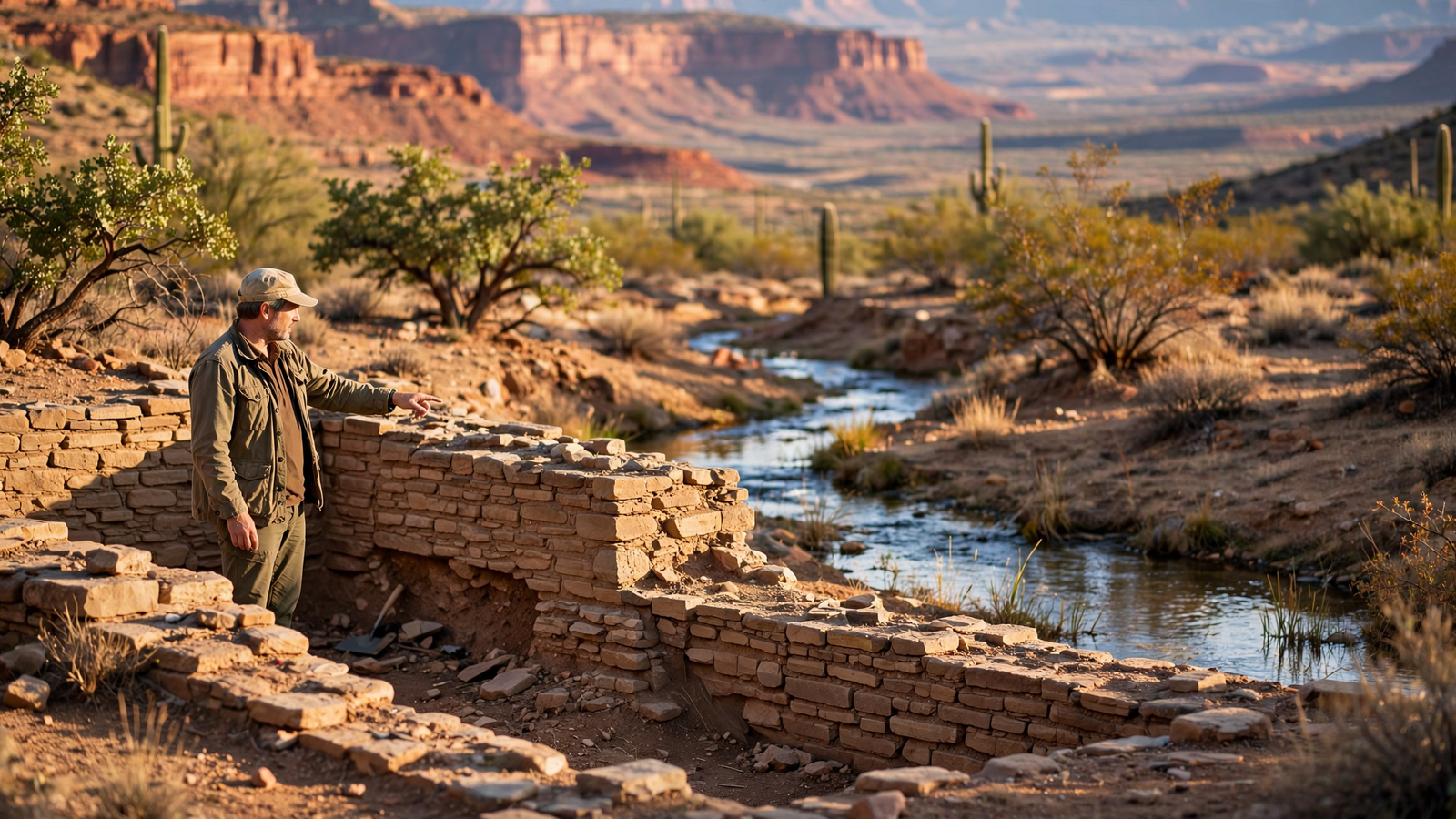
The Verde Valley is often introduced through individual landmarks. Montezuma Castle presents a remarkable cliff dwelling. Montezuma Well reveals an unusual desert spring. Tuzigoot places a pueblo on a high ridge above the river. Each site is memorable, but each also represents only one part of a much larger human story.
The archaeology center helps connect those places. Its exhibits and educational work place local objects within the geography that produced them: the Verde River and its tributaries, the surrounding mesas, the farmable terraces and the high country that has always shaped travel through central Arizona.
That wider view matters. Archaeology can become fragmented when visitors see only isolated ruins. A room of pottery may appear to be about pottery alone. A display of stone tools may seem detached from daily life. In the context of the Verde Valley, those objects become evidence of decisions made by real communities—where to settle, how to store food, how to move across difficult terrain and how to live with an unpredictable desert climate.
The museum’s local focus also provides something large national parks and major institutions cannot always offer: a close relationship with the place outside the door. The valley is not simply a backdrop for ancient sites. It is an active landscape where farming, tourism, conservation, residential growth and cultural stewardship continue to meet.
The people behind the artifacts
The archaeological record of the Verde Valley is often associated with the Sinagua, a term used by archaeologists for the Indigenous people who lived across much of the region before the modern era. Their communities built masonry pueblos, cultivated crops and developed ways to use the valley’s water and varied elevations.
But labels can make the past sound more distant than it was. The people represented by the artifacts in Camp Verde were not an abstract “culture” that appeared, flourished and disappeared. They were families and communities making practical and spiritual choices in a changing environment.
A local museum can help restore that human scale. A bowl is not merely a typology. A room is not merely an architectural feature. A planting area, grinding stone or shell bead can point toward the ordinary work that made community life possible.
It is also important to understand that archaeology does not mark the end of Indigenous history in the Verde Valley. Descendant communities and Native nations remain part of the wider story of the region. Ancient sites are not empty stages, and artifacts are not simply souvenirs of a vanished people. Responsible interpretation requires respect for cultural continuity, sacred places and the limits of what should be displayed or removed.
The National Park Service’s interpretation of Montezuma Castle and nearby sites makes a similar point in a different setting: the people who built these communities were part of a long and continuing Indigenous history, not just a chapter that ended when outside observers arrived.
Why local archaeology still feels current
A museum devoted to the past may seem removed from the pressing questions of the present. In Camp Verde, the opposite is true.
The Verde Valley continues to experience the pressures common to attractive Arizona communities: growth, limited water, increased visitation and the need to balance access with protection. Every new road, subdivision, utility project or tourism plan exists within a landscape that contains traces of earlier lives.
Archaeology gives residents and visitors a longer timeline for thinking about those decisions. It reminds us that the valley’s water has always been precious, that settlement patterns have always responded to geography and that the apparent emptiness of the desert can conceal a dense record of human use.
That perspective does not mean modern communities must freeze the valley in time. It does mean development can be approached with greater care. Surveys, preservation rules and responsible public interpretation are not obstacles to understanding a place; they are ways of making sure the place does not lose the evidence that makes it distinctive.
The center’s work also supports a more thoughtful kind of tourism. Visitors who begin with the museum may arrive at Montezuma Castle, Montezuma Well or Tuzigoot with better questions. They may notice construction details, agricultural traces and landscape relationships that would otherwise be easy to miss. The museum becomes a starting point rather than an endpoint.
A community institution, not just a display space
The value of the Verde Valley Archaeology Center lies partly in its role as a gathering point for knowledge. Museums of this kind often operate between several worlds: professional archaeology, public education, local history, volunteer work and the everyday curiosity of residents.
That combination gives the center a different rhythm from a large metropolitan museum. Its strength is not scale. It is proximity.
Someone visiting from outside Arizona can use the exhibits to decode the valley. A local student can encounter a history that happened nearby rather than in a distant textbook. Residents can see why an artifact found in the region matters beyond its appearance. Researchers and preservation advocates can help keep public attention on sites that may not have the instant recognition of a national monument.
Small museums also perform a less visible task: they help preserve a community’s habit of paying attention. Once people understand that ordinary hillsides, washes and fields may contain a record of earlier lives, the landscape becomes harder to treat as disposable.
Planning a visit
The museum is in Camp Verde, making it a natural stop for travelers moving through the Verde Valley. It can be paired with visits to the National Park Service sites in the area or with a broader exploration of the town and surrounding communities.
Because small museums may adjust hours, programming and exhibits seasonally, visitors should check the center’s official website before making a special trip. Allow time to read rather than simply pass through. The center is most rewarding when treated as preparation for seeing the valley itself.
Afterward, the landscape outside becomes part of the exhibit. The river corridor suggests why communities settled where they did. The mesas explain the defensive and agricultural logic of many sites. The distances between landmarks reveal how much movement and planning were required in a region that can look deceptively open.
The place between the ruins
Yavapai County has no shortage of famous destinations. The Verde Valley Archaeology Center offers a different kind of discovery because it focuses on the connections between them.
It shows that archaeology is not only about spectacular buildings or rare objects. It is also about patterns: the relationship between water and settlement, between tools and food, between architecture and climate, and between a community’s past and its responsibilities in the present.
That is why this modest Camp Verde museum deserves a place on the county’s cultural map. It keeps local history close to the people who live among it, gives travelers a richer way to understand the valley and makes the ancient landscape feel less like a collection of isolated attractions.
The Verde Valley’s ruins may draw the first glance. A place like the archaeology center helps visitors learn how to look again.