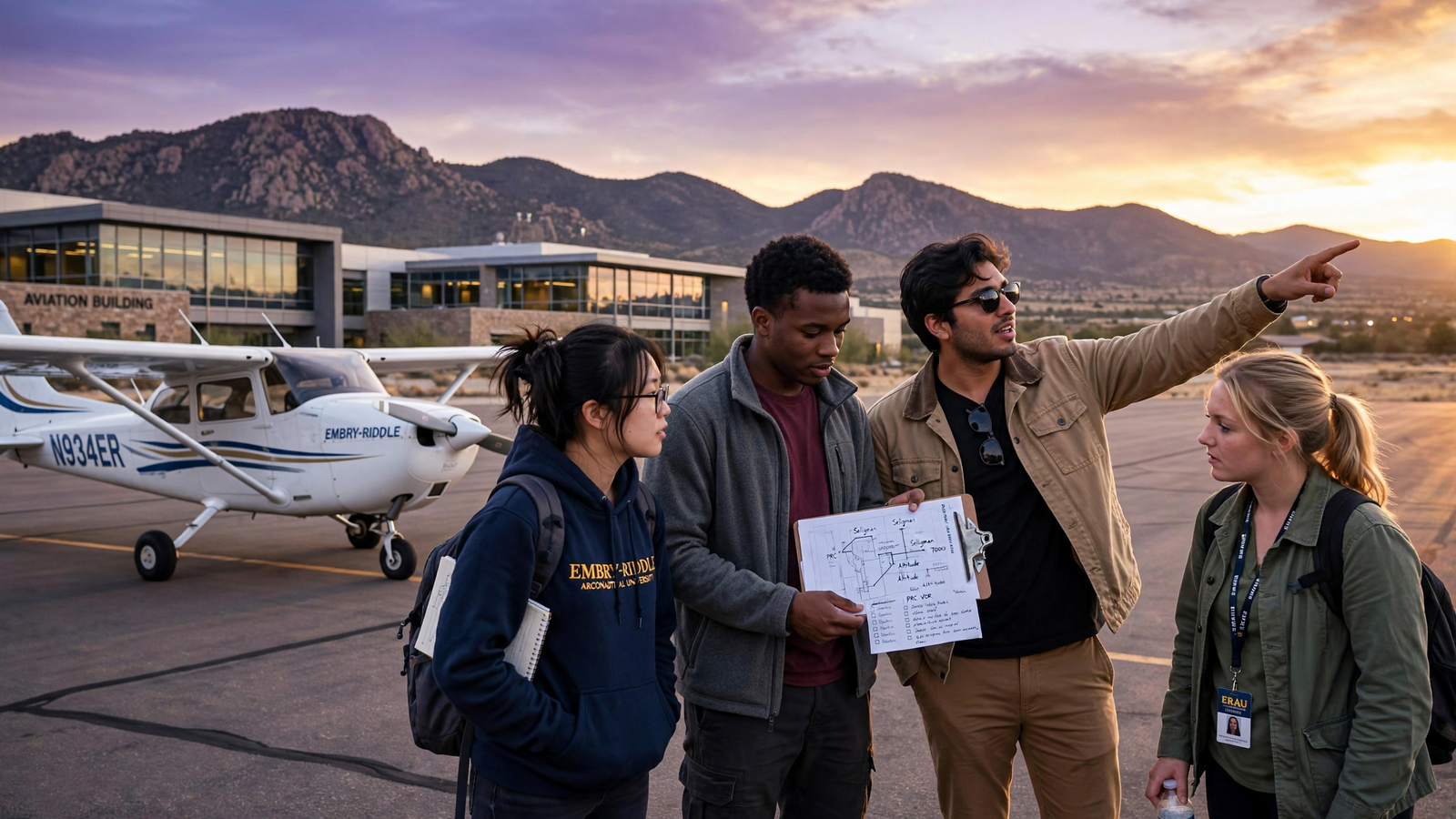
On a clear day in Prescott, the sky can feel less like a backdrop than an invitation. The city sits at roughly 5,000 feet in Arizona’s central highlands, surrounded by ponderosa pine, granite formations, and the open airspace of Yavapai County. At the edge of town, Embry-Riddle Aeronautical University’s Prescott Campus gives that setting a particular purpose: it makes the landscape around a mountain city part of an education in flight.
Embry-Riddle is not Prescott’s oldest institution, and it does not carry the visual drama of the courthouse or the Granite Dells. Its importance is quieter. The campus is a working academic environment where students study aviation, aerospace engineering, space physics, unmanned aircraft systems, cybersecurity, meteorology, and related fields. Aircraft pass through the nearby airport. Laboratories translate classroom theory into experiments. The surrounding terrain becomes a place to understand weather, navigation, geology, wildfire, and the practical demands of operating in the real world.
That combination has made the university one of Prescott’s most distinctive places: a campus where the city’s high-desert identity and Arizona’s long relationship with aerospace meet in everyday routines.
A university that arrived with a clear mission
Embry-Riddle’s roots reach back to the early days of aviation in the United States. The institution began in 1925 as an aviation school in Cincinnati, later expanding to Florida and then establishing its residential Prescott campus in Arizona. Today, Prescott is one of the university’s two residential campuses, alongside the larger campus in Daytona Beach, Florida.
The Arizona campus was built around an idea that remains visible in its academic structure: aviation is not a single subject. Pilots depend on weather information, aircraft design, navigation, communication, human factors, and increasingly sophisticated software. Space missions require engineering, physics, data analysis, operations, and an understanding of the environments beyond Earth. The university’s programs reflect that overlap rather than treating flight as an isolated specialty.
That breadth also helps explain why the campus belongs in a story about place. Embry-Riddle is not simply located in Prescott; much of its character comes from the way Prescott supports the institution’s work. The city provides a small-community setting, access to a regional airport, nearby public lands, and a climate that allows outdoor activity through much of the year. In turn, the university adds a specialized academic presence that reaches well beyond the traditional image of a college town.
The airport is part of the classroom
Prescott Regional Airport—Ernest A. Love Field—is a public-use airport north of the city. It handles commercial service, general aviation, business aircraft, emergency operations, and flight training. For Embry-Riddle students, the airport is also an essential piece of the learning environment.
Students in flight-related programs do not learn only from diagrams of runways or simulated instrument panels. Their education includes the practical systems that make aviation possible: preflight planning, communications, weather interpretation, aircraft performance, safety procedures, and decision-making. The university’s flight operations connect its students to the airport environment while also teaching them that aviation is a coordinated public system rather than a solo activity in the sky.
Prescott’s elevation and terrain add another layer. Pilots training in Arizona must account for changing weather, high-desert temperatures, mountain geography, and the differences between controlled and uncontrolled airspace. Those conditions do not replace formal instruction, but they give the lessons a physical setting. A student studying atmospheric conditions can look out over a landscape where weather changes are visible. A student learning navigation can see how ridges, valleys, and developed areas shape a route.
The relationship between the university and the airport also makes aviation part of Prescott’s public soundscape. The presence of aircraft is not an occasional spectacle reserved for an air show. It is part of the region’s daily infrastructure—and a reminder that a specialized form of higher education is operating nearby.
Learning beyond the cockpit
Although flight training is among the campus’s most recognizable activities, Embry-Riddle Prescott is organized around a much wider definition of aerospace. Its colleges and departments include programs in engineering, aviation, business, arts and sciences, security and intelligence, and space-related disciplines.
That mix reflects how modern aerospace work is actually done. An aircraft may begin as an engineering problem, but it becomes an operational problem, a human-factors problem, a cybersecurity problem, and a business problem as soon as people rely on it. A satellite may require advanced physics, but it also needs communications, mission planning, software, and a team capable of interpreting what it sends home.
The campus’s laboratories and student projects give those subjects a place to overlap. Engineering students can work with hardware and systems. Space-focused students can study the physics of the upper atmosphere and space environment. Students interested in unmanned aircraft can explore a technology that is changing surveying, emergency response, agriculture, infrastructure inspection, and scientific research. Cybersecurity students confront the fact that aviation and space systems depend on secure digital networks as much as they depend on engines and structures.
The result is a campus that feels less like a collection of unrelated majors and more like a series of connected doors. A question about how an aircraft flies can lead to questions about materials, energy, weather, navigation, software, or human judgment. That is one of the strongest educational advantages of a place devoted so thoroughly to one broad field.
Why Prescott matters to the campus
Embry-Riddle could have been built in a much larger metropolitan area. Instead, its Prescott campus developed in a city known for historic buildings, forested hills, public trails, and a slower rhythm than Phoenix or Tucson. That setting gives the university a different atmosphere from an urban research campus.
The surrounding environment is especially useful for subjects that depend on observation. Prescott’s elevation and relatively open skies support astronomy and atmospheric study. Its forests and rugged terrain provide a nearby laboratory for questions about fire, remote sensing, mapping, and environmental monitoring. The region’s distance from major urban congestion also makes the connection between campus and open space unusually immediate.
None of this means the university exists apart from the city. Students rent homes, shop, work, volunteer, and spend free time in Prescott. Faculty and staff contribute to the local economy and civic life. The airport serves the broader region, not just the university. The campus is one part of a place that also includes longtime residents, small businesses, public agencies, cultural institutions, and the landscapes that draw visitors to Yavapai County.
That shared setting can create the kind of exchange that is easy to miss when a university is treated as a self-contained institution. Prescott gives students a lived experience of community scale. The university gives the city a steady stream of people working at the intersection of transportation, technology, science, and public safety.
A place built around the next question
Aviation education has changed dramatically since the first flight schools opened. The modern aerospace workforce includes pilots, but it also includes autonomous-systems specialists, data scientists, spacecraft operators, software engineers, safety analysts, meteorologists, and researchers studying conditions that affect Earth and near-Earth space.
Embry-Riddle Prescott’s significance lies partly in its ability to bring those fields into the same geographic and academic conversation. The campus does not need to claim that every student will enter the cockpit or design a spacecraft. Its larger contribution is showing how many kinds of expertise are required to move through the air, operate above it, and understand the systems that make both possible.
For Prescott, that makes the campus more than a place where students attend classes. It is a local expression of a national story: the continuing expansion of aerospace from a specialized industry into a network of technologies that touches communications, transportation, weather, emergency response, security, and scientific discovery.
On the ground, the campus is a collection of lecture halls, residence buildings, laboratories, roads, and gathering places. In practice, it is also a threshold. One direction leads toward Prescott’s forests and granite hills; another toward the runways at Ernest A. Love Field; another toward the technical questions shaping the future of flight and space exploration. That is what makes Embry-Riddle a distinctive Prescott place—a mountain campus where the horizon is not the limit of the classroom, but part of the lesson.