In the summer of 1944, the American army in Europe had a weapon that could not fire a shell, carry a soldier, or hold a position. It was made of canvas, plywood, loudspeakers, radio equipment, paint, and nerve.
The weapon belonged to the 23rd Headquarters Special Troops, a secret formation better known today as the Ghost Army. Its soldiers were artists, engineers, radio operators, sound technicians, and conventional troops trained to create convincing evidence of an army that did not exist.
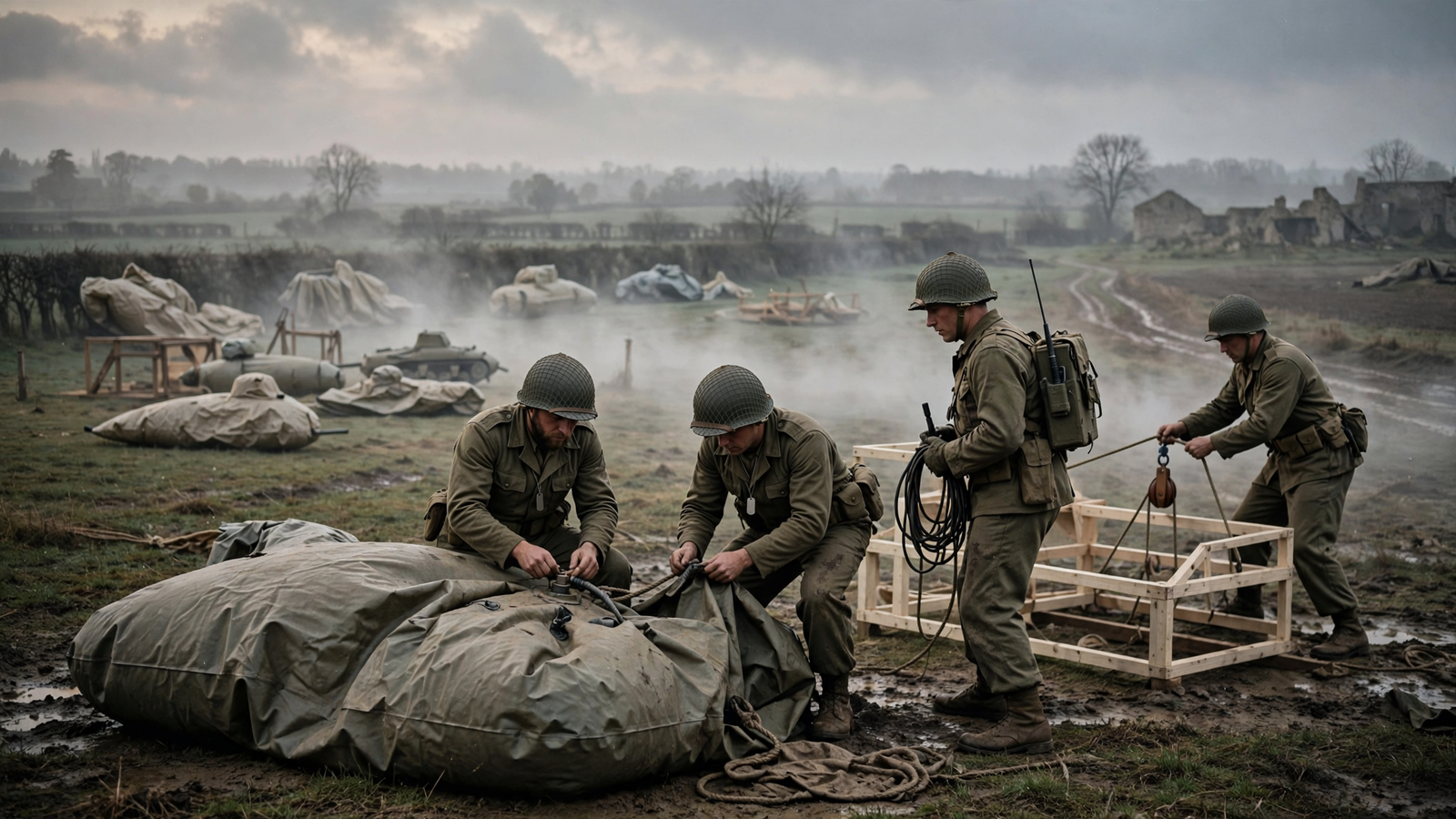
They built inflatable tanks that looked real from a distance. They transmitted carefully designed radio conversations. They played recordings of armored columns moving at night. They placed fake headquarters signs along roads and allowed selected enemy observers to see just enough activity to draw the wrong conclusion.
The goal was not to defeat German units in a direct fight. It was to persuade German commanders that American forces were larger, closer, or moving somewhere other than their actual destination. In a war where timing and information could determine whether an attack succeeded, the Ghost Army made uncertainty into a battlefield tool.
An Army Built for Deception
The unit was activated in January 1944, as the United States prepared for the invasion of Europe. Its existence reflected a hard lesson of modern war: armies did not rely only on what enemy soldiers could see from the ground. They also watched roads, intercepted radio traffic, studied aircraft photographs, and pieced together patterns of movement.
A successful deception had to survive more than one kind of inspection. A line of fake tanks might fool a distant observer but fail under aerial photography. A radio operator could imitate the transmissions of another unit, but experienced German listeners might recognize the wrong style. A sound recording could suggest a convoy, but only if it was used in a setting where the enemy expected to hear one.
The 23rd Headquarters Special Troops therefore combined several specialties. The 603rd Camouflage Engineers worked on visual deception. The 3132nd Signal Service Company developed sound-based operations. Radio operators practiced reproducing the communication habits of real formations. Other personnel helped create the physical signs of a large military presence: vehicle tracks, traffic, headquarters activity, and the general disorder of an army on the move.
Many of the men had civilian backgrounds in commercial art, design, theater, radio, and architecture. Those skills were not decorative additions. They helped the unit understand how people interpret appearances, how sound creates a sense of distance and movement, and how small details can make a staged scene seem ordinary.
Making Canvas Look Like Steel
The inflatable tanks were among the Ghost Army’s most recognizable tools. They were not intended to withstand close examination. Their purpose was to look convincing from a distance or from the air, especially when placed among genuine support activity.
Soldiers could move the decoys into position, inflate them, and arrange them beside imitation trucks and other equipment. From above, a collection of vehicles could suggest an armored force preparing for action. German analysts did not need to identify every tank correctly; they only needed to believe that a substantial formation might be present.
Visual deception also depended on the landscape around the equipment. Soldiers created the marks of traffic and occupation. They built dummy installations and used camouflage to blend the display into its surroundings. Sometimes the most persuasive part of the illusion was not the object itself, but the ordinary-looking activity around it.
This work demanded discipline. A fake unit had to appear to have a chain of command, a reason for being where it was, and enough movement to seem active. Too little activity made the position look abandoned. Too much made it suspicious. The Ghost Army was staging a performance for an audience that could not be allowed to know it was watching one.
The Sound of an Army That Wasn’t There
One of the unit’s most unusual capabilities came from sound. The 3132nd Signal Service Company recorded the noises of armored and supply formations, including engines, vehicles, and other activity associated with a large military movement. The recordings could then be played through powerful speakers.
Sound traveled beyond the visible edge of a position. At night, it could suggest trucks arriving, tanks assembling, or engineers building a crossing. Used carefully, it helped support the visual story. A distant observer who saw little might still hear enough to believe that a much larger force was nearby.
The technique was not a substitute for real military power. It worked because it was integrated with radio deception and physical staging. An apparent armored unit needed the radio traffic of an armored unit. A supposed headquarters needed guards, vehicles, signs, and mess activity. The illusion became stronger when separate clues appeared to confirm one another.
Deception in the European Campaign
After the Allied landings in Normandy, the Ghost Army moved through France and later into Belgium, Luxembourg, and Germany. Its operations were usually temporary. The unit might arrive near a threatened sector, construct the appearance of a major formation, and then withdraw once the deception had served its purpose.
In some cases, the Ghost Army impersonated specific American divisions. That meant reproducing their identifying markings, radio habits, traffic patterns, and command signals. The aim was to convince German intelligence that a real division was in one location when the actual troops were elsewhere.
The unit’s work was especially valuable when Allied commanders needed to protect a vulnerable movement or draw German attention away from an intended operation. A false concentration of troops could encourage the enemy to hold reserves in the wrong place. A simulated crossing could suggest an attack that never came. A phantom armored force could make German commanders hesitate while real American units advanced.
One of the best-known late-war operations took place near the Rhine in March 1945. The Ghost Army helped create the impression that a larger American force was preparing to cross the river at a different location from the main operation. The deception formed part of a broader effort involving real troops, camouflage, sound, and radio traffic.
It is difficult to measure the exact effect of any deception operation. Military decisions rarely depend on one clue, and German records do not always reveal how much weight commanders gave to the Ghost Army’s activity. The unit’s contribution should therefore not be reduced to claims that it single-handedly changed the war. Its value lay in making the enemy’s picture of the battlefield less reliable at critical moments.
The Cost of Being Invisible
The Ghost Army’s secrecy continued after the war. Veterans were instructed not to discuss their missions, and the unit did not receive the public recognition given to more conventional formations. For decades, many Americans knew little about the soldiers who had spent the war pretending to be someone else.
That silence also shaped the historical record. The unit’s work depended on concealment, and its veterans carried the habits of secrecy into civilian life. Only after records were declassified and veterans began sharing their experiences did the wider story become easier to reconstruct.
The surviving evidence shows a military organization that depended on imagination without abandoning rigor. Artists had to think like soldiers. Radio operators had to understand both technology and human expectation. Engineers had to build objects that were physically light but psychologically convincing. Every prop existed to influence a decision made by someone far away.
A Different Kind of Courage
The Ghost Army offers a different picture of military courage from the familiar image of troops advancing under fire. Its members served close to the front, often in dangerous conditions, but their most important contribution was frequently invisible. Success meant that the enemy noticed the wrong thing and that friendly troops reached their objectives with less resistance.
The unit also reveals how modern warfare widened the battlefield. Information, sound, visual evidence, and expectation could all become weapons. A tank did not have to be real to affect an enemy’s plans. A radio message did not have to describe an actual movement to send staff officers searching for a nonexistent force.
Today, the Ghost Army is remembered as a remarkable wartime experiment in deception. But its deeper lesson is more practical: armies fight not only over ground, but over what each side believes about that ground. In Europe during World War II, a small group of American specialists learned how to occupy that uncertain space—and make an absent army seem present.