For much of Phoenix, distance is not an abstract idea. It is the time spent crossing broad roads, finding parking, waiting in traffic, or deciding whether a short errand is worth making at all. For related reading, see The Grand Canalscape: How Phoenix Turned an Old Waterway Into an Everyday Route.
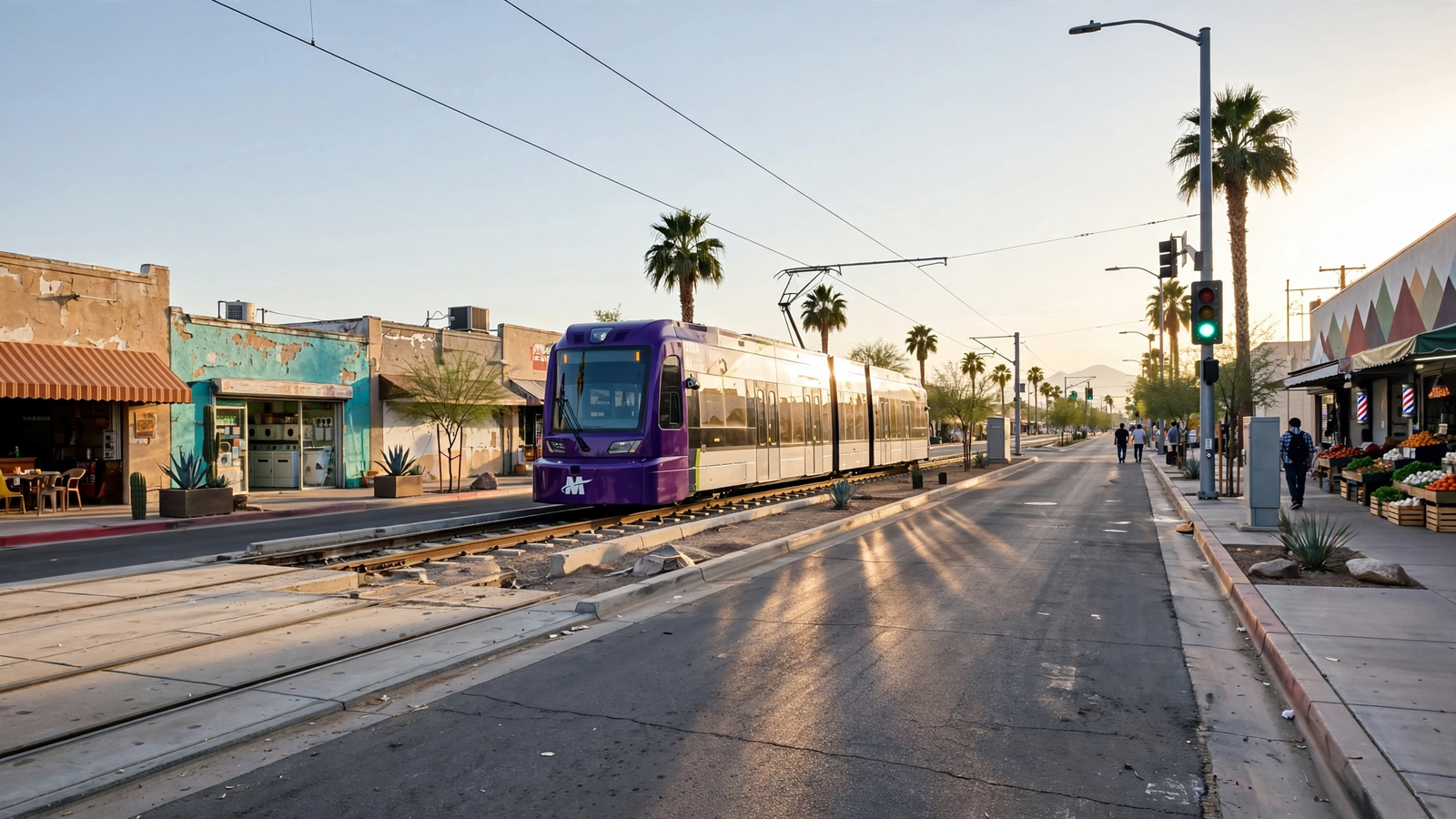
The city’s next major light-rail project is aimed at changing that calculation in South Phoenix. The South Central Extension/Downtown Hub will carry Valley Metro rail south from downtown along Central Avenue, creating a new connection between the central city, neighborhoods south of the Salt River, and the regional transit network. For related reading, see The Verde Canyon Railroad: How a Working Rail Line Became a Window Into Arizona’s Verde Valley.
The project is not simply a new line on a transportation map. It is an attempt to make ordinary movement more predictable: getting to work, reaching a medical appointment, visiting a library, meeting friends downtown, or making a transfer without needing a car for every part of the trip.
A rail line built around a daily corridor
The South Central Extension is planned as a roughly 5.5-mile extension from downtown Phoenix to Baseline Road, with seven new stations along Central Avenue and nearby streets. It is being built by Valley Metro in partnership with the City of Phoenix and the Federal Transit Administration.
Central Avenue is an important north-south spine. It passes through downtown, crosses the Salt River, and continues through South Phoenix toward neighborhoods, schools, businesses, medical services, and community institutions. Yet the corridor has long been shaped primarily by automobiles. Wide intersections and long distances between destinations can make walking difficult, while bus riders often face the same traffic that slows everyone else.
Light rail cannot solve every problem along the avenue. It will not eliminate heat, traffic, housing costs, or the need for local bus service. But it can provide a dependable backbone for trips that are currently slower or more complicated than they need to be.
That reliability matters in a region where summer temperatures can make a long walk or an unshaded wait especially difficult. A rail station does not replace shade, safe crossings, or comfortable sidewalks, but a well-designed transit corridor can bring those needs into the same public conversation.
Connecting South Phoenix to the wider Valley
Valley Metro’s existing light-rail system already links Phoenix with Tempe and Mesa. The South Central project extends that network into a part of Phoenix that has historically had fewer high-capacity transit options.
At the northern end, the project includes a downtown hub intended to improve transfers among light rail lines and other forms of transit. The hub is important because a rail system becomes more useful when passengers can change direction without making an unnecessarily long trip or crossing an uncomfortable gap between services.
For a rider in South Phoenix, the value of the extension may be measured less by the length of the line than by the destinations it makes easier to reach. A trip could involve one train instead of several buses, a simpler transfer downtown, or a more direct route to jobs and services in the central city.
The same connection works in the opposite direction. Downtown residents, workers, and visitors will have a more direct rail route to South Phoenix. That can support businesses along the corridor and make neighborhood institutions more visible to people who might otherwise pass through the area without stopping.
Why the stations matter as much as the tracks
Transit projects are often described in miles of rail and numbers of stations. For everyday passengers, however, the experience begins before the train arrives.
A useful station needs safe approaches, clear crossings, shade, lighting, seating, information, and enough room for passengers to wait without feeling exposed to traffic. It also needs connections to buses, bicycles, wheelchairs, and the surrounding sidewalk network.
The South Central project includes improvements along the corridor that are intended to make access to the stations more practical. Those improvements are significant because a rail line is only as accessible as the first and last several hundred feet of a trip.
This is particularly important in South Phoenix, where residents and community organizations have raised concerns over construction impacts, displacement, access to businesses, and the long-term distribution of benefits. A new station can bring opportunity, but it can also place pressure on rents and property values if public investment is not matched by protections for existing residents and businesses.
That tension is part of the project’s real story. Better transit should not require a neighborhood to become unaffordable before the people who live there can benefit from it.
A long construction story with a practical purpose
The extension has taken years of planning, design, funding work, utility relocation, street construction, and community coordination. That process can be frustrating for residents and merchants, especially when construction changes traffic patterns or temporarily makes access more difficult.
Large infrastructure projects are rarely experienced as a smooth line from approval to opening. They arrive in stages: survey work, lane changes, concrete barriers, track installation, station construction, testing, and adjustments. The public sees the disruption before it sees the finished service.
But the purpose of the project is ultimately ordinary. It is about whether a person can reach a destination without owning a car, whether a worker can make a transfer without losing an hour, and whether a teenager or older adult has more freedom to move independently.
Those benefits can be easy to overlook because they do not always appear as dramatic events. A transit line succeeds through repeated small uses: the same ride to work every morning, the same stop for a medical appointment, the same evening trip home, and the same familiar station becoming part of a neighborhood’s routine.
Heat, access, and the shape of a Phoenix trip
Phoenix’s transportation choices are closely tied to climate. In cooler months, walking a few blocks or waiting outside may be manageable. In extreme heat, the same trip can become a serious barrier, particularly for people without air conditioning, flexible work schedules, or access to a private vehicle.
That makes the design of the entire corridor important. Rail service needs to be supported by shade and shelter, but also by frequent buses, dependable operations, accessible sidewalks, and buildings that place useful destinations near stations. A train can move people efficiently between stops; the surrounding public realm determines whether people can comfortably reach those stops.
South Central Phoenix also illustrates why transit is a land-use decision. Rail can encourage new housing, shops, and services near stations. It can help turn a road used mainly for passing through into a sequence of places where people stop. Whether that change benefits current residents depends on decisions about zoning, housing affordability, small-business support, and public space.
The line therefore represents two connected projects: the physical construction of a railway and the civic work of deciding what kind of corridor should grow around it.
What success will look like
Success will not be measured only by ridership figures, though those will matter. It will also be visible in less dramatic ways.
- A resident can reach downtown without arranging a ride.
- A worker can make a reliable transfer between rail and bus.
- A student can travel to a class, library, or job with greater independence.
- An older passenger can reach a medical appointment without navigating several car-dependent connections.
- A local business gains customers without losing its neighborhood identity.
- A station feels like a public place rather than an island beside moving traffic.
Those outcomes are not automatic. They depend on service frequency, maintenance, safety, fare policy, station design, and whether the city protects the people and businesses already in the corridor. Still, the extension creates an opportunity that South Phoenix has not had at this scale: a permanent transit investment organized around the neighborhood rather than around the highway.
A different idea of how close Phoenix can feel
Phoenix is often described through its vastness. The city’s broad streets and spread-out development make the region feel larger than a single urban place. The South Central Extension offers a different way to understand that landscape.
It suggests that distance is not fixed. A destination can become closer when the trip is direct, frequent, comfortable, and affordable. A neighborhood can become more connected without losing its own character. A major public project can be judged not only by its engineering but by the everyday choices it makes possible.
When the line enters regular service, its most important moments may be quiet ones. Someone will board for a routine shift. Someone else will take the train to an appointment, a store, a park, or a meeting downtown. For those riders, the project will stop being a construction zone and become part of the city’s daily rhythm.
That is the promise of South Central Phoenix’s new rail connection: not a spectacular transformation overnight, but a gradual reshaping of how close ordinary life can feel.
Use: Project route, approximate length, station count, downtown hub, and project purpose.
Use: City partnership, corridor context, construction information, and local project details.
Use: Federal New Starts program context and the role of federal funding in major transit projects.
Use: Regional light-rail network context and connections among Phoenix, Tempe, and Mesa.
Valley Metro — South Central Extension/Downtown Hub — https://www.valleymetro.org/project/south-central-extensiondowntown-hub — Project route, approximate length, station count, downtown hub, and project purpose.
City of Phoenix — South Central Extension — https://www.phoenix.gov/publictransit/projects/south-central-extension — City partnership, corridor context, construction information, and local project details.
Federal Transit Administration — Capital Investment Grants — https://www.transit.dot.gov/capital-investment-grants — Federal New Starts program context and the role of federal funding in major transit projects.
Valley Metro — Rail — https://www.valleymetro.org/rail — Regional light-rail network context and connections among Phoenix, Tempe, and Mesa.