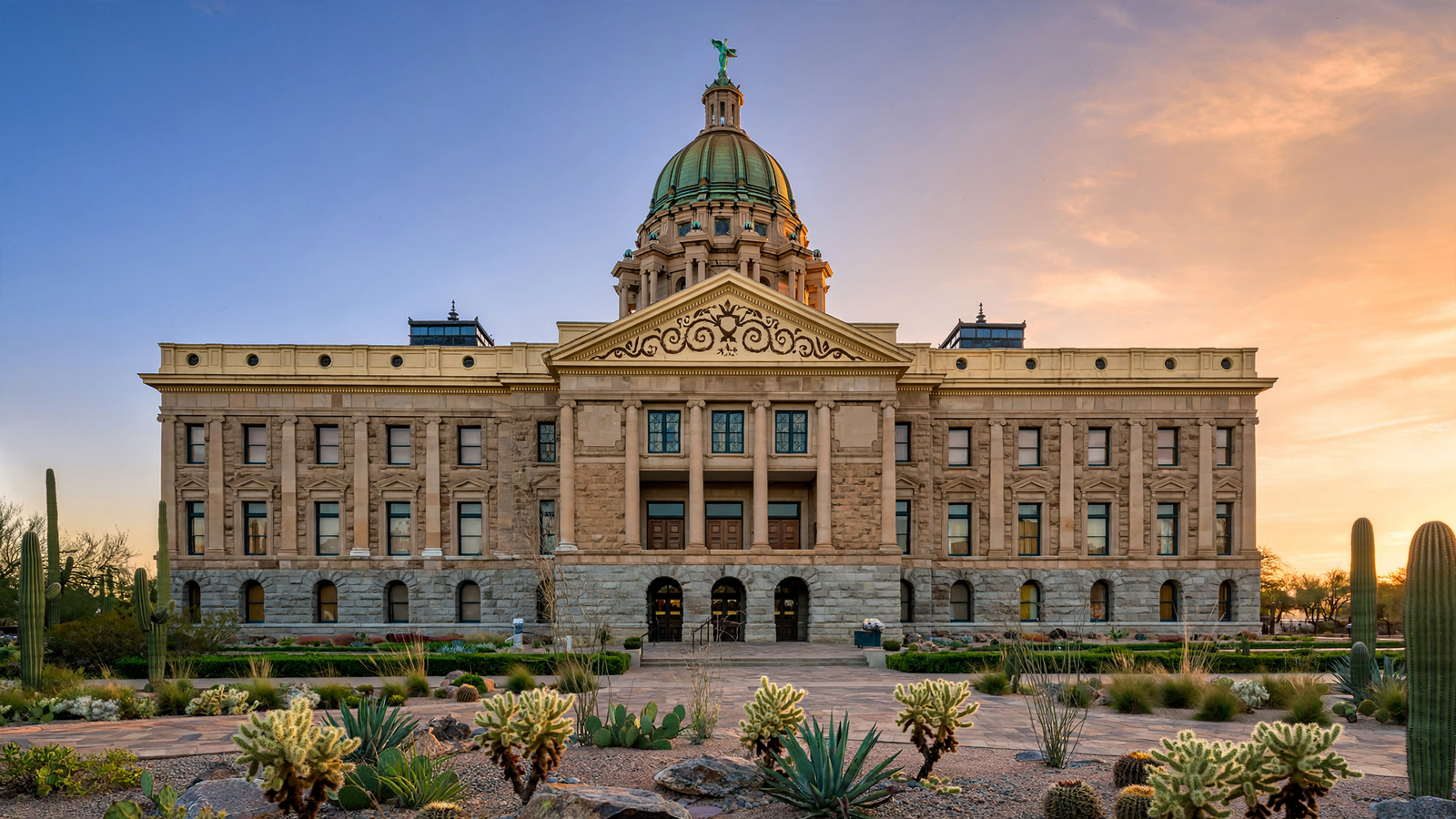
In downtown Phoenix, the Arizona State Capitol does not look like the seat of a vast modern state. Its scale is modest, its sandstone-colored walls are low against the city skyline, and its copper dome has weathered into the green-blue shade that has become one of the most recognizable details in Arizona’s civic landscape. For related reading, see The Rosson House: How a Phoenix Victorian Home Kept Territorial Arizona in View.
That modesty is part of the building’s meaning. The Capitol was planned when Arizona was still a U.S. territory, when Phoenix was a young desert settlement and the future of the region was far from certain. The building became the center of territorial government, witnessed Arizona’s admission to the Union in 1912, and later made room for a museum devoted to the state’s political and public history. For related reading, see S’edav Va’aki Museum: How Phoenix Keeps an Ancient Desert City in View.
Rather than remaining only a ceremonial address, the historic Capitol now works as a public record. Its rooms, objects and exhibits help explain how Arizona’s government developed—and how a territory with a small population became a state with responsibilities stretching from the Grand Canyon to the borderlands and rapidly growing cities.
A government building for a young territory
Arizona’s territorial government had operated from a series of temporary or adapted spaces before construction began on a permanent Capitol in Phoenix. The building was designed in the late 1890s, when the territory was trying to establish Phoenix as an administrative and commercial center.
Construction took place from 1898 to 1900, according to the Arizona State Capitol Museum. The original structure brought the territory’s executive, legislative and judicial functions into one formal public setting. Its design combined practical office space with the visual language expected of a government building: a central dome, symmetrical massing and a prominent position at the end of Washington Street.
The building’s materials also connected it to the region. The exterior used locally available stone and masonry, while the dome provided a distinctive vertical marker in a city that was still largely low-rise. At the time, the Capitol stood in a landscape of open lots, irrigation agriculture and scattered development rather than the dense urban grid that surrounds it today.
It was not an imperial building. It was a working place for a government still proving that it could function. Legislators debated territorial laws there, governors administered a growing region from its offices, and public visitors encountered the machinery of government in a building designed to make that machinery visible.
The dome that became a state symbol
The copper dome is among the Capitol’s most memorable features, but it was not simply decorative. In a young capital, a dome announced permanence. It helped distinguish the building from ordinary commercial blocks and gave Phoenix a civic landmark at a time when the city had few large public structures.
Over time, the copper changed color through exposure to the desert atmosphere. The resulting patina became part of the building’s identity. In photographs of early Phoenix, the Capitol appears as a compact but unmistakable anchor at the edge of town. In contemporary Phoenix, it is surrounded by office towers, government buildings and busy roads, yet the dome continues to provide a visual link to the city’s territorial period.
The building also reveals how Arizona’s public image evolved. Early civic leaders wanted a capital that could support a bid for statehood, but they were working in a territory often portrayed by outsiders as remote, sparsely settled and economically uncertain. The Capitol offered a different argument: Arizona possessed institutions, public ambitions and a political community capable of governing itself.
From territorial seat to state Capitol
Arizona entered the Union on February 14, 1912. The admission transformed the legal status of the government operating in the building, but the Capitol remained part of the state’s political life. Arizona’s first state officials and legislators used the existing structure as the new state government took shape.
For several decades, the building served a state whose population and responsibilities were expanding. Arizona’s growth brought new demands for offices, hearing rooms and legislative space. The original Capitol had been sized for a territory of a much smaller scale, and its limitations became increasingly apparent as the twentieth century progressed.
New legislative buildings were constructed beside the historic structure in the 1960s. The House of Representatives and Senate eventually moved into larger facilities, while the executive branch also developed offices elsewhere. The change reflected a practical reality: the state government had outgrown the building that had once contained nearly all of its central functions.
That transition could have left the original Capitol as an obsolete shell. Instead, Arizona treated it as a place with a different civic role. The building became the Arizona State Capitol Museum, preserving its architecture while turning its rooms into galleries about Arizona government, culture and public history.
What a Capitol museum can preserve
The museum’s value is not limited to portraits of governors or displays about elections. A former seat of government can preserve the everyday texture of public life: the desks where officials worked, the equipment used to communicate across long distances, the objects chosen to represent Arizona and the physical arrangements that shaped how people encountered government.
Among the museum’s notable holdings is the USS Arizona silver service, a collection of silver and serving pieces associated with the battleship USS Arizona. The ship was commissioned in 1916 and was sunk during the attack on Pearl Harbor in 1941. The silver service was later returned to Arizona and is displayed as part of the state’s connection to the vessel and the people who served aboard it.
The museum also interprets Arizona’s statehood story and the development of its public institutions. Exhibits address governors, legislators, state symbols and major chapters in the state’s political history. The building itself supplies much of the context: visitors move through former offices and public rooms rather than encountering Arizona’s past only as a sequence of labels detached from place.
That distinction matters. Government history is often presented as a list of dates and officeholders, but the Capitol makes it possible to imagine how government was physically organized. A meeting room, corridor or office can reveal the scale of an earlier administration more clearly than a statistic can. The building shows that statehood was not only a legal event in 1912; it was also an ongoing process of creating offices, procedures and public expectations.
A landmark in a changing capital
Phoenix has changed dramatically since the Capitol opened. The city grew from a small agricultural community into the center of one of the nation’s largest metropolitan areas. Irrigation, railroads, highways, air conditioning and migration transformed the desert city around the building.
Yet the Capitol’s location makes that transformation easy to read. The historic structure stands within a larger government complex, close to newer buildings designed for a much larger state. The contrast is useful rather than awkward. It shows how public architecture expands as institutions grow, while also showing why older buildings remain important after their original functions have moved elsewhere.
The Capitol Museum also gives visitors a way to encounter Arizona history without treating the state as a single, uncomplicated story. Arizona’s past includes Indigenous nations with histories that long predate territorial government, Hispanic and Mexican communities, mining towns, agricultural settlements, military installations, migration and urbanization. A state institution cannot represent every experience equally, but a museum devoted to public history can help visitors see how official narratives were built—and why they continue to develop.
The building’s continued use as a museum makes the historic Capitol more than an architectural relic. It remains a civic setting where school groups, residents and visitors can connect the visible landscape of downtown Phoenix with the institutions that shaped it.
Why the old building still matters
Historic government buildings often survive because they are beautiful, famous or associated with dramatic events. Arizona’s Capitol offers a quieter lesson. Its importance comes from continuity. It was built for a territory, used by a new state and preserved for a public that now lives in a much larger and more complicated Arizona.
The building does not pretend that the state’s history began with the arrival of territorial officials. Instead, it provides a setting for examining what those officials built, whose voices were included in early government and how Arizona’s civic identity changed over time. Its most useful role is not to freeze the past, but to give the public a place in which the past can be questioned and understood.
Under the green copper dome, Phoenix’s first permanent seat of government remains part of the city’s daily civic geography. The legislature has moved, the population has multiplied and the surrounding skyline has risen. But the former Capitol continues to do something a modern office complex cannot: it lets visitors stand inside the beginnings of Arizona’s state government and see how a working institution became a shared historical place.
Use: Building history, museum mission, exhibits and collections.
Use: Context on Arizona territorial government, statehood and historical records.
Use: Context on the development of Arizona’s state government and the later legislative complex.
Use: Architectural and historical context for the Capitol as a significant Arizona government building.
Arizona State Capitol Museum — official site — https://azcapitolmuseum.gov/ — Building history, museum mission, exhibits and collections.
Arizona State Library, Archives and Public Records — Arizona Capitol history — https://azlibrary.gov/collections/digital-arizona-library — Context on Arizona territorial government, statehood and historical records.
Arizona State Legislature — Capitol history and facilities — https://www.azleg.gov/ — Context on the development of Arizona’s state government and the later legislative complex.
National Register of Historic Places — Arizona State Capitol documentation — https://npgallery.nps.gov/NRHP — Architectural and historical context for the Capitol as a significant Arizona government building.