On Valencia Street in San Francisco’s Mission District, a visitor can walk into a shop and find a surprising inventory: pirate eyepatches, maps of imaginary seas, bottled “kraken bait,” and other supplies for a life that exists somewhere beyond the ordinary. For related reading, see Julia Child: How an American Cook Made French Food Feel Possible.
The store is real. The pirates are not. The writing is.
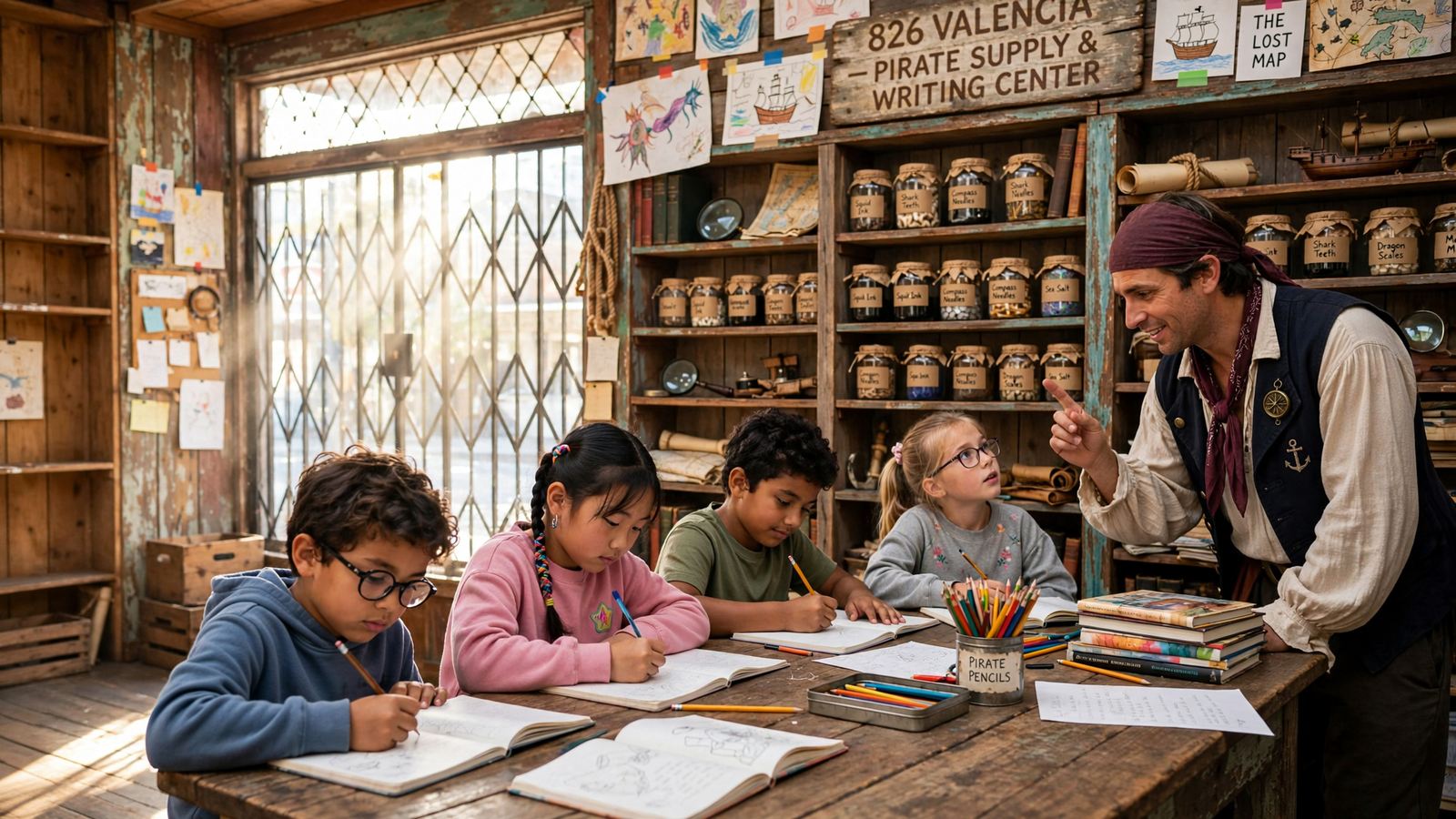
This is the Pirate Store, the public-facing entrance to 826 Valencia, a nonprofit writing and tutoring center founded in 2002 by author Dave Eggers and educator Ninive Calegari. Behind the theatrical storefront, young people receive free academic support, work on creative projects, and get something that can be harder to provide than a worksheet or a lesson plan: the sense that their words are worth taking seriously. For related reading, see Mary Colter: How an Arizona Architect Made the Grand Canyon Feel Human.
Over time, the idea grew beyond one San Francisco address. It helped inspire a national network of 826 chapters and similar youth-writing programs. But the original center remains notable for the way it joined practical help with imaginative play. It did not treat creativity as a reward that came after “real” schoolwork. It used creativity as a way into learning. For related reading, see Octavia E. Butler: The Writer Who Made the Future Feel Personal.
A writing center with an unusual front door
The story began with a practical problem. The organizers wanted to open a writing and tutoring center for students, but the building’s zoning requirements called for a retail business on the ground floor. Instead of hiding that complication, they made it part of the design.
They created a pirate-themed store at 826 Valencia and placed the youth programs behind it. The result was more than a clever name. The shop became an invitation: a place where children could enter through a world of adventure and discover that writing could be adventurous too.
826 Valencia describes its work as providing free writing support and academic assistance to students ages six to eighteen. Its programs have included after-school tutoring, field trips, in-school support, workshops, and opportunities for students to publish their work. Volunteers are central to the model, bringing time and attention to young people who may not otherwise have access to individualized help.
The arrangement also changed the emotional temperature of a learning space. A conventional tutoring center can announce its purpose before a student says a word: improve, catch up, correct. A pirate shop makes room for curiosity first. It gives a child permission to browse, ask questions, and imagine a role for themselves before sitting down to revise a paragraph.
Why imagination belongs in academic support
Writing instruction is often reduced to mechanics—grammar, spelling, structure, and the correct use of evidence. Those skills matter. But a student also needs a reason to write, an audience that will listen, and enough confidence to risk an unfinished thought.
That is where 826 Valencia’s approach has been distinctive. Its programs place conventional school support alongside storytelling, humor, performance, illustration, and publication. A young writer might work on an essay, a comic, a personal narrative, or a collaborative project. The form can change, but the underlying message stays consistent: language is not only something to be corrected. It is something a person can use to make meaning.
This matters especially for students who have learned to associate writing with judgment. A blank page can feel like a test before a teacher has marked it. A playful prompt can lower that barrier. A volunteer who asks a student what they meant—and waits for the answer—can turn revision from punishment into discovery.
The model is not based on the idea that every child must become a professional writer. Its ambition is broader and more useful. Writing helps people explain an experience, understand a subject, persuade an audience, preserve a memory, and participate in public life. Helping young people write is therefore also a way of helping them become more confident readers of the world around them.
The store became part of the lesson
The Pirate Store’s merchandise and visual language are deliberately fanciful, but the underlying educational purpose is serious. Its setting communicates that creativity is not confined to museums, elite classrooms, or the careers of famous authors and artists. It can occupy a neighborhood storefront.
That physical presence is important. A program located inside a school or office can serve students effectively, but a visible community space sends a different signal. Families encounter it while walking down the street. Volunteers can find it. Local residents can become aware of the work. The center becomes part of the neighborhood’s cultural geography rather than a service hidden from public view.
For students, the setting can make the transition into tutoring feel less like being sent away for remediation. The front door does not say that a child is a problem to be fixed. It says that something interesting is happening inside.
That theatricality also creates a useful bridge between art and education. The store’s theme requires design, writing, performance, retail organization, and world-building. Even the act of inventing a believable pirate supply can involve vocabulary, research, visual thinking, and an understanding of audience. The imaginative frame is not separate from learning; it gives learning somewhere to go.
From one address to a wider movement
826 Valencia’s early success helped produce a larger organization, 826 National, which supports a network of independent chapters across the United States. Each location has its own community, programming, and local character. Some have adopted similarly unusual storefronts or imaginative public identities, while others have developed different ways to connect writing with place.
The common thread is free creative and academic support for young people, often delivered through partnerships with schools, volunteers, educators, and community organizations. The network’s growth suggests that the original insight was transferable: students do not need less rigor, but they may need more welcoming ways to encounter rigor.
That distinction is worth preserving. A playful environment is not valuable because it makes learning effortless. It is valuable because it can make effort feel purposeful. Writing still requires drafting, rereading, cutting, reorganizing, and starting again. A pirate store cannot remove that work. It can make a student more willing to attempt it.
The expansion also demonstrates how a local experiment can travel without becoming entirely generic. The idea was never simply “put a costume on a classroom.” It was to pay attention to the relationship between a place and the people it serves. A neighborhood writing center can reflect local schools, local artists, local volunteers, and the particular stories young people want to tell.
A public place for unfinished voices
Much of adult culture is built around finished work. Bookstores display completed novels. Museums hang finished paintings. Newspapers print polished articles. Young people, by contrast, are often expected to learn in private and present only the corrected result.
826 Valencia offers a different picture of creative life. It makes room for drafts, questions, experiments, and the awkward middle stages in which a story has not yet found its shape. That is a generous idea, especially for children who may already believe that talented people produce perfect work on the first try.
The center’s lasting contribution is not merely that it made tutoring more colorful. It helped make the process of becoming a writer feel public, social, and attainable. A student can see adults volunteering, other students working, and imaginative projects taking form. Writing becomes less like a solitary talent one either possesses or lacks and more like a practice that grows through attention.
There is a hopeful lesson in the building’s unusual arrangement. A zoning requirement could have been an administrative obstacle. Instead, it became the beginning of a new kind of civic doorway. A retail shop became a writing center’s invitation. A fantasy theme became a serious educational tool. And a neighborhood experiment showed that academic support can be rigorous without being intimidating.
On Valencia Street, the pirate supplies remain part of the charm. But the deeper treasure is quieter: a young person discovering that an idea can be written down, revised, shared, and received by someone else. That is how a storefront becomes more than a storefront. It becomes a place where a voice begins to feel real.
Use: Background on the organization, its founding, student services, and volunteer-supported programs.
Use: Information about the pirate-themed storefront and its relationship to the writing center.
Use: Background on the national network and the expansion of the 826 model beyond San Francisco.
826 Valencia — About — https://826valencia.org/about/ — Background on the organization, its founding, student services, and volunteer-supported programs.
826 Valencia — Pirate Store — https://826valencia.org/pirate-store/ — Information about the pirate-themed storefront and its relationship to the writing center.
826 National — About — https://826national.org/about/ — Background on the national network and the expansion of the 826 model beyond San Francisco.