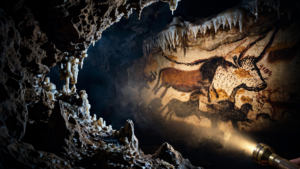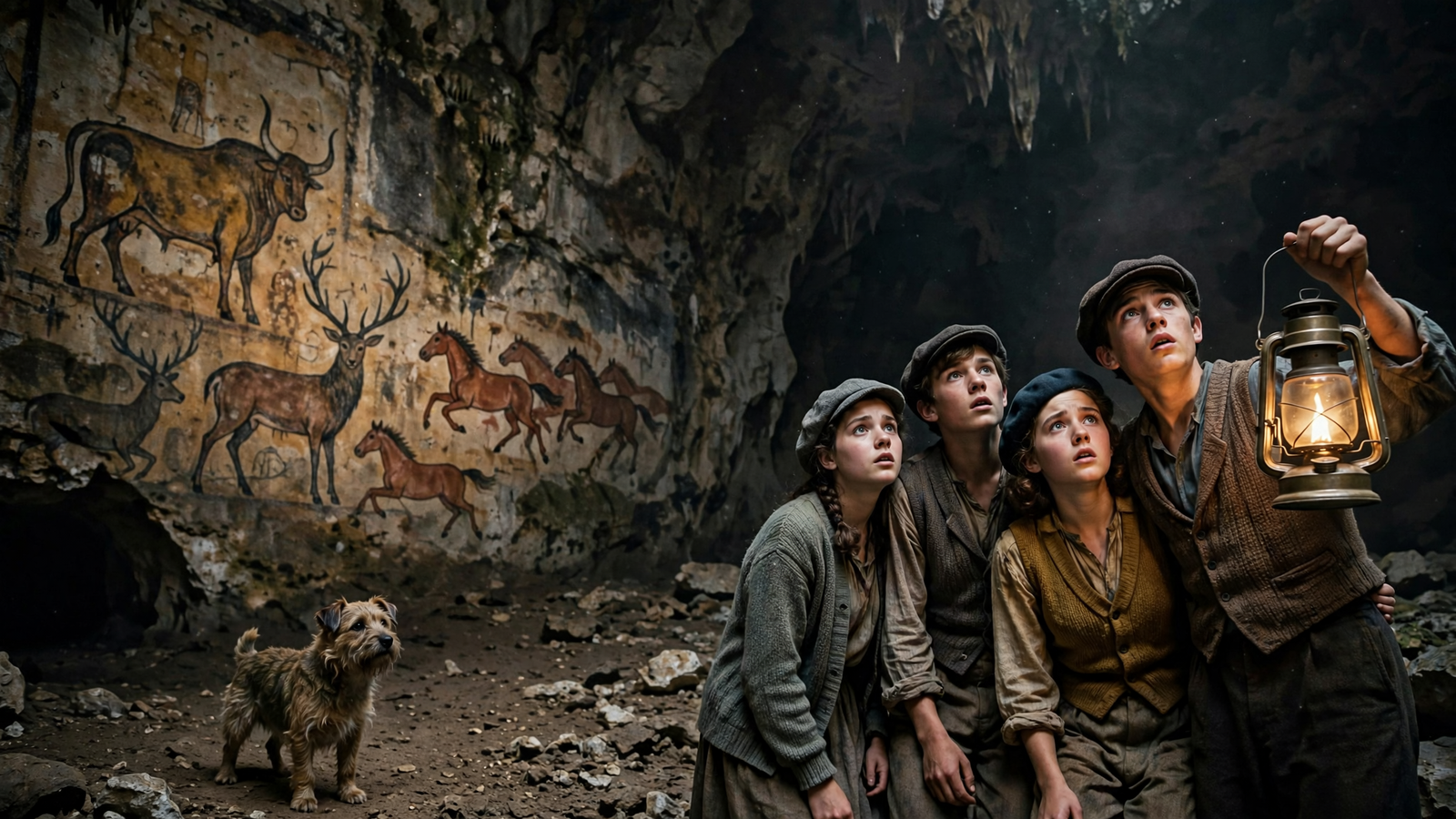
On a September afternoon in 1940, four teenagers were exploring the hills above Montignac in southwestern France when their dog disappeared into a hole. The opening was small, but the space beneath it was not. After widening the entrance, the teenagers climbed into darkness and found walls covered with animals: horses, bulls, deer and other figures moving across the stone in mineral reds, blacks and ochres.
The discovery of Lascaux did more than add another archaeological site to the map. It changed the public understanding of Ice Age people. The artists who worked in the cave roughly 17,000 years ago left no written explanation of their lives, but they left a powerful visual record of attention, imagination and technical skill. Their paintings helped make the distant human past feel less like a collection of tools and bones and more like a world inhabited by artists.
A hole in the hillside
The story began near the village of Montignac in the Dordogne, a region already rich in prehistoric remains. On September 12, 1940, Marcel Ravidat was walking with his friends Jacques Marsal, Simon Coencas and Georges Estradel. Ravidat’s dog, Robot, ran toward a depression in the ground. The teenagers believed the opening might lead to an underground passage or perhaps a hidden treasure associated with a local legend.
Instead, their lights revealed images that were startlingly lifelike. The group returned with lamps and told their former teacher, Léon Laval. Word spread quickly, and the cave soon attracted archaeologists, officials and curious visitors. The site was formally investigated, and the paintings were recognized as authentic prehistoric art rather than a modern hoax.
That confirmation mattered. European caves had already produced important evidence of Paleolithic life, including carved objects and earlier paintings. But Lascaux presented an unusually rich and coherent visual environment. Its walls and ceilings were not decorated with a single isolated image. They carried hundreds of painted figures and more than a thousand engravings, arranged through chambers and passages that made the cave itself part of the experience. For related reading, see Lascaux: How Four Teenagers Found a Window Into Ice Age Life.
An underground gallery from the Ice Age
Lascaux is often called a prehistoric art gallery, but the comparison can be misleading. A modern gallery is designed for easy viewing, while Lascaux is a dark, narrow limestone cave whose surfaces rise, bend and disappear into shadow. The artists had to work with the shape of the rock rather than a flat wall prepared for display.
In the Hall of the Bulls, large animals seem to gather and move across the curved surface. The Axial Gallery contains some of the cave’s most recognizable images, including horses and other animals rendered with deliberate lines and blocks of color. Elsewhere, figures are partly hidden by the cave’s contours or placed high above the floor. The paintings do not form a simple illustrated story that modern viewers can read with certainty.
Many of the animals are shown in profile. Their bodies were outlined, filled or shaded with pigments made from minerals. Black was produced largely from forms of charcoal or manganese dioxide, while red and yellow tones came from iron-rich earths. The artists also used the natural relief of the limestone to suggest muscles, backs and bellies. A bulge in the rock could become part of an animal’s body; a crack could help define its outline.
The technical decisions are among the discoveries preserved at Lascaux. Some images were painted with brushes or pads, while others may have been applied by blowing pigment onto the surface. The artists understood how to work in low light, how to prepare or use mineral color and how to organize images within a difficult three-dimensional space. Their materials were simple compared with those available to later painters, but the results were not simple.
What the paintings reveal—and what they do not
It is tempting to treat Lascaux as a message waiting to be decoded. Researchers have proposed explanations involving hunting, ritual, mythology, social identity and the symbolic importance of particular animals. Some figures may have had meanings shared by the people who used the cave. But there is no surviving Ice Age caption to tell us what every image meant. For related reading, see The Island Fox: How California’s Smallest Canid Found Its Way Home.
That uncertainty is part of the site’s importance. Lascaux gives researchers evidence of what Paleolithic artists chose to depict, how they handled materials and how they used a landscape beneath the ground. It does not provide a complete account of their society. Human figures are rare, and the animals represented are not simply a direct inventory of the surrounding environment.
The cave also challenges older assumptions about prehistoric people. The artists were not merely surviving at the edge of history. They were making choices about composition, movement and visibility. They were capable of planning work in a complex setting and of returning to a place where earlier images already existed. Their culture remains difficult to reconstruct, but the paintings make it impossible to reduce Ice Age life to technology and subsistence alone.
Fame brought a new danger
Lascaux became a public sensation after the Second World War. Visitors entered the cave in large numbers, eager to see the paintings that had been hidden for millennia. But human presence changed the cave’s delicate environment. Breath added carbon dioxide and moisture. Artificial lighting and the movement of visitors affected temperature and air circulation. Microorganisms began to grow on surfaces that had remained stable for thousands of years.
French authorities closed the original cave to the public in 1963. The decision was disappointing, but it prevented the attraction of the site from destroying the art that made it significant. Conservation work has continued for decades, with specialists monitoring climate, air movement and biological growth. The central lesson is uncomfortable but clear: preservation can require limiting access, even when public attention helped make a place famous.
To let people experience the paintings without exposing the original cave to constant visitation, France developed detailed replicas. Lascaux II opened in 1983 with reconstructions of major sections. Later exhibitions carried reproductions to audiences beyond the Dordogne. In 2016, the International Centre for Cave Art, known as Lascaux IV, opened near Montignac with a full-scale replica and digital and educational displays. For related reading, see The Bald Eagle: How America’s National Bird Found Its Way Back.
These recreations are not the original cave, and they cannot reproduce every quality of an underground space. They do, however, solve a problem that confronts museums and heritage sites around the world: how can a fragile place remain part of public culture without being consumed by public access? At Lascaux, the answer has been to separate the experience of seeing from physical entry into the most vulnerable chambers.
A discovery that keeps changing
Lascaux’s importance has grown beyond the first excitement of finding painted walls. It is now studied through archaeology, conservation science, pigment analysis, imaging and the history of art. Researchers can examine the images in great detail while trying to leave the original surfaces undisturbed. Digital tools make it possible to map chambers, compare marks and study details that visitors could never safely approach.
The cave also belongs to a wider prehistoric landscape. The Vézère Valley contains numerous decorated caves and archaeological sites, including places that document long sequences of human occupation. UNESCO recognizes the valley as a World Heritage landscape because its value lies not only in individual paintings but in the concentration of evidence across the region.
In that context, Lascaux is both exceptional and connected. Its paintings are unusually famous, yet they form part of a much larger record of Ice Age creativity in southwestern Europe. The cave should not be treated as proof that one site explains all prehistoric art. It is better understood as one extraordinary chapter in a much broader human story.
The teenagers who entered the passage in 1940 could not have known that their discovery would reshape public ideas about the distant past—or that the greatest challenge would be protecting what they had found. Lascaux remains powerful because it joins two kinds of wonder. There is the ancient wonder of people painting animals in darkness, and there is the modern wonder of a society learning that sometimes the best way to preserve a masterpiece is to build a new path toward it.
Use: Background on Lascaux’s archaeological significance, the Vézère Valley sites and their World Heritage status.
Use: Research on the 1940 discovery, the cave’s paintings and engravings, Ice Age dating, conservation history and replica sites.
Use: Additional heritage-conservation context for the protection of prehistoric decorated caves.