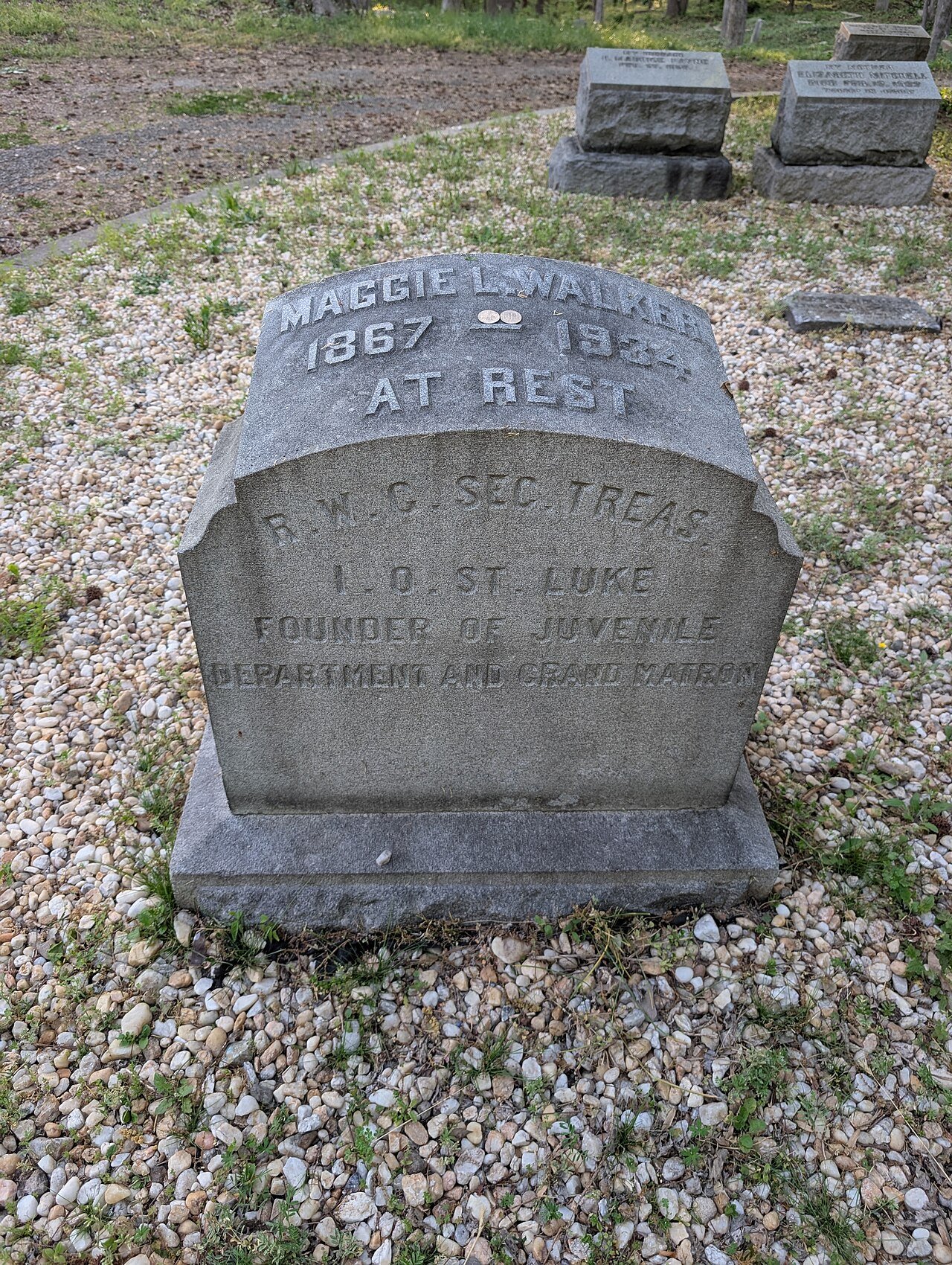
When Maggie Lena Walker opened the St. Luke Penny Savings Bank in Richmond, Virginia, in 1903, she was pursuing more than a new business. She wanted Black residents—often shut out of mainstream financial institutions—to have a place to save, borrow and build economic independence. The bank grew from years of organizing in a fraternal society, and Walker’s achievement rested on the collective effort of its members as well as her own leadership.
A leader formed by local organizing
Born in Richmond in 1864, Walker came of age in a city where Black residents were creating institutions to meet needs that public life and private business often left unmet. She trained as a teacher and taught in Richmond’s public schools. She also joined the Independent Order of St. Luke, a mutual-aid society founded to support African Americans through illness, death and other hardships.
Mutual-aid groups depended on members’ contributions and participation. They were not simply charitable societies: they created ways for people to support one another and take on responsibilities that could be denied to them elsewhere. Walker rose through the Order and, in 1899, became its Right Worthy Grand Secretary. At the time, the organization faced financial difficulties. She worked to strengthen its operations and expand its reach.
Making small savings count
The bank was part of that wider effort. Walker helped secure a charter for the St. Luke Penny Savings Bank, which opened in 1903 with her as president. The name conveyed an important idea: a modest deposit, repeated and pooled with others, could become a resource for a community. The institution gave customers a place to save and offered a foothold in a financial system that had long treated Black people unequally.
Walker’s role was remarkable in a period when both race and gender restricted access to business leadership. She is widely recognized as the first African American woman to charter a bank in the United States and serve as its president. That distinction can make the story sound like one person’s triumph. But the bank was connected to the Independent Order of St. Luke, whose members and customers gave the enterprise its purpose and made its work possible.
Her organizing also reached beyond banking. The Order supported a newspaper, the St. Luke Herald, and other ventures that helped circulate information and provide opportunities for Black workers and businesses. Together, these institutions formed a local network: a society could organize members, a newspaper could share ideas, and a bank could help turn regular savings into financial capacity.
A legacy rooted in Richmond
Walker’s story is often told through the bank, but the larger subject is institution-building. She understood that economic opportunity depended not only on individual ambition but also on durable organizations, trusted leadership and people willing to contribute over time. The penny in the bank’s name was not a promise that every obstacle could be solved with thrift. It was a reminder that small contributions could matter when people had an institution through which to act together.
Walker remained a prominent figure in Richmond until her death in 1934. Her home in the city’s Jackson Ward is now preserved as Maggie L. Walker National Historic Site, where visitors can learn about her life and the community in which she worked. The site returns the story to its setting: a neighborhood where Black residents built organizations, businesses and public life under unequal conditions.
More than a century after the bank opened, Walker’s work offers a useful way to understand leadership. It was not only a matter of reaching a position few women had held. It was also the work of creating institutions that could outlast a single person—and make room for many people to participate.