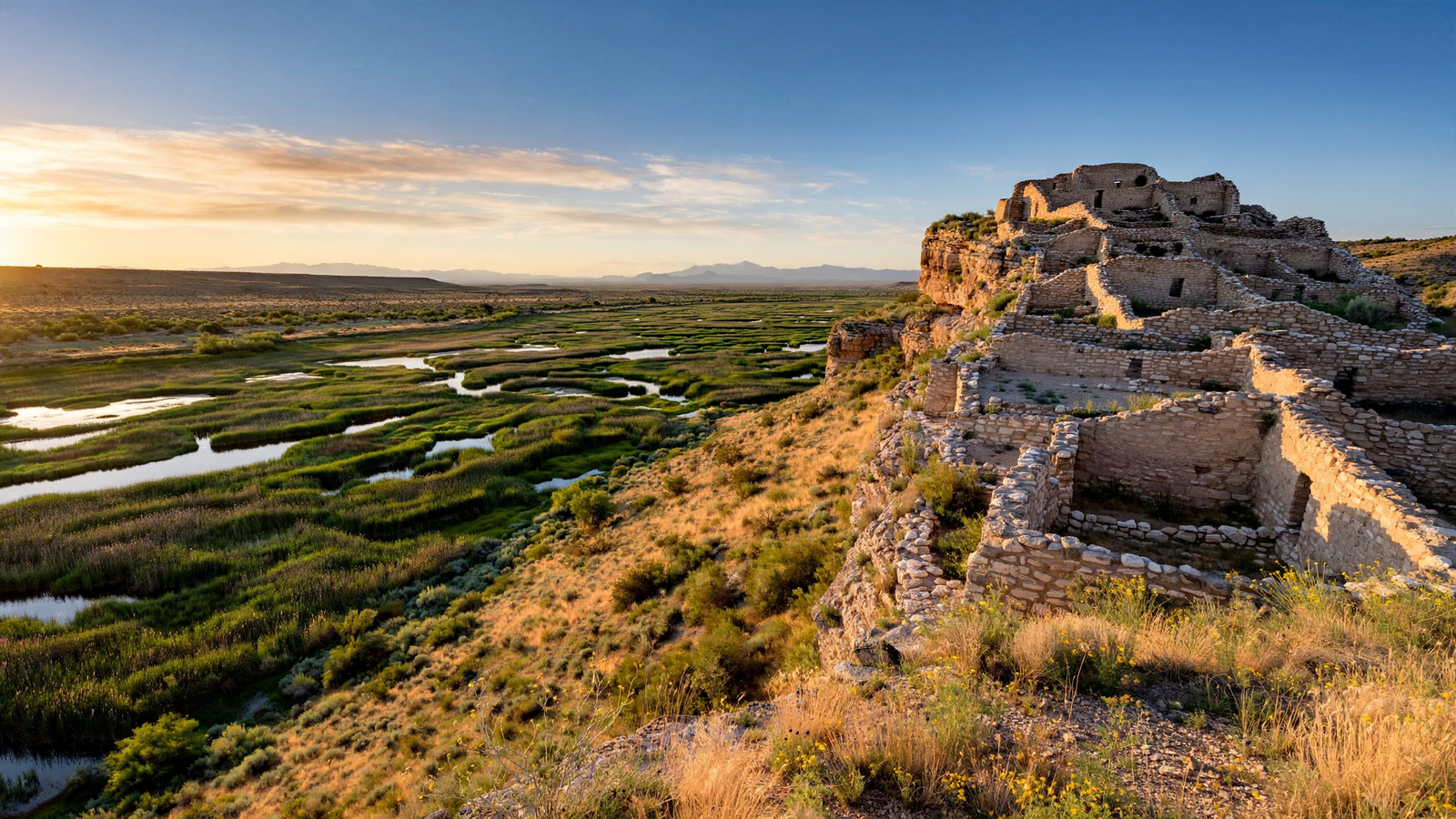
On a low limestone ridge above the Verde Valley, the walls of Tuzigoot rise against the Arizona sky. The pueblo is not the largest archaeological site in the Southwest, and it does not depend on spectacle to make an impression. Its power comes from placement: rooms gathered on a hilltop, a river valley opening below, and a marsh that still gives the landscape a sense of movement and life.
Tuzigoot National Monument, near Clarkdale in Yavapai County, is one of the places where Arizona’s past remains inseparable from its geography. A visit is not only an encounter with old masonry. It is a chance to understand why people lived here, how communities adapted to the Verde Valley, and how archaeology can preserve both a structure and the setting that made it meaningful.
A pueblo built above the valley
The settlement now known as Tuzigoot was built and occupied by people archaeologists identify as the Sinagua. The name is a modern archaeological label, formed from the Spanish words sin agua, or “without water,” to describe a cultural tradition recognized in the dry uplands of central Arizona. It should not be mistaken for the name these people used for themselves.
Construction at Tuzigoot began around the 11th century, according to the National Park Service. The settlement grew over time into a pueblo of roughly 110 rooms, with buildings arranged across the crest and slopes of the ridge. Some structures rose two or three stories. Rather than spreading across the valley floor, the community took advantage of a defensible, highly visible position above it.
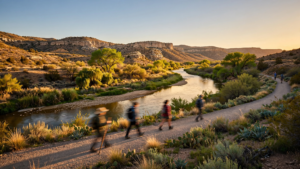
From the hilltop, the surrounding environment becomes easy to read. The Verde River corridor runs through the valley, while Tavasci Marsh occupies a broad wetland nearby. Beyond them are dry hills, cottonwoods and distant mountain ranges. The view helps explain the settlement’s location better than a room count ever could: the pueblo stood near water, farmland, travel routes and a varied collection of habitats.
Why the Verde Valley could support a community
Central Arizona can appear uniformly dry from a distance, but the Verde Valley has always contained more ecological variety than its climate might suggest. The river provided a dependable corridor through the region. Springs, seeps and wetlands supported plants and animals that could not thrive on the surrounding uplands. Floodplain soils offered opportunities for agriculture, while the nearby hills supplied stone, wood and other materials.
That combination allowed communities to make a life in a place that required careful attention to water and seasons. The people who lived at Tuzigoot cultivated crops, gathered wild plants and hunted. Their buildings were part of a wider system that included fields, paths, storage areas and nearby settlements. The hilltop rooms were not an isolated monument in their own time; they were one part of a lived-in valley.
Tavasci Marsh remains an important piece of that story. The National Park Service describes it as one of Arizona’s largest freshwater marshes. Its presence beside the monument makes the relationship between settlement and habitat visible. A visitor can stand among ancient walls, look toward the wetland and see how a community’s choices were shaped by the resources around it.
The people behind the archaeological label
Archaeological sites can become misleading when they are presented as empty ruins rather than former homes. Tuzigoot’s walls were built by people who cooked, raised children, made tools, stored food, exchanged goods and maintained relationships with neighboring communities. The rooms may now be roofless or partly reconstructed, but their original purpose was ordinary and practical as well as ceremonial.
The Sinagua tradition extended across a large part of central Arizona, including the Verde Valley. Its communities were connected by movement and exchange, not sealed off from one another. Objects found at archaeological sites show that people participated in regional networks that carried materials and ideas over long distances.
By about the 14th century, Tuzigoot was no longer occupied as a permanent pueblo. Archaeologists do not reduce that change to one simple explanation. Communities in the region moved, reorganized and adapted over generations, responding to changing environmental conditions and social circumstances. The end of occupation at Tuzigoot was not the disappearance of Indigenous people from Arizona. It was one transition in a much longer history of Native presence in the Southwest.
From excavation to national monument
For centuries, the pueblo remained part of the landscape as a distinctive but largely unstudied ruin. Archaeological excavation began in the 1930s, when the University of Arizona worked at the site under archaeologist Earl Morris. The project also involved workers from the Civilian Conservation Corps, whose labor helped stabilize and reconstruct portions of the pueblo during the New Deal era.
Those efforts made Tuzigoot more accessible to the public, but they also reflect an earlier period of archaeology, when excavation and reconstruction practices were different from today’s standards. Modern interpretation has a broader responsibility: to explain what researchers know, acknowledge what remains uncertain and recognize that archaeological places are connected to Native histories that continue into the present.
President Franklin D. Roosevelt established Tuzigoot National Monument in 1939. The designation protected the pueblo and helped create a public setting where people could encounter the site without separating it from the valley around it. That distinction matters. A ruin displayed without its landscape can seem like an isolated object. Tuzigoot makes more sense as part of a river system, a wetland and a network of communities.
What visitors can see today
The monument’s main experience is compact but layered. A trail leads from the visitor area up to the pueblo, where visitors can move through and around the surviving rooms. The route includes uneven and steep sections, and the National Park Service advises visitors to consider the terrain and conditions before beginning. The elevated rooms and rooftop areas offer views across the Verde Valley, Tavasci Marsh and the surrounding mountains.
Inside the visitor center, exhibits and archaeological objects provide context for the settlement and the people who lived in the region. That context is important because the masonry alone cannot answer every question. Exhibits help connect architecture to foodways, tools, trade, agriculture and the larger Sinagua tradition.
The monument is also close to other places that help broaden the story of the Verde Valley. Montezuma Castle National Monument preserves a cliff dwelling farther south, while Montezuma Well protects a natural limestone sink and a long record of human use. Nearby Dead Horse Ranch State Park offers access to the Verde River corridor and its riparian habitats. Together, these sites show that the region’s history is not contained in a single ruin. It is distributed across water, wetlands, cliffs, farms and travel routes.
A place for looking closely
Tuzigoot rewards a slower kind of sightseeing. The first view is memorable, but the details become more revealing with time: the thickness of a wall, the way a doorway frames the valley, the change from dry hillside to green wetland below. The pueblo’s elevated position encourages visitors to look outward, yet the rooms also invite questions about intimate daily life.
That balance is what makes the site enduringly useful. Tuzigoot is a destination for history, but it is also a lesson in environmental awareness. It shows how architecture responds to terrain, how water can shape settlement and how a community’s story becomes clearer when the surrounding landscape is protected alongside its buildings.
The monument does not offer a simple story of a vanished people. Instead, it preserves evidence of adaptation and continuity in a region where Native communities developed sophisticated ways to live with limited water and changing conditions. The hilltop remains, the marsh below and the river beyond all belong to the same story.
That is why Tuzigoot continues to matter. It is not merely an old pueblo placed on a ridge for visitors to photograph. It is a surviving point of connection between archaeology and place—a reminder that the best way to understand a historic landscape is often to stand inside it, look carefully and allow the land to explain why people chose to call it home.