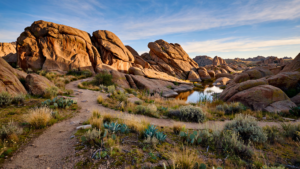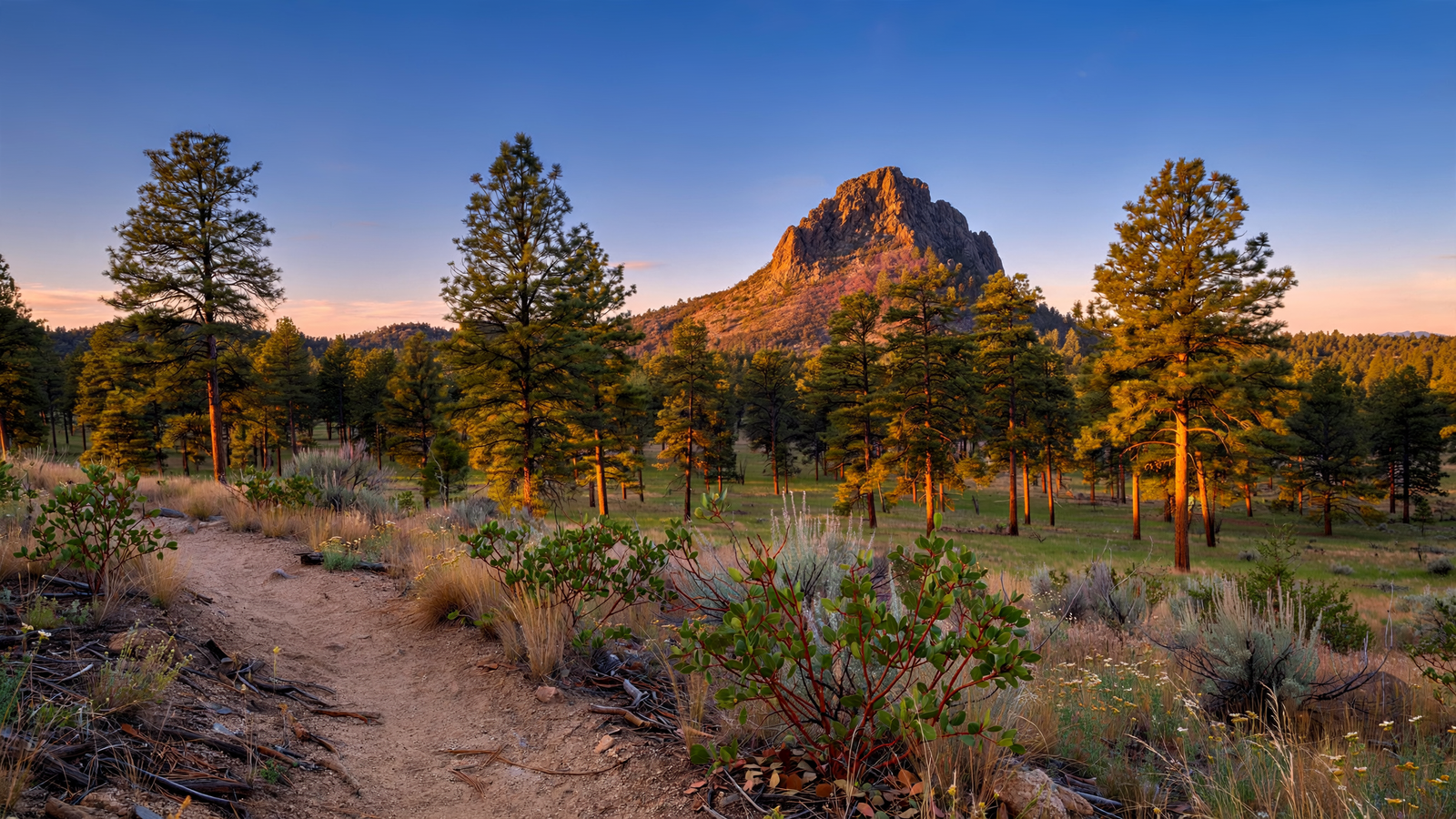
For many people arriving in Prescott, Thumb Butte is one of the first landmarks that makes the city feel like a place rather than a stop on a map. The distinctive rise stands west of town, visible above neighborhoods, roads and the surrounding forest. It is easy to treat it as scenery. But walk its trails and the landmark becomes more immediate: a climb through ponderosa pine, a lookout over the granite country, and a meeting place for people who want a short outing without leaving the city’s orbit.
Thumb Butte is not a city park in the usual sense. It is part of the Prescott National Forest, a much larger public landscape managed for recreation, wildlife habitat, watershed protection, timber and fire resilience. That combination gives the place its character. A visitor can follow a well-used trail in the morning, hear a Steller’s jay in the trees and look across a landscape shaped by both natural forces and years of active forest management.
A landmark with a close-to-town scale
The Thumb Butte Recreation Area lies a short drive from central Prescott. Its proximity is central to its importance. Many public lands require a full day, special equipment or a long journey to reach. Thumb Butte asks less of visitors. The trip from town is brief, the trail system is concentrated, and the views arrive before the effort becomes an expedition.
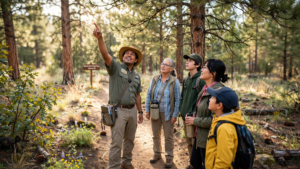
That accessibility has made the area one of Prescott’s best-known outdoor destinations. Hikers, runners, families, photographers and visitors adjusting to the city’s high elevation all use the recreation area in different ways. Some come for the summit experience. Others are satisfied with a walk beneath the trees or a picnic near the trailhead. The same place can function as a serious workout, a quiet introduction to the forest or a familiar routine for local residents.
The landmark’s form is part of the appeal. Thumb Butte is not a broad plateau or a distant mountain wall. Its profile rises distinctly from the surrounding terrain, giving the city a fixed point of orientation. From the trails, however, the butte is less like a symbol and more like a piece of rough country: rock, soil, pine needles and steep sections that demand attention.
What the trail reveals
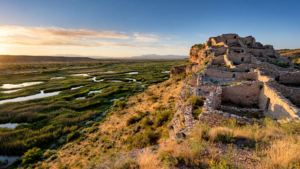
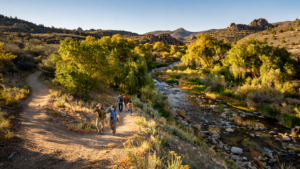
The recreation area’s principal hiking routes climb through a forest of ponderosa pine and other high-country vegetation. The terrain changes as the trail gains elevation, and the views open gradually rather than all at once. Looking back toward Prescott, hikers can see how the city occupies a relatively compact place among wooded slopes, granite outcrops and broad valleys.
That gradual change is one reason Thumb Butte works well as an everyday public landscape. A visitor does not need to complete every trail to experience the setting. A shorter walk still offers shade, elevation and a sense of departure from the built environment. Those who continue higher are rewarded with wider views and a clearer understanding of the surrounding topography.
The trails also make the forest’s seasonal changes visible. Spring can bring fresh color to the understory after winter moisture. Summer mornings may be cool beneath the pines even when lower desert communities are already hot. Autumn changes the appearance of the deciduous trees scattered through the conifer forest, while winter can make the butte feel dramatically different after snow or a cold front.
Conditions are part of the experience. Heat, ice, thunderstorms and wildfire-related restrictions can alter access and trail safety. The Prescott National Forest advises visitors to check current conditions before traveling, especially during periods of high fire danger. That is not a minor logistical detail. On public lands in Arizona, responsible recreation begins with recognizing that the landscape is dynamic and that access can change to protect visitors, firefighters and the forest itself.
A recreation area inside a working forest
Thumb Butte’s popularity can make it seem separate from the larger Prescott National Forest. It is not. The surrounding forest is part of a managed public system with responsibilities that extend well beyond recreation. Forest officials work across the region on fuels reduction, prescribed fire, habitat, roads, watersheds and the protection of communities near forested land.
That work matters at Thumb Butte because the landscape is close to homes and heavily visited. Dense vegetation, drought and extreme heat can increase the risk of severe wildfire. Treatments such as thinning and prescribed burning may change the appearance of parts of the forest, but they are intended to reduce hazardous fuel, improve forest conditions and make future fire behavior less extreme where possible.
For visitors, the result can be a more useful understanding of what a national forest is. It is not simply untouched scenery preserved behind a boundary. It is a public landscape where ecological processes, recreation and human safety have to be managed together. A trail beside a recently treated area may look different from a trail through older, denser trees, yet both are part of the same effort to keep the forest healthier and communities better prepared.
The setting also supports wildlife. Birds and mammals move through the pine forest, oak pockets, rocky slopes and open areas around the butte. Visitors are most likely to notice common signs of life—a bird call, movement in the brush or tracks after rain—rather than dramatic encounters. That quiet presence is part of the place’s value. A landscape does not need to be remote to provide habitat.
The public value of a nearby climb
Prescott has long marketed itself as a mountain community, but places such as Thumb Butte give that description practical meaning. Residents can reach a forest trail without planning a long vacation. Children can encounter a real mountain landscape close to home. Older hikers can choose a modest outing, while experienced users can turn the climb into a demanding workout.
This range of uses is easy to overlook. Public lands are often discussed through spectacular destinations—deep canyons, major rivers and famous viewpoints. Thumb Butte represents a different category: the nearby landscape people can return to repeatedly. Its value accumulates through ordinary visits. A person may walk there once as a tourist, then return years later as a resident, bringing friends or family to the same overlook.
That repeated use can create a stronger relationship with public land than a single dramatic trip. Visitors learn where the shade falls, how the trail changes after rain and which viewpoints reveal the city. They begin to notice maintenance, fire restrictions and the effects of weather. Familiarity can become a form of stewardship when people understand that the place depends on careful use.
Keeping the landmark available
Thumb Butte’s future will depend on more than its visual appeal. The recreation area needs safe trails, responsible visitors, reliable information and continued attention to the surrounding forest. Simple choices help: staying on designated routes, packing out waste, keeping dogs under control where required, avoiding wildlife harassment and never assuming that a fire restriction is optional.
Visitors should also prepare for the elevation and exposed sections of trail. Water, sun protection and sturdy footwear are sensible even for a short outing. During hot weather, an early start is safer and more comfortable. After storms, slick rock and muddy sections can make familiar routes more difficult. Checking the Prescott National Forest’s alerts and recreation information before leaving town is the best way to account for changing conditions.
Those habits may sound ordinary, but they are what allow a heavily used landscape to remain welcoming. Thumb Butte does not need to be transformed into a resort or surrounded by new attractions to matter. Its strength is the combination already in place: a recognizable mountain, a living forest, public trails and a city close enough to use them often.
From Prescott, Thumb Butte can look like a single, familiar silhouette. On the ground, it is more layered. It is a view, a climb, a habitat, a recreation area and one part of a national forest adapting to drought, wildfire and growing public use. That is what makes it a valuable place in Yavapai County—not because it is far away from everyday life, but because it brings a durable piece of the high-country landscape within reach of it.