In Yavapai County, some of the best views are reached without a trailhead, a four-wheel-drive vehicle, or a long climb. For related reading, see The Verde Canyon Railroad: How a Working Rail Line Became a Window Into Arizona’s Verde Valley.
They appear beyond the windows of a slow-moving train.
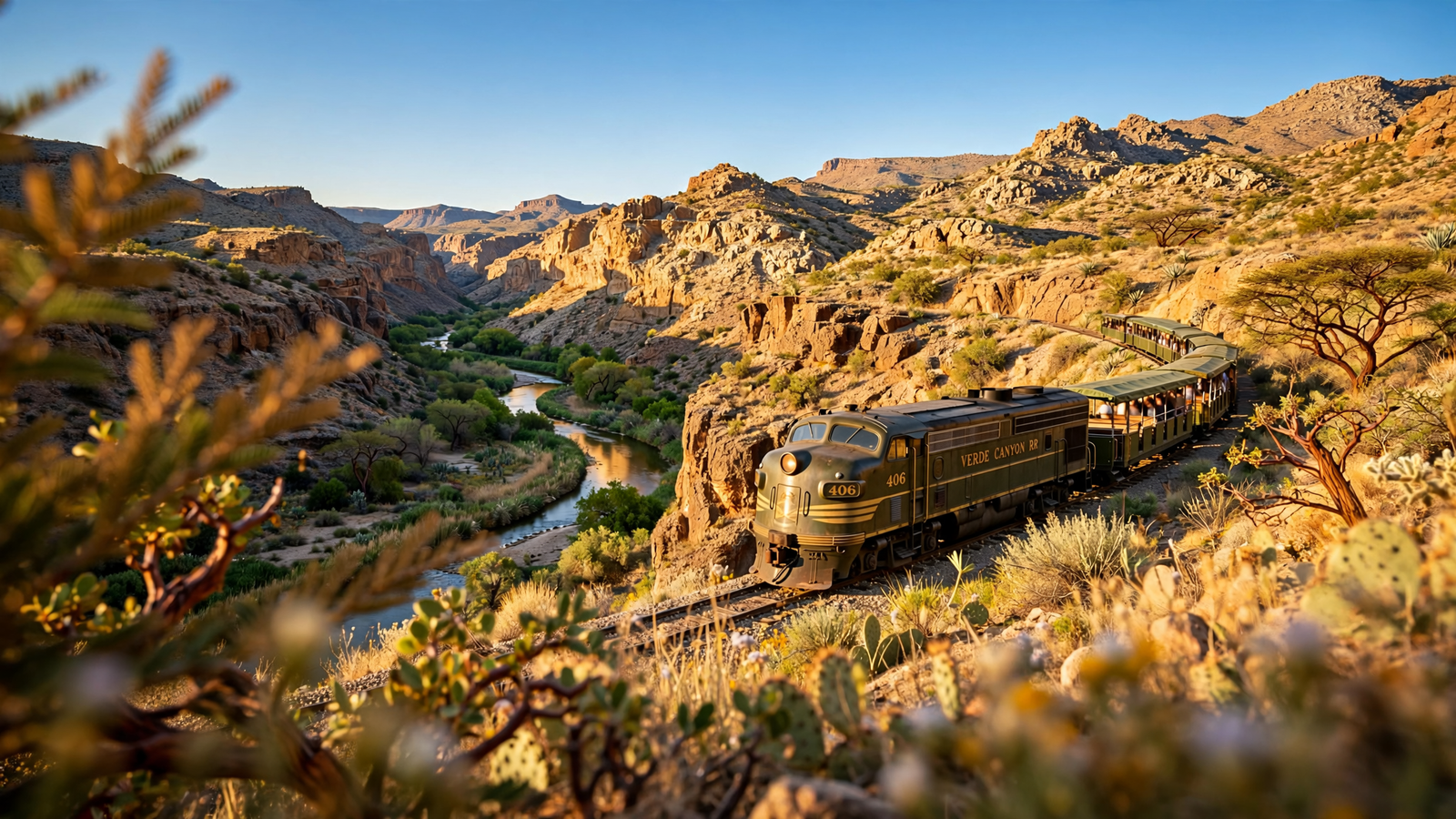
The Verde Canyon Railroad follows a historic line between Clarkdale and Perkinsville, traveling through a narrow section of northern Arizona where the Verde River, red-rock cliffs, cottonwood groves, and high-desert slopes gather close together. The route is not a modern transportation project. It is an old industrial corridor that found a new civic purpose: giving people a way to see a difficult-to-reach landscape while keeping a piece of regional railroad history in motion. For related reading, see The Verde River Greenway: How a Yavapai County Riverfront Became a Shared Landscape.
That transformation is what makes the railroad more than a sightseeing attraction. It is a living link between Yavapai County’s mining past, its public lands, and the growing value of experiencing the Verde Valley at a slower pace. For related reading, see Camp Verde’s Archaeology Center: The Yavapai County Place Where the Verde Valley’s Past Stays Local.
A railroad built for copper
The line began as part of the transportation system that supported copper mining in the Verde Valley. Clarkdale grew around a major smelter built to process ore from the Jerome mining district, while rail lines connected the smelter and surrounding communities with the broader railroad network.
The tracks that now carry excursion passengers were laid in the early twentieth century. Their original purpose was practical: move ore, equipment, workers, and supplies through a rugged corridor where roads were limited and the terrain made overland travel difficult.
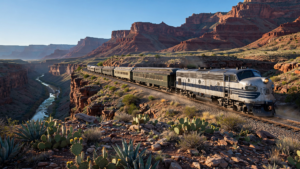
That industrial history remains visible along the route. The railroad leaves Clarkdale near the former smelter town and heads north toward Perkinsville, following the contours of the Verde River. The trip passes through a landscape shaped by both geology and industry—basalt cliffs, red-rock formations, volcanic hillsides, and occasional reminders of the communities and infrastructure that grew around mining.
When copper production declined and the region’s industrial economy changed, the railroad faced a familiar question for historic infrastructure: what happens when the original reason for a line disappears?
In the Verde Valley, the answer was not to erase the corridor. The line was adapted for public use.
From working route to public experience
The Verde Canyon Railroad began excursion operations in 1990. Its trains now make a round trip from Clarkdale toward Perkinsville, carrying visitors through roughly 20 miles of canyon country before returning to the Verde Valley.
The route’s appeal comes partly from its simplicity. Passengers do not have to navigate a remote road or plan a wilderness route. They can sit in a restored rail car, watch the terrain change, and let the railroad do the work of moving through the canyon.
That makes the experience unusually accessible without making the landscape feel developed. Much of the route passes through country where roads and buildings are scarce. The train becomes a moving observation point: close enough to the river to reveal its green corridor, but distant enough to show how small that corridor is within the surrounding desert.
The railroad’s passenger cars also preserve a sense of travel that has largely disappeared from everyday life. The pace is measured in miles rather than minutes. The trip invites attention to details that are easy to miss from a highway—a hawk circling above a cliff, a cottonwood stand following the water, or the changing color of the rocks as the train enters a narrower section of the canyon.
Some cars include open-air viewing areas, while enclosed cars provide shelter during changing weather. The arrangement allows visitors to experience the route in different ways, but the central attraction remains the same: a sustained view of country that is often more visible from the river corridor than from the surrounding roads.
The Verde River as the route’s guide
The Verde Canyon Railroad is best understood as a river journey conducted on rails.
The Verde River is one of Arizona’s important perennial waterways, and its flow supports a ribbon of vegetation through an otherwise dry landscape. Along the railroad corridor, cottonwoods, willows, and other riparian plants stand out against the surrounding cliffs and uplands. The contrast is one of the defining visual patterns of the trip.
Water also explains why the canyon has long mattered to both people and wildlife. A river corridor provides shade, food, cover, and a dependable route through a difficult environment. The same features that made the Verde useful to communities and industries also help make it valuable habitat.
Visitors may see birds of prey, waterfowl, songbirds, and other wildlife from the train. The railroad identifies bald eagles as one of the notable species associated with the route, particularly during the cooler months when wintering birds may be present in the Verde Valley. Wildlife sightings are never guaranteed, and the absence of a dramatic encounter is part of the honest nature of the experience. The landscape remains worthwhile even when it keeps its animals hidden.
The river corridor also connects the railroad to a larger public-land story. Nearby portions of the Prescott and Coconino national forests protect extensive areas of canyon, woodland, and high desert. The railroad does not replace hiking or wilderness travel, but it offers a different form of access—one that can reveal the scale and continuity of the landscape before or instead of a backcountry outing.
A quieter way to understand the Verde Valley
Tourism can sometimes flatten a place into a list of viewpoints. The Verde Canyon Railroad works differently when it is at its best. It does not ask visitors to arrive at one overlook, take a photograph, and leave. The route creates time for the landscape to develop.
First come the settled edges of Clarkdale. Then the train moves into a more secluded corridor, where the river and rock walls begin to dominate. The scenery changes gradually. The Verde Valley is not presented as a single postcard but as a sequence of relationships: town beside tracks, tracks beside river, river beneath cliffs, and cliffs rising into forested uplands.
That gradual movement helps explain why the railroad remains valuable in the present. It is an experience of place rather than merely a destination. The train makes geography legible. It shows how the river shaped settlement, how geology constrained transportation, and how a working line can remain useful after its economic purpose has changed.
The trip also offers a reminder that preservation does not always mean freezing an old structure in time. A historic railroad can survive by serving a new public need. In this case, the line carries fewer tons of ore than it once did, but it carries something else: regional memory, visitors, and attention.
Why the old line still matters
Yavapai County contains famous destinations that are easy to name—Prescott, Jerome, Sedona, Montezuma Castle, the Granite Dells. The Verde Canyon Railroad belongs to a quieter category of place: a corridor whose meaning emerges over several hours.
Its importance is not based on one monument or one spectacular formation. Instead, it gathers several aspects of northern Arizona into one moving experience. The train passes through the history of copper mining, along a living river, beneath cliffs shaped by volcanic geology, and beside public lands that remain difficult to reach by ordinary road.
That combination gives the railroad unusual staying power. It preserves a physical connection to the region’s industrial past while supporting a present-day economy built around heritage, recreation, and landscape appreciation. It also allows people who may not be able to hike deep into a canyon to encounter the Verde River and its surroundings in a meaningful way.
The route is a reminder that a place does not have to be untouched to be valuable. Rails, bridges, smelters, old towns, river forests, and wilderness can all belong to the same story. In the Verde Valley, the past is not sealed away from the landscape. It runs through it.
That is the quiet achievement of the Verde Canyon Railroad. A line built to move the materials of an extractive economy now moves people toward a fuller understanding of the country that made that economy possible. The train keeps traveling—not toward a vanished mining boom, but into a landscape whose value continues to widen.
Use: Railroad history, excursion operations, route background, and its connection to the Verde Valley.
Use: Current passenger experience, route description, viewing areas, and wildlife information.
Use: Context on the public-land landscape and forests surrounding the Verde Valley and canyon country.
Use: Historical context for the Verde Valley’s copper-mining era, Clarkdale, and the Jerome-area industrial landscape.
Verde Canyon Railroad — About the Railroad — https://verdecanyonrr.com/about-us/ — Railroad history, excursion operations, route background, and its connection to the Verde Valley.
Verde Canyon Railroad — Experience the Canyon — https://verdecanyonrr.com/experience/ — Current passenger experience, route description, viewing areas, and wildlife information.
U.S. Forest Service — Prescott National Forest — https://www.fs.usda.gov/prescott — Context on the public-land landscape and forests surrounding the Verde Valley and canyon country.
Arizona State Parks — Jerome State Historic Park — https://azstateparks.com/jerome — Historical context for the Verde Valley’s copper-mining era, Clarkdale, and the Jerome-area industrial landscape.